Professional makeup artists · Social media
Use Instagram to show the work a bride wants and move the chat to a booking.
Social media marketing for a makeup artist means showing finished looks, process and real brides on the platforms where brides save ideas. GullySales plans what to post, how to reply to messages that follow and how to turn a saved reel into an enquiry.
Scope, fee, reporting and term are agreed in writing after we have read your brief and spoken to you.
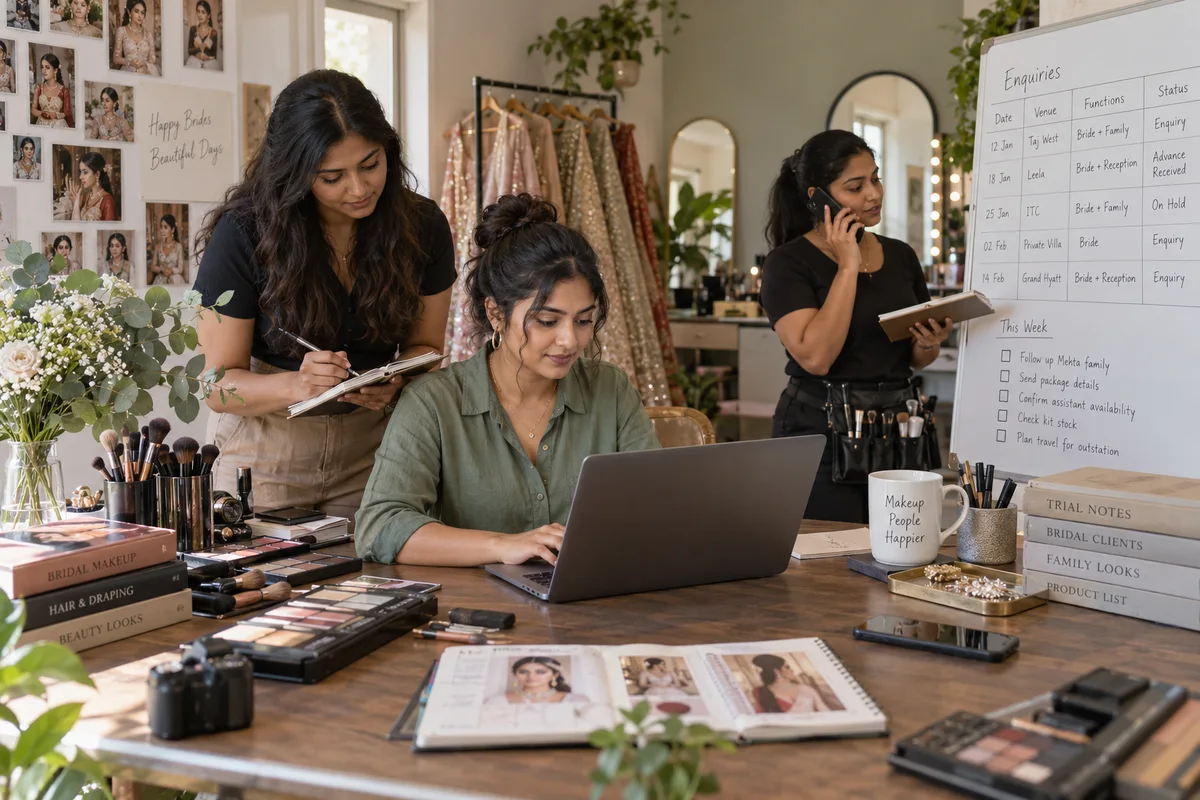
What social media means
Social media is the ongoing posting your business does on platforms such as Instagram, Facebook and LinkedIn to stay visible to customers and prospects between purchases. GullySales plans a posting calendar, writes captions and designs the images so the page looks active and answers what a visitor would ask.
Also for professional makeup artists
Sales and marketing for professional makeup artists, the overview.
Last updated 14 Nov 2026.
For professional makeup artists
Where it usually goes wrong, and what we would do.
“A bride saves reels for months before a message is sent to anyone”
The save is the real signal. A bride collects looks long before messaging an artist. Reels that show a full look from bare skin to finish, in daylight, give the bride something worth saving and a reason to recall your name when the date is fixed.
“Filtered photographs cost trust”
Heavy editing makes a look unfit for the bride who saw it and then met you. Unedited close-ups, in natural light, of different skin tones and ages, tell a bride what to expect on the day. A smaller set of honest posts does more than a long gallery of polished ones.
“The comment and the direct message are separate jobs”
A comment asking about price is public and needs a short reply that moves the conversation to a message. A direct message needs the date, venue and party size asked at once. Treating both the same loses the bride who commented and never wrote.
“Behind-the-scenes posts show reliability”
Photographers and production coordinators watch for an artist who arrives early, packs a kit carefully and handles a large party calmly. A short post of the morning set-up tells them what a caption cannot.
What we do
What we deliver for professional makeup artists.
The work available for this need. We agree the deliverables and responsibilities for your engagement in writing.
A content plan around looks and ceremonies
A list of looks and wedding styles to post, matched to the dates your region marries.
Result: A plan of what to post, tied to the wedding calendar.
Reel formats you can film alone
Simple ways to record a transformation, a kit tour and a day-of morning on a phone, between clients.
Result: Formats that need no assistant and no studio.
A consent routine for client photographs
A short message and a record for each bride, saying which photographs may be posted and where.
Result: Every posted photograph has a consent note behind it.
Reply scripts for comments and messages
Two sets of short replies, one for public comments and one for direct messages, each asking for the date.
Result: Comments turn into messages that carry a date.
A highlights set for the profile
Pinned stories and highlights sorted by wedding style, trial, rates and travel.
Result: A bride lands on a profile that answers the first questions.
How the result is measured
- Posts published
- Engagement rate
- Enquiries from social profiles
Recorded as a baseline before work starts, so every later report has an honest comparison.
Posts and pieces to plan
Plan posts around the questions a bride asks before a message goes to anyone.
- Bare skin to finished bridal look
- A reel in daylight with no heavy filter, showing the skin, the base and the finish, which tells a bride what to expect on the day.
- The same look on three skin tones
- A carousel or reel with consent from each client, so a bride with a deeper complexion can see work on skin like the bride's own.
- A trial, start to finish
- A short video of what happens at a trial, how decisions are made and what the bride takes away, with the bride's agreement to appear.
- The morning kit set-up
- A behind-the-scenes clip of packing and arriving early, for photographers and planners deciding who to recommend.
- Saree draping and dupatta setting
- A close-up reel on how the look is finished with the garment, a detail a bride's mother notices at once.
Who it is for
This is written for these professional makeup artists.
- Bridal makeup artists working from a home studio
- Freelance artists who travel to the venue or the home
- Artists who also do hairstyling and saree draping
- Party, engagement and reception makeup specialists
- Editorial, fashion and ad-shoot makeup artists
- Film, TV and OTT makeup artists and hair-and-makeup crews
- Prosthetic and special effects makeup artists
- Makeup artists who also teach masterclasses
- Teams of three or four artists under one name for large wedding parties
Before you decide
When this may not be the right fit.
- You are unable to film or photograph during busy weeks, so a posting plan would lapse just when brides are looking.
- You have no signed consent for the faces in your best photographs, and posting them would risk the trust you are trying to build.
- You have no one to answer comments and messages the same day, which leaves brides asking questions and finding silence.
Before you decide
Agree the work. Know how to judge it.
Social media marketing for makeup artists: use these checks to prepare, choose the scope, and review what changes.
Bring the right evidence
Review the posts that produced useful conversations, not only the ones with the most views. Gather buyer questions and decide which team member can contribute credible material.
Make the scope clear
Choose the audience and channel before setting a posting volume. Agree who supplies material, approves posts, and handles messages, including complaints or questions the agency cannot answer.
Check the work in use
Follow a post through to the profile, website, and response. A useful report explains the quality of conversations and enquiries, alongside reach and engagement.
Know when to change course
If publishing takes time away from unanswered buyer messages, fix the response routine first. Do not expand to another channel without a clear reason for being there.
These are discussion points, not a fixed package. GullySales confirms the deliverables, responsibilities, fee, and term in writing after reading your brief and speaking with you.
Before we start
What to have ready before the work starts.
The records, access and decisions this work needs from professional makeup artists. Anything missing is noted in the written scope, with who will supply it.
- Access to the profile and its insights
- Login to the business account and its analytics. They show which reels were saved, not just liked. If the account is personal, converting it is the first task. Add a second administrator, so that the account is not lost if the phone is.
- A folder of finished looks with consent
- Photographs and reels of finished looks, each with the bride's consent noted. Material without a note is not posted. If few exist, the first posts use trial work and models who agree in writing. Include trial looks that were shot in daylight, since brides trust daylight photographs.
- Times you can film on a working day
- When you can set a phone on a stand while you work. Reels filmed alone depend on this. If no time exists, the plan uses photographs and short clips from assistants. A tripod or a stand is worth buying before the plan starts.
- An assistant who can reply to messages
- A person who can answer messages when you are with a bride. Brides who wait go elsewhere. If nobody can, an away message states when you reply. If the assistant is a family member, agree on a simple script first.
How it works
How the social media work runs
The work itself, in order. How an engagement starts, from your brief to a written scope, is set out on our method page.
- 1
Scroll your feed as a saving bride would
We go through your profile as a bride does, looking at the first nine posts, the highlights and the bio. You tell us which looks you want to book more of. We note which wedding styles are missing from the feed and where the filters hide the skin tone. The nine posts form the grid a bride sees first, so we note whether they show range across skin tones and ceremonies or repeat one look.
- 2
Plan posts around looks and ceremonies
From your calendar we set the post types: a finished bridal look, a process reel, a trial, a ceremony close-up and a day-of story. You choose the ones you can film alone. Each wedding style you want more of gets its own series. A wedding style you rarely get, such as a church ceremony, is planned as a short series, so brides of that community find work that looks like theirs.
- 3
Set up the client photograph routine
At the trial, a short consent is read out and noted, covering the face, the use and the platforms. We write the wording and you keep a record. A folder of cleared images results, and the feed is drawn from it. A bride who declines is marked in the record, and those photographs are deleted from the shared folder.
- 4
Write the comment and message replies
A comment gets a short public reply, and a message gets a longer one that asks for the date and the venue. We draft both in your voice. You test them on a friend who plays a bride. The scripts ask for the date and the venue early, because those two facts tell you whether the enquiry is real.
- 5
Build the highlights set and compare enquiries
Highlights for trial, rates, travel and reviews let a bride find the usual answers without a message. After a season we compare enquiries that came from the feed with the count made before, and you decide which post types to keep.
Where this fits
Three pieces of sales work, in this order.
This work sits inside sales process design, at stage 0, foundation. The audit comes before it, and sales management keeps it running.
Step 1
Sales audit
Find where deals are being lost and what to fix first.
Start here if you cannot say where orders are lost.
Step 2 · you are here
Sales process design
One written way to sell, from first enquiry to repeat order.
Start here if every salesperson sells differently.
Step 3
Sales management
A target, a review routine and someone who owns the number.
Start here if the team has targets and no routine.
FAQ
Questions owners ask before they call.
Not here? More answers, or ask on WhatsApp.
How frequently should I post?
Should I run paid promotion on Instagram?
Should I show a bride's face without asking?
What if my feed has only one kind of look?
How many posts do I need for a bride to trust me?
Should I film my own reels or hire someone?
How long is the contract?
How soon will we see results?
Who will actually do the work?
What do you need from us?
More for professional makeup artists
Related work to consider.
Closest to this: content and social
Also for professional makeup artists
Or start from the overview: sales and marketing for professional makeup artists.
Your next practical step
Tell us what you are trying to grow, and we will read it before we call.
Eight short steps, mostly taps. Skip anything you would rather answer on the call.