Hindi TV advertising · Marketing
Buy the Hindi market you actually sell into, not the national feed.
Television advertising covers how spots are bought on any channel. This page is about one market rather than one language, because Hindi television is bought to reach the states where Hindi is the language of the house.
Scope, fee, reporting and term are agreed in writing after we have read your brief and spoken to you.
In one paragraph
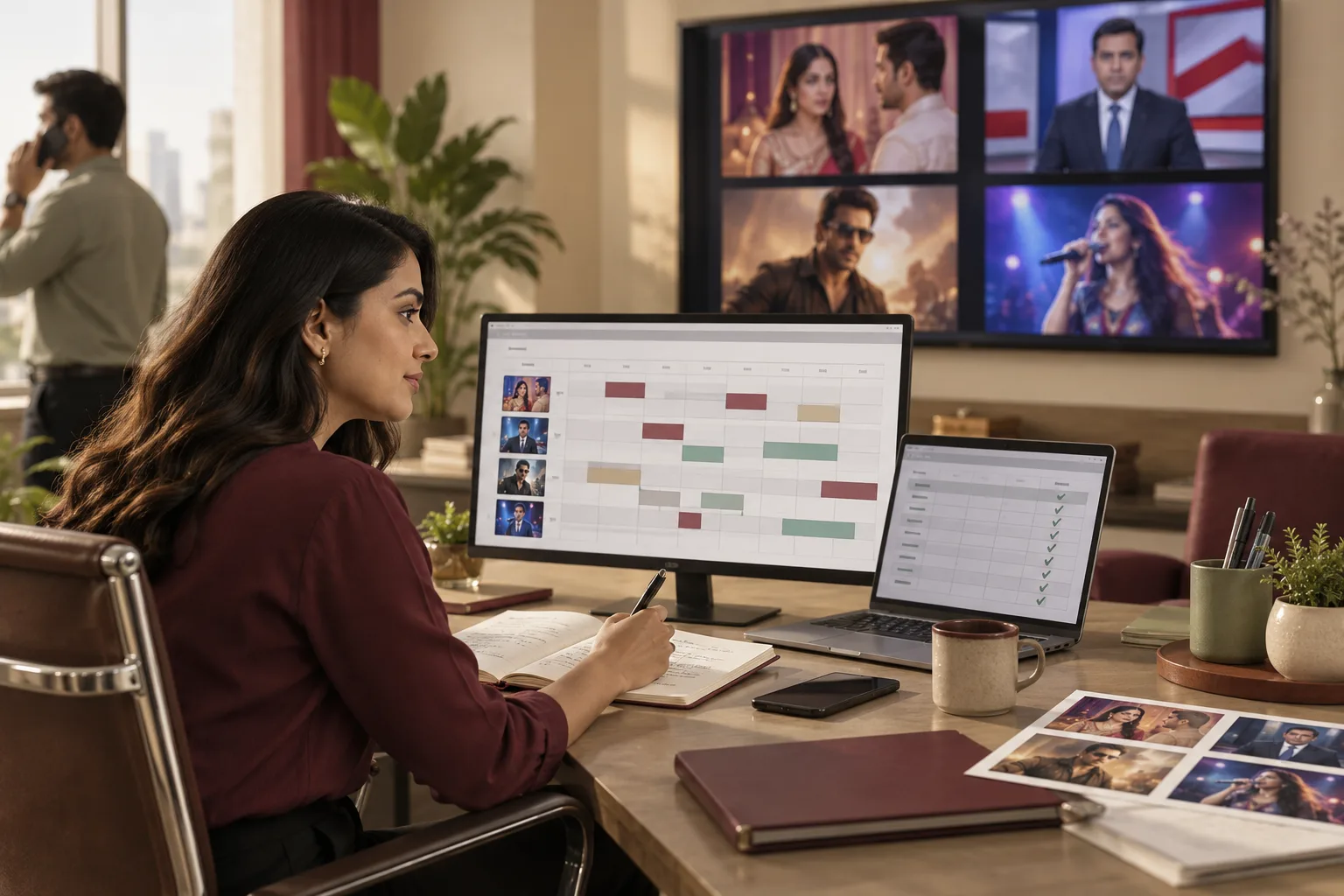
Hindi television advertising buys spots on Hindi entertainment, news, movie and music channels, quoted in ten-second units against a channel, a feed and a time band. GullySales works out which feeds and bands match where you actually sell, coordinates the booking with the broadcaster or their agency, and checks the telecast log line by line.
That market is not one thing. A buyer in Lucknow, a buyer in Indore and a buyer in Gurugram watch different channels at different hours. A national feed charges you for all three, whether you sell to them or not.
So the first question is never which channel. It is which feed, which band, how many spots a week, and whether the commercial you already have will work in that market at all.
Who it is for
This is written for you if these sound familiar.
- Brands selling into Uttar Pradesh, Bihar, Madhya Pradesh, Rajasthan, Delhi and the states around them
- Consumer goods and appliance makers with distribution across the Hindi belt and a season to hit
- Builders, hospitals and education groups who want a city or state feed instead of a national one
- Owners quoted a package of channels who want it read back to them band by band
Not for
It is not the right fit if.
- A business selling in one Bengaluru locality, where a Hindi channel reaches almost nobody who can buy from you
- Anyone with no commercial made and no budget to make one, since the film is the larger cost of the two
- Sellers who need to know which enquiry came from which spot, because a telecast log records the spot and not the viewer
The problem
Does this sound like your business?
What owners tell us on the first call, in their words.
“We paid for the whole country and sell in four states”
A national feed is priced for a national advertiser. The same channel sells a regional or state feed at a fraction of it, and nobody offers that unless you ask.
“The spots ran at two in the morning”
A cheap package is cheap because of when it runs. Unless the band is named on the order, the leftover hours are what you get.
“The commercial was our regional film with a Hindi voice on top”
A translated line lands as a translated line. The words, the faces and the house on screen have to belong to the market, or the viewer hears an outsider.
“Half the booked spots never went out”
Spots get dropped for live events and breaking news. The telecast log shows it, and a make-good has to be asked for inside the window the broadcaster allows.
What we do
Everything that is included.
Each deliverable, and what it gets you. Nothing here is an extra.
Feed and market shortlist
Which regional or state feeds cover where you actually sell, and which your distribution can service, so you are not advertising into towns with no stockist.
Genre and band plan
Where the money sits between evening entertainment, news through the day and weekend movies, with the band named on the order rather than left open.
Spot length set
How the budget splits between a longer film for the opening weeks and a ten-second reminder cut for the rest. The unit of sale is ten seconds, so length multiplies every airing.
Commercial production and clearance
The Hindi film written and shot for this market in the lengths booked, then put through the clearance a broadcaster requires before anything can be telecast.
Schedule and booking coordination
A release order raised with the broadcaster or their agency carrying the dates, feeds, bands and spot counts, instead of a schedule agreed on a phone call.
Telecast reconciliation
The telecast log read against the schedule you bought, with dropped spots raised and make-goods claimed while the window is still open.
Ground support through the burst
A campaign number in the film, stock in the shops and the phones answered, because a television burst sends people to a dealer who has to be ready for them.
How the result is measured
- Spots telecast against spots booked, from the log
- Spots delivered inside the band you paid for
- Rate per ten-second unit against the first quote
- Calls to the campaign number through the burst
- Enquiries and dealer offtake in the burst states, before and after
Recorded as a baseline before work starts, so every later report has an honest comparison.
How it works
How the hindi TV advertising work runs
The work itself, in order. How an engagement starts, from your brief to a written scope, is set out on our method page.
- 1
Fix the market first
We list the states and towns you can actually supply and sell in, then cut the plan to those before looking at a single channel.
- 2
Choose feeds and bands
Feeds are shortlisted for that market and the money is placed in the hours your buyer is in front of the set, with the band written into the order.
- 3
Compare packages
Broadcaster packages are restated on one sheet so spots, bands, feeds and duration can be compared rather than taken on trust.
- 4
Make and clear the film
The commercial is produced in the lengths booked and cleared for telecast before the schedule begins, not while it is running.
- 5
Book and brief the ground
The order is placed, and your dealers, phone lines and counter staff are told when the burst starts so the response has somewhere to land.
- 6
Reconcile and report
The log is read against the schedule, shortfalls are claimed, and enquiries are reported against the weeks before the burst started.
Where this fits
Three pieces of sales work, in this order.
This work sits inside sales process design, at stage 1, prospecting and lead generation. The audit comes before it, and sales management keeps it running.
Step 1
Sales audit
Find where deals are being lost and what to fix first.
Start here if you cannot say where orders are lost.
Step 2 · you are here
Sales process design
One written way to sell, from first enquiry to repeat order.
Start here if every salesperson sells differently.
Step 3
Sales management
A target, a review routine and someone who owns the number.
Start here if the team has targets and no routine.
FAQ
Questions owners ask before they call.
Not here? More answers, or ask on WhatsApp.
Is a Hindi national channel the same as a Hindi feed for my state?
Can I dub my existing regional commercial into Hindi?
Does the commercial need clearance before it can go on air?
Can you tell me how many enquiries the burst produced?
Do you hold rates with any broadcaster?
How long is the contract?
How soon will we see results?
Who will actually do the work?
What do you need from us?
What if we are not happy with the work?
By industry
Hindi TV advertising, written for your industry.
Related services
Often bought with this, or instead of it.
Your next practical step
Tell us what you are trying to grow, and we will read it before we call.
Eight short steps, mostly taps. Skip anything you would rather answer on the call.