Newspaper and magazine advertisement design · Marketing
Our newspaper advertisement got lost on a crowded page.
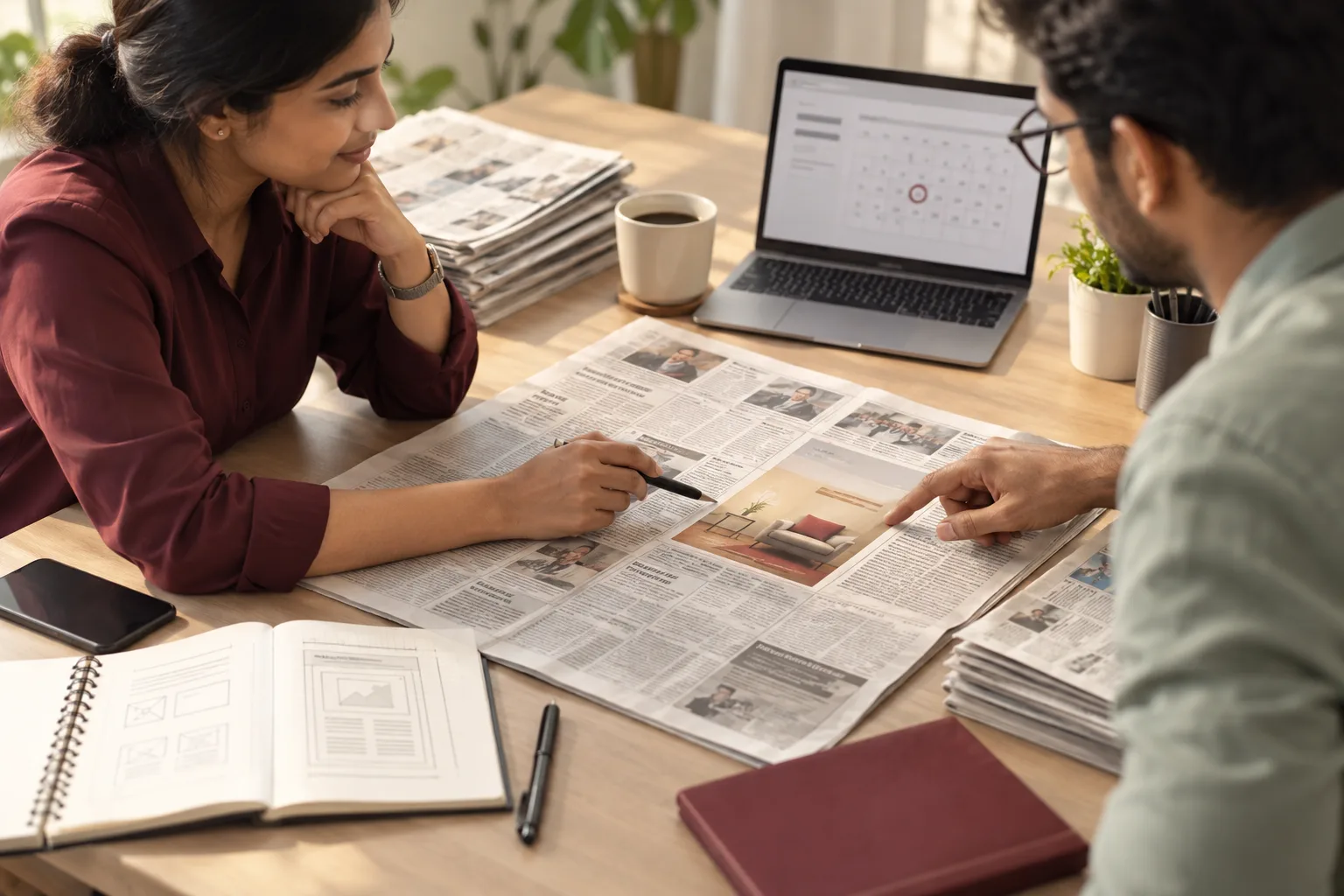
An advertisement in a newspaper or magazine sits among stories, other advertisements and a reader who did not ask to see it. It has a moment of attention and then the page turns. The design has to win that moment before the words are read.
Scope, fee, reporting and term are agreed in writing after we have read your brief and spoken to you.
In one paragraph
Newspaper and magazine advertisement design is the artwork for a space you have already booked, laid out to the publication's format and read by a stranger turning pages. GullySales designs the advertisement from your approved words and hands over the print-ready file the publication asks for.
The two media ask different things. A newspaper page is crowded, printed on paper that takes ink unevenly, and read in a glance. A magazine page is calmer, kept longer and read with more patience. A newspaper advertisement and a magazine advertisement are designed to different habits, even for the same offer.
This service delivers artwork and the file the publication accepts. The space, the booking and the price belong to media planning and buying, the words to print advertisement copywriting, and the copy deadline to the publication. A hospital notice, a school admission and a shop sale are all treated as one page seen once.
Who it is for
This is written for you if these sound familiar.
- Retailers and showrooms with a sale, a launch or a festival offer booked in a local newspaper
- Schools and coaching centres placing an admission notice that readers must find among other notices
- Clinics and hospitals placing a service announcement in a publication their regulator permits
- Manufacturers and distributors with a half-page in a trade magazine aimed at specifiers and buyers
- Property developers and builders with a page that must show a project fairly and carry required lines
- Restaurants and event organisers with a small space where one picture and one line must do the work
Before you decide
When this may not be the right fit.
- Businesses that have not yet chosen the publication or the space. Print and outdoor advertising and media planning and buying choose where the advertisement runs.
- Businesses that need the wording written as well. Print advertisement copywriting delivers the words, and the two can be scoped together so the headline and the layout are planned as one.
- Businesses that want a poster, a flyer or a hoarding. Poster design and flyer and leaflet design handle those formats, which are read at a different distance.
The problem
Does this sound like your business?
Common situations this work addresses.
“Our advertisement looks like every other one on the page”
The layout follows the competitor's style, with a crowded block of text and a small logo. A reader turning the page sees a grey rectangle and moves on before the offer is understood.
“The publication sent our file back”
The file was built at the wrong size, in the wrong colour setup, or without the margin the publication needs. The booking window comes closer while artwork is rebuilt, and the space may be lost.
“The advertisement works in a magazine but not in a newspaper”
The same artwork was dropped into both media. Fine detail and pale tints vanish on newsprint, and the layout built for a calm page looks thin on a crowded one.
“The offer was there, but the way to respond was hidden”
The telephone line, the address and the web link sit in small type at the foot of the space. A reader who wanted to respond cannot find the action in the time the page allows.
Choose the right scope
Start with the work your business needs.
A single advertisement for one booking
One space in one publication, designed from your approved words, with a print-ready file and a specification sheet. Suited to a sale, an admission notice or a launch that runs once.
A set for a newspaper and a magazine
A pair of versions built for the two media from one idea. Each is set for its paper and its reader, and the pair is recognisably one campaign, so the buyer meets one message in both.
A refresh of an advertisement you have run
An earlier advertisement is rebuilt for the current brand, with a clearer reading order and a more visible response action. Wording is kept unless you supply new text, and the new file meets the current specification.
A version for a second audience
The approved layout is adapted for a second language edition or a second readership, such as a consumer title and a trade title. The two keep a shared look and carry different lines and response actions.
What we do
The work we can include.
Each deliverable and the purpose it serves. Your written scope confirms what is included, who is responsible, and what it costs.
Layout concepts for the booked space
Layout directions for the exact shape you have booked, each showing the picture, headline, offer and response action. You pick one, and the finishing work follows it.
A version for each medium
A newspaper version and a magazine version where both are in scope, each set for its paper, its colour setup and its reader. The two stay recognisably one campaign without being the same file.
Typography and picture treatment
Headline, supporting lines and imagery set so the advertisement reads at a glance on a printed page. Pictures you supply are used where their quality allows, and anything that will not print well is flagged before layout.
Response and legal line placement
The telephone line, address or web link is placed where a reader finds it, together with any registration, licence or disclaimer line your regulator requires. You supply the wording; we place it so it is legible.
Print-ready file for the publication
A file built to the publication's current specification, with the margin, colour setup and format it asks for. Where the publication builds the file from your artwork itself, we hand over the artwork and a note.
Artwork specification sheet
A single sheet naming the booked space, the medium, the colour setup, the margin, the fonts used and anything the publication must confirm. It gives the person placing the booking everything needed in one place.
Resized versions for other placements
Where the scope includes them, versions for a second space, such as a smaller notice or a classified position, built from the approved layout so the campaign stays consistent.
How the result is measured
- Files accepted by the publication without a query
- Responses traced to a code or line shown only in this advertisement
- Calls and visits the front desk records as coming from the advertisement
- Coupon or reply panels brought back
- Corrections needed after the publication's proof
- Responses compared between the newspaper and magazine versions
Recorded as a baseline before work starts, so every later report has an honest comparison.
Marketing and sales together
The front desk and the sales team record every response against this advertisement.
Whoever answers the telephone, whether a shop assistant, a clinic receptionist or a sales coordinator, hears the first response. We design a line, code or coupon shown only in this advertisement so that person can record where each enquiry came from. The sales team then compares publications by the responses each one brought in.
Decisions to make before the work starts
What is not included
Writing the words, choosing the publication, booking the space, paying for the placement and proofing at the publication are separate scopes. Photography and illustration come in only if the written scope names them. Outdoor sites and posters have their own pages.
What stays your decision
The offer, the price, the claims, the legal wording and any trade mark or licence line stay with you. Each is marked on the layout for review. For health, school, food, finance and property advertisements, your own regulator or adviser sets the final wording.
Where others set the rules
The publication sets its own specification and its own advertising standards, and may refuse or change an advertisement. Medical, financial and property advertisements also meet the rules of the regulator concerned. We design to the publication's current specification and you confirm the rest.
This or a nearby service
Which piece of work fits your situation.
These services sit close to each other. The line between them, in plain words.
- Print and outdoor advertising
- Choose print and outdoor advertising when you need the right publications and sites chosen, matched to an audience, and the booking coordinated. Choose newspaper and magazine advertisement design when the space is decided and the artwork is the job.
- Print advertisement copywriting
- Choose print advertisement copywriting when the headline and body text are the missing piece and you need them written for a printed page. Choose newspaper and magazine advertisement design when the words are approved and the layout, picture and file are still to be made.
- Poster design
- Choose poster design when the piece is displayed on a wall or a stand and read from a distance by people passing. Choose newspaper and magazine advertisement design when the piece is placed on a page and read by a reader turning pages.
A sample of the output
An artwork specification sheet lists what the publication needs before the file is sent.
Each row is one item the person placing the booking must have. The sheet shows what is set, who supplies it and what the publication still has to confirm. Read the last column first, since an unconfirmed item can hold the booking.
| Item | How it is set | Who supplies it | Publication to confirm |
|---|---|---|---|
| Booked space and shape | Built to the exact format named in the booking | Your booking contact | That the format matches the rate card |
| Colour setup | Set to the paper the publication prints on | The publication's specification sheet | That the setup is current |
| Margin and safe area | Text and logo kept clear of the trimmed edge | Designer, to the publication's margin | Whether a border is added at their end |
| Legal and registration line | Placed where it stays legible at print size | Your adviser or regulator, in final wording | Whether the publication requires it first |
| Final file type | Exported to the type the publication accepts | Designer | Deadline for artwork and for any proof |
Before we start
What we need from you.
The work depends on these. Each says why it is needed and what happens when it is missing.
- The booked space and publication
- The artwork is built to one format in one publication. We need the booking, or a clear note of the space intended. Without it, we design to a guess and the file may have to be rebuilt once the real format is known.
- Approved final words and offer
- Layout is shaped by the length of the headline and the offer. Final text from you or a writing scope is acceptable. Draft wording holds the layout until it settles, because changed text shifts every other element.
- One response route to print
- Decide whether the reader should call, visit, scan or use a web link, and name one. If nobody owns that route, responses cannot be recorded and the advertisement cannot later be judged against the publication.
- Brand files and the best images
- We need the logo, colours and photographs at print quality. Files from an earlier designer are acceptable. Low-quality pictures are flagged at once, since newsprint exposes weak images and replacement takes time.
- Someone who signs off the claims
- One named person must approve claims, prices and legal lines before the file leaves us. The publication can refuse an advertisement, and without that approver the deadline may pass while wording is still disputed.
How it works
How the work runs
The work itself, in order. How an engagement starts, from your brief to a written scope, is set out on our method page.
- 1
Reading your brief and your booking
We read what the advertisement must do, who reads the publication, and the exact space booked. If the space is not yet booked or the words are not final, we say so, because both change the layout.
- 2
Fixing the specification
We obtain the publication's current specification through your booking contact: format, colour setup, margin and file type. We design to that sheet, so no later file has to be rebuilt to fit it.
- 3
One message and a reading order
We settle the single message and the order in which the reader sees picture, headline, offer and response action. You approve this plan before colour or typeface is applied.
- 4
Concepts for the space
We present layout directions in your brand and with your images. You pick one and say what to change. A change that touches a claim or an offer is held for your approval.
- 5
Finishing and checking
We complete the artwork, test legibility at the size and on the paper the reader will meet, and mark each claim and legal line for your sign-off. Publication-specific points go to the booking contact.
- 6
File handover
We export the file to the publication's specification and write the specification sheet. We answer the publication's technical questions on the artwork. The booking, proof and publication remain with you and the publication.
Before you hire anyone
Do this first yourself.
A print advertisement is easier to design once you know the space, the reader and the single thing you want them to do.
- Write down the publication, the exact space booked and the edition so the designer builds to one format.
- Pick one response action, such as a telephone line or a visit, and decide how you will record who used it.
- Look at the last few advertisements in the same publication and note what on the page made you stop or turn over.
- List every price, offer, condition and legal line that must appear and who signs off each one.
- Ask the publication for its current artwork specification and its deadline for files, then send both to the designer.
Judge any provider
What to ask any provider of this service.
Useful whoever you choose, including us.
- How do you design differently for a crowded newspaper page and a calmer magazine page?
- Which publication specification will you work from, and who obtains the current version?
- Where will the response action and the legal line sit, and how legible will they be at print size?
- What do you do when my pictures are not good enough for newsprint, and when do you tell me?
- Which files and which specification sheet do I receive, and who answers the publication's technical questions?
Where this fits
Three pieces of sales work, in this order.
This work sits inside sales process design, at stage 1, prospecting and lead generation. The audit comes before it, and sales management keeps it running.
Step 1
Sales audit
Find where deals are being lost and what to fix first.
Start here if you cannot say where orders are lost.
Step 2 · you are here
Sales process design
One written way to sell, from first enquiry to repeat order.
Start here if every salesperson sells differently.
Step 3
Sales management
A target, a review routine and someone who owns the number.
Start here if the team has targets and no routine.
FAQ
Questions owners ask before they call.
Not here? More answers, or ask on WhatsApp.
Do you book the space or buy the advertisement?
Do you write the words for the advertisement?
Who owns the artwork and the files you hand over?
How are changes handled?
Who approves claims and legal wording?
Can one design serve both a newspaper and a magazine?
By industry
Newspaper and magazine advertisement design, written for your industry.
Related services
Often bought with this, or instead of it.
Your next practical step
Tell us what you are trying to grow, and we will read it before we call.
Eight short steps, mostly taps. Skip anything you would rather answer on the call.