Car dealers · Automotive
Call the portal lead back before the other dealer of your brand does.
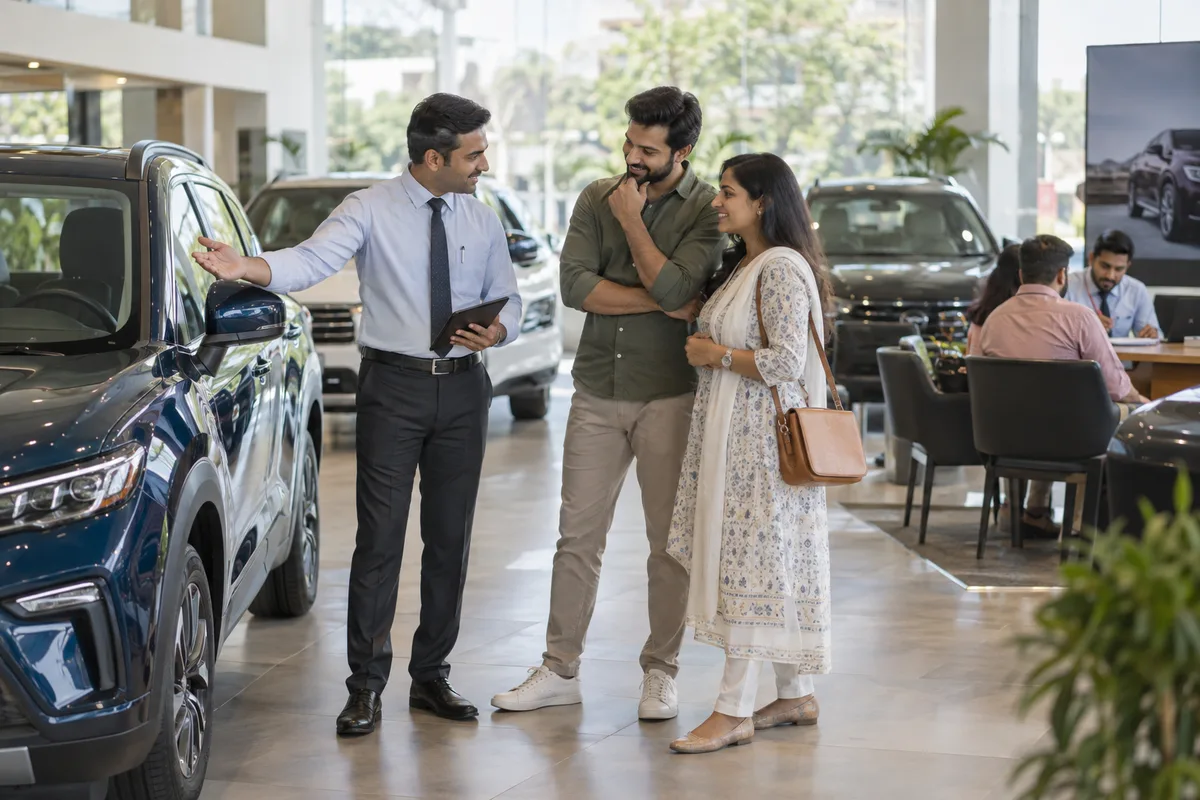
A buyer walks into a showroom having already done most of the research. They have watched review videos, compared variants and on-road prices on CarDekho or CarWale, and asked friends about mileage and service. What is left is which dealer to book with, and whether the exchange and finance deal is good enough to sign today.
Scope, fee, reporting and term are agreed in writing after we have read your brief and spoken to you.
In one paragraph
Car dealer marketing makes your showroom the one a buyer contacts for the model they have already shortlisted. Car dealer sales turns that enquiry into a test drive, a booking and a delivery. GullySales gets every lead called within minutes, makes each branch visible for its models, and follows up with the family through loan approval and exchange valuation.
The manufacturer's national advertising brings buyers into the market, but it does not decide which dealer they book with. The dealer who calls back first and offers a test drive at home usually gets the visit. The one who follows up after that visit, instead of waiting for the family to return, usually gets the booking.
Last updated 5 Oct 2026.
How buyers decide
How car dealers are chosen.
The trigger is usually a life event or a date. It might be a new job, a growing family, or an auspicious day such as Dhanteras, Onam, Ugadi or Akshaya Tritiya. The buyer shortlists two or three models on YouTube, leaves a number on the brand website or a car portal, and gets calls from several dealers of the same brand. The first to call with a clear on-road price and a home test drive usually gets the visit.
The family decides together. The spouse weighs in on colour and comfort, while the person paying watches the EMI and the exchange value of the old car. Many buyers visit two dealers of the same brand to compare discounts and delivery dates. The booking closes when the numbers are written down clearly and the delivery date is believable.
Pre-owned buyers are more cautious. They compare Cars24, Spinny, OLX and the manufacturers' certified used programmes, and want service history, an inspection report and a clean RTO transfer. Fleet buyers and taxi operators decide on price, finance terms and service support, usually after a formal quotation.
The problem
What usually goes wrong for car dealers.
What owners tell us on the first call, in their words.
“Leads from the manufacturer portal are called back too late”
A lead arrives on Saturday evening, the salesperson calls on Monday, and the buyer has already test-driven at the other dealer across town.
“Buyers visit once, take a quote and never return”
A family spends an hour in the showroom, leaves with a printed quote, and no one follows up in a planned way while they decide.
“Our Google reviews are mostly about the service workshop”
Complaints about a long service wait sit on the same profile the new car buyer checks, with no reply from the dealership.
“Festival months are flooded and the rest of the year is flat”
We cannot handle every walk-in during Navratri and Diwali, and then the showroom is empty in the months after.
“Our salespeople keep leads in their own phones”
When a salesperson leaves, their pipeline of warm buyers leaves with them, and nobody else knows who was about to book.
“Our used cars sit in the yard for months”
Exchange vehicles come in faster than we sell them, and our listings have poor photos and no inspection details.
“The service workshop never tells sales who is ready to upgrade”
A customer with a seven-year-old car and rising repair bills is in our workshop every few months, and no one offers them a new model.
What we do
What we do for car dealers.
Everything included for car dealers, and the result each part is there to produce.
Lead response routine for every source
One routine for leads from the manufacturer portal, the dealership website, car portals, Google, Meta ads and walk-ins, with a first call target and a named salesperson for each.
Result: A buyer who asks for a price hears from you before they hear from the other dealer.
Google Business Profile for each showroom and workshop
Separate, complete profiles for sales and service at each branch, with current models, photos, hours and a reply to every review.
Result: A buyer checking the showroom does not land on a workshop complaint.
Follow-up sequences after a showroom visit
A planned sequence of calls and WhatsApp messages after a visit or test drive, covering the quote, the finance offer, the exchange value and the delivery date.
Result: A family still deciding hears from you with something useful to say.
Local search campaigns by model and branch
Google and Meta campaigns for specific models and localities, within the manufacturer's brand rules and co-op advertising terms, sent to landing pages with an on-road price enquiry.
Result: The ad budget goes to buyers near your branch who are ready to visit.
Pre-owned listing standard
A photo and description checklist for every used car, with service history, inspection summary, ownership and insurance details, for your website and portals.
Result: Used cars are listed in a way a cautious buyer can trust.
Dealership CRM discipline
Every lead, visit, test drive and booking recorded against the buyer in the dealer management system or a CRM, not in personal phones, with a lost-lead review.
Result: The pipeline stays with the dealership when a salesperson moves on.
On-road price sheet for every variant
One current sheet per model with ex-showroom price, registration, insurance, accessory packs and this month's offers by variant, shared with every salesperson.
Result: The first call gives the buyer a clear number, not a promise to send one later.
How the result is measured
- Leads by source and branch
- Time from lead to first call
- Test drives per hundred leads
- Bookings and deliveries by source
- Used car days in stock
- Upgrade bookings from service customers
Recorded as a baseline before work starts, so every later report has an honest comparison.
Every service, written for car dealers
Each has its own page: what it involves for car dealers, what you get, and what it is measured on.
- Newspaper advertisingBuy the edition your territory covers, not the one your co-dealer shares.
- Outdoor advertisingBuy the road that reaches your gate, not the one that reaches the co-dealer.
- Radio advertisingThe manufacturer already sold the car, so your spot sells the showroom.
- SEOYou will not outrank the brand, so own the showroom and city searches.
- PPC adsYour own brand name is the cheapest click and the biggest argument.
- Lead generationA shared lead rewards the first call and nothing else.
- Digital marketingThree businesses under one roof compete for the same monthly budget.
- Reputation managementA buyer reads a service complaint before reading about your showroom.
- Local SEOMaps decides which dealer of your brand a buyer drives to.
- Branding and identityYou sell somebody else's brand, so the dealership name is all you own.
- Social media marketingDelivery photographs are the content this trade never runs out of.
- Content marketingThe buyer has watched every review and still cannot get a straight price.
- Email marketingEmail is for fleet quotations and the paperwork, not for retail buyers.
- Buyer personasWrite down who signs the cheque and who chooses the car before you plan any campaign.
- CRMA lead that lives only in a salesperson's phone leaves when the salesperson does.
- Follow-up systemsThe sale is made in the weeks between the showroom visit and the booking.
- WhatsApp marketingThe family already shares the car shortlist on WhatsApp, so be in that thread.
- WebsitesA dealer website earns its place when a buyer can book a test drive from it.
Worth a page and a campaign of their own
Launches of new models and facelifts · Festival season bookings · Exchange and upgrade offers · Car finance and EMI schemes · Test drives at home · Electric vehicle bookings · Certified pre-owned cars · Corporate and fleet sales · Accessories and extended warranty · Service-to-sales upgrades for older cars
Priority campaigns
Campaigns for what car dealers most want to sell.
Each one planned around when your buyers decide, and measured against the baseline.
Festival booking campaign
A booking campaign timed to Navratri, Dhanteras and Diwali, or to Onam, Ugadi and Gudi Padwa by region, with delivery-date promises the showroom can keep.
Result: Buyers who want delivery on an auspicious day book with you early.
Exchange and upgrade campaign for workshop customers
A targeted message to service customers whose cars are past a certain age or mileage, with an exchange valuation and a test drive of the new model.
Result: Upgrade buyers come from your own workshop instead of a rival showroom.
New model launch campaign
A pre-booking page, a local event and follow-up for a new model or facelift, with a waiting list for early test drives.
Result: Buyers interested in the new model register with you before the launch week.
Year-end clearance campaign
A focused campaign in December for current model-year stock, explaining the offer and the model-year question honestly.
Result: Old stock moves before the calendar changes.
Corporate and fleet outreach
A quotation pack and outreach to local companies, cab operators and institutions buying several vehicles, with finance and service terms.
Result: Multi-vehicle orders arrive in months when retail is slow.
Beyond search
Where we reach buyers of car dealers, beyond Google.
Search matters, but it is rarely the only way this industry's buyers find a supplier.
Companies in nearby business parks
We prepare an employee purchase offer and a showroom visit day for HR teams in nearby offices and industrial estates.
Banks, NBFCs and loan agents
We prepare a referral arrangement with car loan teams who meet buyers who have not yet chosen a dealer.
Apartment complexes and gated communities
We prepare a weekend display and test drive event proposal for apartment associations, with a registration link for residents.
Driving schools
We prepare a tie-up for driving schools whose students are about to buy their first car.
Cab operators and travel agencies
We build a list of local fleet owners and prepare a fleet quotation and service support note for them.
Who it is for
This is written for these car dealers.
- Authorised new car dealerships for mass-market brands
- Premium and luxury car dealerships
- Electric vehicle dealers and experience centres
- Multi-brand pre-owned car dealers
- Manufacturer-certified used car outlets
- Commercial vehicle and taxi fleet dealers
- Dealer groups with several showrooms and workshops
- Rural and semi-urban dealer outlets
Not for
It is not the right fit if.
- You want a guaranteed Google ranking or a guaranteed number of leads. Nobody honest can promise either.
- You need enquiries by next week and have nobody to answer them.
- You want posts and reach reported, not enquiries and orders.
How it works
How the work runs for car dealers
The work itself, in order. How an engagement starts, from your brief to a written scope, is set out on our method page.
- 1
Assess
We trace leads from each source through first call, test drive, booking and delivery, and check each branch profile and its reviews.
- 2
Fix the first call
A response routine and ownership rule for every lead source, recorded in the dealership CRM.
- 3
Follow up after the visit
Calls and WhatsApp messages planned around quotes, finance approval, exchange valuation and delivery dates.
- 4
Bring buyers in
Local campaigns by model and branch, festival campaigns, workshop upgrade offers and corporate outreach.
- 5
Keep the owner
Delivery follow-up, a review ask, service reminders and an upgrade offer when the car ages.
United States
Working with US car dealers.
An internet lead arrives in the CRM as an ADF from CarGurus, Autotrader or the factory site, and the shopper has sent the same form to two other stores. The shopper asked three things: the out-the-door price, whether the car is still on the lot, and what the trade is worth. An auto-response inviting the shopper to call the dealership answers none of them. The speed-to-lead report your CRM already produces shows exactly how long the shopper then waited.
We write the replies your BDC sends, the comments on each used vehicle detail page, and the follow-up schedule for a shopper still deciding between two stores. Your manager reads the CRM reports with us. Factory co-op rules on logos, disclaimers and payment claims are followed as your regional representative publishes them, and nothing runs before your side approves it.
A first reply that answers the price question
An out-the-door figure where your store allows one, or a straight explanation of what is still missing, with the stock number and two appointment times. Vague replies are why shoppers stop answering.
Speed to lead measured by source and by salesperson
The timestamps already sit in VinSolutions or eLead and nobody reads them. We report first response time beside appointments set and shown, against the baseline taken before we start.
Used vehicle comments written per unit
One owner, service records, new tyres in April, and the trim spelled out in words. A shopper comparing three of the same year and colour picks the one they know something about.
Co-op claims that do not come back rejected
Tier three advertising carries the factory's rules on logos, disclaimers and payment claims, and a claim is refused when the fine print is wrong. We build to the guide your representative gives you and keep the proof file for the claim.
Where this fits
Three pieces of sales work, in this order.
GullySales builds every engagement from three pieces of sales work. This page is not one of them, but the same three steps apply to the business behind it.
Step 1
Sales audit
Find where deals are being lost and what to fix first.
Start here if you cannot say where orders are lost.
Step 2
Sales process design
One written way to sell, from first enquiry to repeat order.
Start here if every salesperson sells differently.
Step 3
Sales management
A target, a review routine and someone who owns the number.
Start here if the team has targets and no routine.
FAQ
Questions car dealers ask before they call.
Not here? More answers, or ask on WhatsApp.
Can a dealer run its own ads when the manufacturer controls the brand?
Why do our portal leads convert so poorly?
Should our service workshop have a separate Google profile?
How can we sell exchange vehicles faster?
Do test drives at home actually increase bookings?
Our BDC answers in five minutes already. What is left to fix?
Can an outside team work inside our CRM?
Is this worth it for a single rooftop?
How much does it cost?
How long is the contract?
Notes for owners
Read more about car dealers.
- Using due dates to bring vehicle owners back: service, insurance and pollution checksHow a workshop or dealer can record each vehicle's next service, insurance and pollution-check dates, then call owners with a real reason instead of a generic offer.
- How buyers choose a showroom, workshop or parts counterCar, bike, repair and parts buyers send one enquiry to several sellers and pick the first clear answer. This post lists what each buyer checks, and where a dealer or workshop quietly loses them.
- Handling price negotiation in a vehicle showroomA give-and-get ladder for showroom price talks: what each salesperson may concede, in what order, and what to ask for in return, so buyers are treated alike and margin is kept.
- Tamil advertising creative: what actually changesTamil is written one way and spoken another, and its script cannot tell b from p. What that means for your line, voice artist and brand spelling.
- Radio advertising vs social media advertising: where should your money go?Radio reaches a driver who cannot click. Social reaches a thumb that can. One buys a name people remember, the other buys the enquiry itself.
- How to write a radio scriptA spot is heard once, by somebody at the wheel who cannot look at anything or write anything down. Time the words with a stopwatch, not on the page.
Part of Automotive. See the other industries in the sector.
Your next practical step
Tell us what you are trying to grow, and we will read it before we call.
Eight short steps, mostly taps. Skip anything you would rather answer on the call.