Car dealers · Website
A dealer website earns its place when a buyer can book a test drive from it.
A website for a car dealer is the page a shortlisted buyer opens to check the model, the branch and the next step, and it competes with the manufacturer's own site. GullySales plans the pages, the enquiry routes and the pre-owned listings so the site gives a reason to contact you.
Scope, fee, reporting and term are agreed in writing after we have read your brief and spoken to you.

What website means
A website is the page a customer lands on after searching, clicking an advert or scanning a code, and it decides whether they call or leave. GullySales builds and maintains sites that load quickly, explain the offer plainly and make the enquiry form or phone number easy to find.
Last updated 5 Oct 2026.
For car dealers
Where it usually goes wrong, and what we would do.
“The manufacturer's site already has the brochure”
A buyer who reaches your site has seen the specifications. What they need from you is what the manufacturer cannot give: your branch, your stock, your exchange offer and a person to call.
“Every model page needs a next step”
A page that ends with a brochure download loses the buyer. Ending with test drive booking, an on-road price request and a call button turns a visit into a lead the team can follow up.
“Pre-owned listings are judged on their photographs”
A used car shown with two blurred pictures and no inspection summary looks like a car with something to hide. Clear photographs, ownership details and a visible report move the enquiry along.
“The site is opened on a phone”
The buyer opens it between meetings or on the sofa, often from a WhatsApp forward. Slow loading, tiny buttons or a form with too many fields sends them back to the portal.
What we do
What we deliver for car dealers.
Every deliverable, what it covers for you, and the result it is there to produce. Nothing here is an extra.
A page for each model you sell
Variants, colours, features and a request for the on-road price, with the branch that stocks it named.
Result: A buyer finds their shortlisted model in one tap.
A test drive booking route
A short form and a WhatsApp button that lead to a named person, including the home test drive where you offer it.
Result: Interested visitors reach the sales desk without a search.
Branch pages with the practical details
Address, map, hours, parking, workshop and showroom phone lines for each outlet, kept consistent with the listing.
Result: A buyer knows which branch to visit.
Pre-owned listing pages
Photographs, ownership, kilometres, inspection summary and finance options for each vehicle, removed when sold.
Result: Used car enquiries come from buyers who read the details.
Exchange valuation request
A simple form asking for the make, year and condition of the old car, passed to the right desk.
Result: The upgrade conversation starts from the website.
Tracking of enquiries by source
Each form and call button tagged, so the CRM shows which page produced which enquiry.
Result: You see what the site actually brings in.
How the result is measured
- Page load time
- Bounce rate
- Enquiries from the website
Recorded as a baseline before work starts, so every later report has an honest comparison.
Searches your buyers type
Each page answers a search a car buyer types before choosing a dealer.
- [model] on-road price in [city]
- A model page with the break-up for your city, the variants and a button to book a test drive.
- [model] waiting period
- A page kept current by the sales head, stating the waiting time the brand gives and the date it was last checked.
- [brand] showroom near me
- Branch pages with address, hours, a map and the names of the sales team, one for each branch.
- used [model] in [city] with service history
- Pre-owned listings with photographs of the actual car, kilometres, owners and the inspection report.
- car exchange value for my old car
- A request form asking make, year and photographs, and stating that the figure is confirmed after inspection.
Who it is for
This is written for these car dealers.
- Authorised new car dealerships for mass-market brands
- Premium and luxury car dealerships
- Electric vehicle dealers and experience centres
- Multi-brand pre-owned car dealers
- Manufacturer-certified used car outlets
- Commercial vehicle and taxi fleet dealers
- Dealer groups with several showrooms and workshops
- Rural and semi-urban dealer outlets
Not for
It is not the right fit if.
- The manufacturer owns the dealer site and you cannot change pages, so ask what is permitted before planning.
- Nobody can update used car listings, and a sold car left online loses trust.
- You have no one to answer the test drive form on the day it arrives.
How it works
How the website work runs
The work itself, in order. How an engagement starts, from your brief to a written scope, is set out on our method page.
- 1
Confirm structure and content
We agree the page list, what each page must answer, and who supplies the text and photographs, before any design starts.
- 2
Design the templates
The home page, a service page, a location page and the enquiry page are designed first, on phone and desktop, and shown to you.
- 3
Build and test
The site is built and checked on real phones and the common browsers. Every form, call button and WhatsApp link is tested end to end.
- 4
Load real content
Actual copy, images and information replace placeholders. Pages are read through once by you, since you spot wrong details we cannot.
- 5
Check before launch
Tracking, page titles, the sitemap and the privacy page are checked on the staging site. If an old site exists, its addresses are mapped so old links still land somewhere.
- 6
Launch and hand over access
The site goes live and we record the domain, hosting, content login and analytics in your name. The first live enquiry is traced to confirm tracking works.
Where this fits
Three pieces of sales work, in this order.
This work sits inside sales process design, at stage 1, prospecting and lead generation. The audit comes before it, and sales management keeps it running.
Step 1
Sales audit
Find where deals are being lost and what to fix first.
Start here if you cannot say where orders are lost.
Step 2 · you are here
Sales process design
One written way to sell, from first enquiry to repeat order.
Start here if every salesperson sells differently.
Step 3
Sales management
A target, a review routine and someone who owns the number.
Start here if the team has targets and no routine.
FAQ
Questions owners ask before they call.
Not here? More answers, or ask on WhatsApp.
The manufacturer gives us a dealer microsite. Is that enough?
Should the site show prices?
How do we keep stock listings current?
Should the site list the manufacturer's scheme offers?
How long is the contract?
How soon will we see results?
Who will actually do the work?
What do you need from us?
What if we are not happy with the work?
From the blog
Further reading for car dealers.
 5 min read · 11 Oct 2026Using due dates to bring vehicle owners back: service, insurance and pollution checksHow a workshop or dealer can record each vehicle's next service, insurance and pollution-check dates, then call owners with a real reason instead of a generic offer.
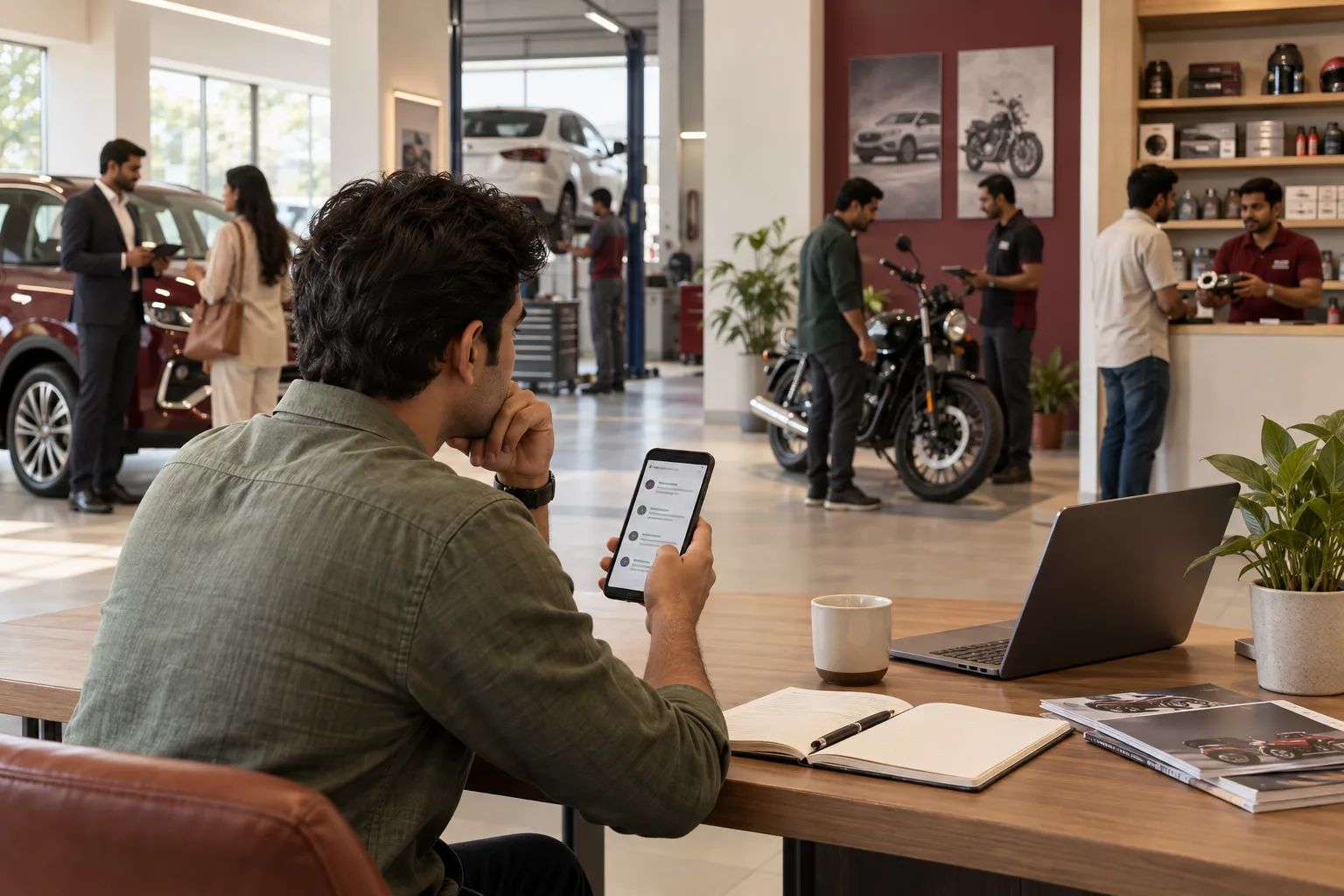 6 min read · 6 Oct 2026How buyers choose a showroom, workshop or parts counterCar, bike, repair and parts buyers send one enquiry to several sellers and pick the first clear answer. This post lists what each buyer checks, and where a dealer or workshop quietly loses them.
 6 min read · 5 Oct 2026Handling price negotiation in a vehicle showroomA give-and-get ladder for showroom price talks: what each salesperson may concede, in what order, and what to ask for in return, so buyers are treated alike and margin is kept.
More for car dealers
Everything else we would do for you.
Closest to this: search and visibility
Also for car dealers
Or start from the overview: sales and marketing for car dealers.
Your next practical step
Tell us what you are trying to grow, and we will read it before we call.
Eight short steps, mostly taps. Skip anything you would rather answer on the call.