Notes for owners · Industry playbooks
EMS and contract manufacturing: what procurement asks in the first meeting
The questions a sourcing team asks an electronics contract manufacturer at the first meeting, on parts, lead time, testing and traceability, with the plain answer to prepare and the paper to bring.
The GullySales team · Updated 17 Oct 2026 · 6 min read
On this page
The engineer liked your quote. Now the sourcing manager has asked for a meeting, and the first question is not about your SMT lines. It is whether you build turnkey or consigned, and what you do when the microcontroller goes on allocation. Procurement checks four things: where your parts come from, how long the build takes, how each board is tested, and how you trace a failure. Prepare a plain answer to each. Bring one real test report. Then the meeting moves on to quantities.
Who is across the table, and what are they checking?
Procurement is judging risk. Will this vendor stop our line? Expect a purchase or sourcing manager, and at a larger OEM a supplier quality engineer too. The purchase manager asks about price breaks, payment terms and dates. The quality engineer asks about process and listens for the shop floor in your answers.
Neither of them wants your company history. The meeting goes well when your answers come in the order they think in. For the earlier stage, where the engineer finds you, see electronics and embedded systems.
The questions you will hear, and what to prepare
| Question you will hear | What they are really asking | Prepare this answer | Bring this |
|---|---|---|---|
| Turnkey or consigned? | Who carries the parts risk and the working capital | Which you offer, and for turnkey, the distributors you buy from | Your list of authorised and franchised sources |
| What is your lead time? | Can I plan a launch on your date | Two numbers: build time once parts are in stores, and parts lead time, line by line | A past BOM with lead time marked on each line, customer name removed |
| What if a part is on allocation or end of life? | Will you swap a part without telling me | Your rule: no substitute fitted without their engineer's written approval | A blank alternate-approval form |
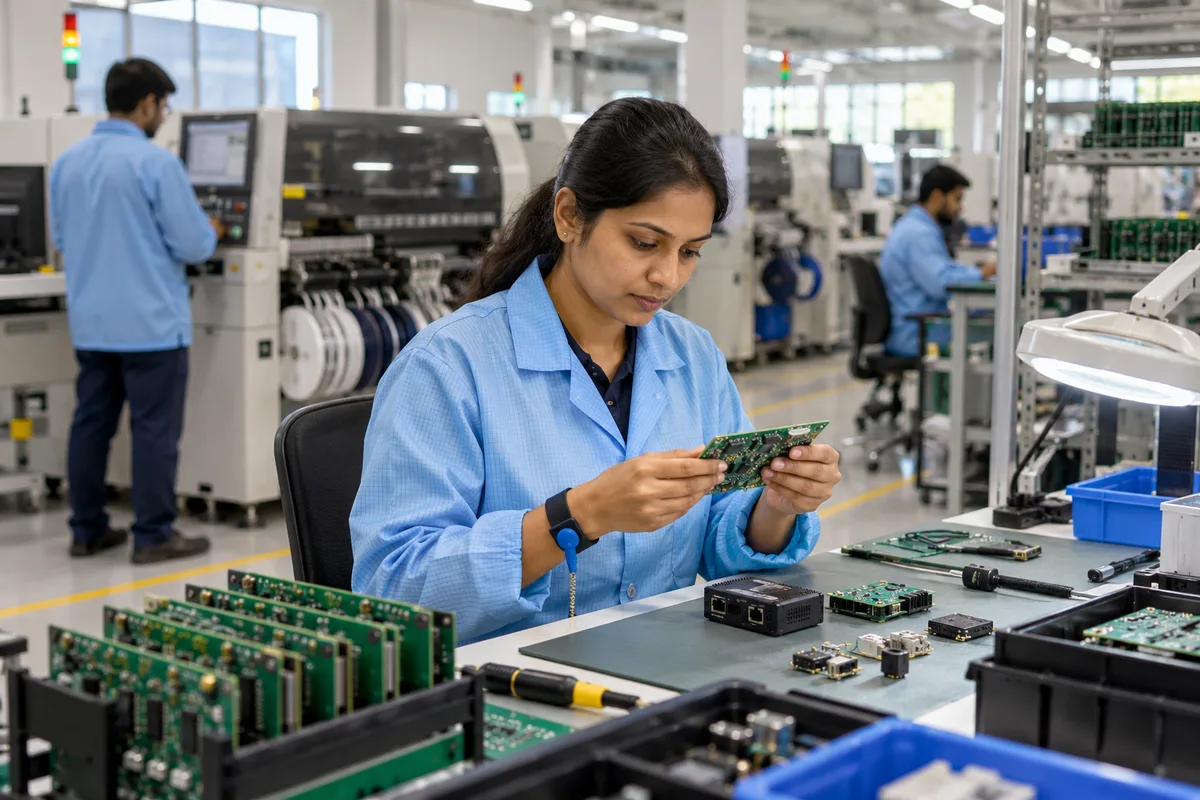
| How is each board tested? | Will bad boards reach my customer | Paste inspection, AOI, X-ray if you have it, ICT or functional test, and who writes the test | One sample test report |
| Can you trace a board back? | When a field failure comes, can you find the batch | Serial label, date codes of key parts, line and shift | The record for one past board |
| What are the one-time costs? | What will this really cost at 500 and at 5,000 | Stencil, jig and programming fixture listed apart from the per-board rate | A sample quotation layout |
Answer the lead time question in two parts every time. "Four weeks" is heard as a promise for the whole order, parts included. The quality engineer will also ask how you store moisture-sensitive reels and check ESD straps. A photograph of the dry cabinet and the strap-check register answers that faster than a description.
What should the sample test report show?
One real report from a past build does more than a capability deck. Ask that customer's permission first, or remove every name and part number that identifies them.
Make sure the report carries:
- The board name, revision and quantity built
- Each inspection stage, with what it found
- Every defect, and the rework done on it
- Functional test results against the customer's own test specification
- A name and a signature on the release
Keep your own figures, untidy ones included. A report that shows three reworked solder bridges, with the cause and the action, is believed; one that shows nothing found on any stage is not. If you are new and have no customer report to show, build a batch of your own test board and report that, saying exactly what it is.
An assembler in Greater Noida
This is an invented example. A contract assembler in Greater Noida with two SMT lines meets the sourcing manager of a Noida company that makes vehicle trackers. The meeting goes well until the lead time. The owner says "four weeks, sir", meaning four weeks to build two thousand boards once the parts are in.
The sourcing manager writes down four weeks for the order. When the BOM arrives, the cellular module shows a much longer lead time at every distributor the owner checks. The owner goes back with a new date. To the buyer, this is now a vendor whose dates move, and the trial order goes to a larger EMS in Noida.
At the next first meeting, with a smart lighting maker, the owner answers in two parts. Build time for the quantity comes first. Then the owner says the parts lead time depends on the BOM, and offers to mark each line with the current distributor lead time, with a marked BOM from an old build to show what that looks like. The buyer asks for that sheet with the quotation. The first purchase order carries a date both sides read line by line, though for a smaller quantity than the tracker maker had wanted, and marking the BOM took a day of the stores head's time.
What if you cannot answer on the day?
Say "I will confirm that with our stores and send it in writing", and send one dated note afterwards. If they ask for other customers' names or prices, decline politely.
When the full preparation is not worth it
A first meeting pack takes a day to put together. Spend that day when the buyer has shared a BOM, a quantity and a timeline. If they want your rate per placement before sending a BOM, they are collecting rates for a spreadsheet. Send a capability sheet and ask for the BOM.
Skip it, too, for a five-board prototype from a hobbyist or a college team. Our note on telling a prototype enquiry from a production one has the questions that sort them. Be honest when the volume is beyond your lines. Saying so in the first meeting costs you one order. Discovering it during a ramp costs you the customer. Vendor registration comes next, and the purchase team's document list is what they will send.
Before your next sourcing meeting
Write your two-part lead time answer, mark one old BOM with distributor lead times, and choose the test report you would show. The sales hub places this meeting in the wider selling process, and enterprise and solution selling is the work if several people will sit across the table. If a sourcing meeting is on your calendar, tell us what you need.