Notes for owners · Branding and communication
Home decor product photography: show the piece in a room your buyer actually lives in
A decor buyer wants to see the piece in a room like theirs. Which corner each piece belongs in, what to keep in frame, the renter's version, and festive scenes an ordinary flat can match.
The GullySales team · Updated 17 Oct 2026 · 6 min read

On this page
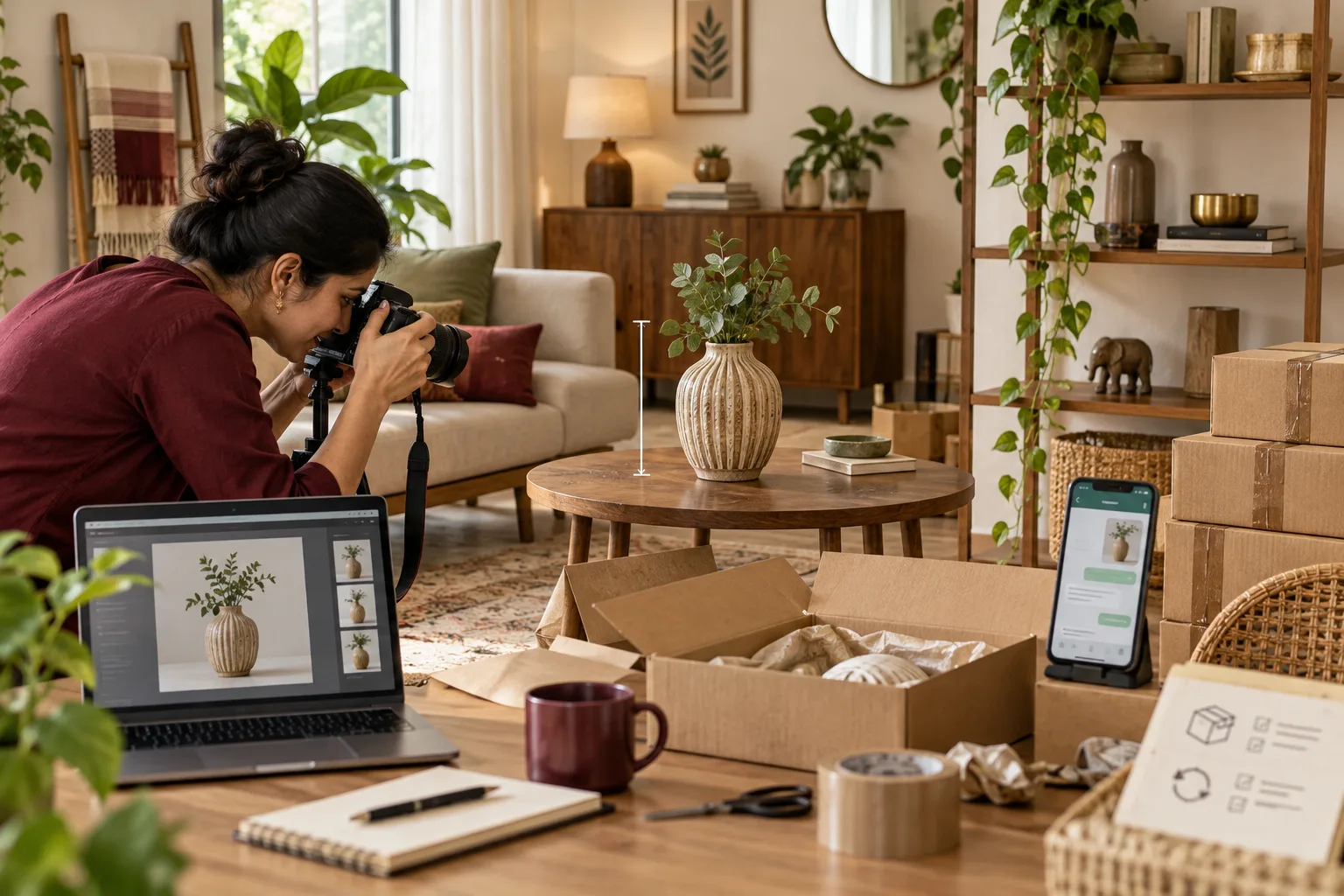
A buyer sees your brass urli on a marble console in a double-height hall. The buyer thinks, "lovely, but where would it go in my flat?" They order anyway, and it looks lost on the shoe cabinet. Home decor product photography has one job: show the piece in a room like the buyer's, in the corner where it would actually live. Their tiles, their TV wall, their balcony grille. A set no home can reproduce sells the room, and the product becomes a prop in it.
What the scene shot has to prove
A scene shot answers questions the white-background photo cannot. How big is it next to things I own? What does it look like in light like mine? What does it sit beside? A styled room answers a different question, "is this a beautiful room?".
So judge every scene photo with one test. If the buyer put this piece in their own room, could they get close to this picture? If the honest answer is no, you have photographed an advertisement for the room.
Shoot in a room your buyer lives in
The room your buyer lives in has vitrified tiles, a TV wall, a three-seater against one side and a balcony with a grille. Show your piece there, not on oak floorboards borrowed from a foreign catalogue.
If your studio is a white room, borrow a real flat. A friend's living room at ten in the morning is a better set than anything you can hire. The rest of the kit, from window light to a scale shot with the size written on it, is in our post on product photography on a small budget. This post is about the scene.
A scene planner: which corner each piece belongs in
Every decor piece has a place in an Indian flat where it will most likely end up. Shoot it there, with that place's neighbours in frame.
| The piece | Its corner | Keep in frame | Leave out |
|---|---|---|---|
| Brass urli, diya set, bell | Near the pooja shelf or the entrance | The shelf edge, a photo frame, the door frame | Fresh flowers floating in it every shot |
| Figurine or small sculpture | TV unit or a glass showcase | The set-top box, the edge of the TV | A bare plinth with a spotlight |
| Wall hanging or mirror | A painted wall above a three-seater | The sofa back, a switchboard if there is one | A gallery wall of ten other pieces |
| Planter or wind chime | The balcony | The grille, the ledge, a plastic chair | A garden the buyer does not have |
| Cushion cover or throw | The everyday sofa | The remote, a phone, a crease | A bed made with eight pillows |
| Table lamp or candle stand | A bedside or side table | A water bottle, a book | A dark room lit only by the lamp |
Then shoot the renter's version. If many of your buyers rent, show what needs no drilling. Put the wall piece on an adhesive hook, lean the mirror on the floor, use the shelf that stands on its own. Say so in the caption. A tenant scrolls past anything that looks screwed into the wall.
Festive scenes the buyer's flat can match
Diwali, Navratri, Onam and the wedding season are when decor sells, and when the styling gets out of hand. A rangoli the size of a hall, forty diyas and a heap of marigolds make a lovely picture. The buyer's version is a shoe cabinet by the door, one string of lights and a handful of flowers from the market. Shoot that version.
Two rules keep a festive scene honest. Build it from things the buyer can pick up in their own market that week. And lead with it only in the season; after the festival, it drops behind the everyday scene. If you shoot reels too, shoot them in the same flat, so the ad and the product page show the same room.
For example: dhokra horses still dressed for Diwali in February
For example, a dhokra studio in Kondagaon, in Chhattisgarh, sells brass-cast horses, bells and wall pieces online across India. Its best photographs were shot before Diwali: a pair of horses on a carved chowki, ringed by a rangoli, rows of diyas and a terracotta floor. They sold well in the festive weeks.
Then the festival ended and the listings went quiet. The same festive picture still led every listing in February. The questions that did arrive were about ordinary rooms: "Will these look right on a TV unit?" "Is the bell too heavy for a balcony hook?" Nothing on the page answered them.
The studio borrowed a two-bedroom flat for a morning. The horses went on the TV unit beside the set-top box and a family photo. The bell hung from a hook on the balcony grille, the wall piece above a three-seater. The festive scene was reshot in the same flat on a shoe cabinet by the door, with five diyas and a string of lights. In this illustration, the horse listing had been getting about 40 questions a month in the off season, and the studio counted roughly half as many once the TV unit shot led. The festive scene leads only from Navratri to Diwali; the rest of the year the TV unit shot comes first. The borrowed flat cost a morning and a tank of petrol.
When a plain photograph is enough
Not every product needs a scene. Hooks, storage boxes and replacement parts sell on size and price, and a plain shot with a ruler beside it does the job. Skip the scene too if you cannot shoot in a real room: a clean white-background photo with an honest scale shot beats a borrowed set the buyer will never recognise. Interior designers and hotels buying in bulk usually ask for the plain shot, the size and the finish code, so keep those on file.
How to sell home decor online covers the channels, packing and returns; this post is only about the picture. Decor is one of the categories on our e-commerce sales and marketing page; see also e-commerce and marketplace marketing.
Reshoot one morning in a real flat
Open your listings and look only at the first scene photo of each. Ask whether a buyer could put the piece in that spot in an ordinary flat. Where the answer is no, find the row for it in the scene planner and book one morning in a real flat to reshoot. If you want help planning short-form video and reels production and the product pages around those shoots, tell us what you need.