Notes for owners · Sales management
Pattern and die cost: how a foundry should present it in a quotation
Buyers compare foundries on piece price and forget the pattern. How to show pattern and core boxes as their own line, price the cheaper and dearer pattern routes, total both at the buyer's quantity, and state ownership.
The GullySales team · Updated 17 Oct 2026 · 5 min read
On this page
You lost the order on piece price. Months later you heard the buyer paid the other foundry a pattern bill that never appeared on the comparison sheet. Stop letting that happen. Show the pattern and its core boxes as their own line, next to the piece price. Where a cheaper pattern means a dearer piece, price both routes. Add a total for each at the buyer's own yearly quantity, so every foundry is compared on the same sum. Then say in one sentence who owns the pattern once it is paid for.
Why the cheaper foundry was not cheaper
Purchase builds its comparison on piece price, because that is the column that repeats. The pattern is paid once, sometimes from a different budget, and sometimes approved later by someone else. A foundry that writes "pattern extra as actual", or "pattern by party", wins that column without ever disclosing its full price.
Your own quote can lose the other way. Spread the pattern into the piece price without saying so, and your piece price looks the highest on the sheet. The buyer cannot see that it falls once the pattern is paid off, because you never said so.
Price the pattern route, not only the pattern
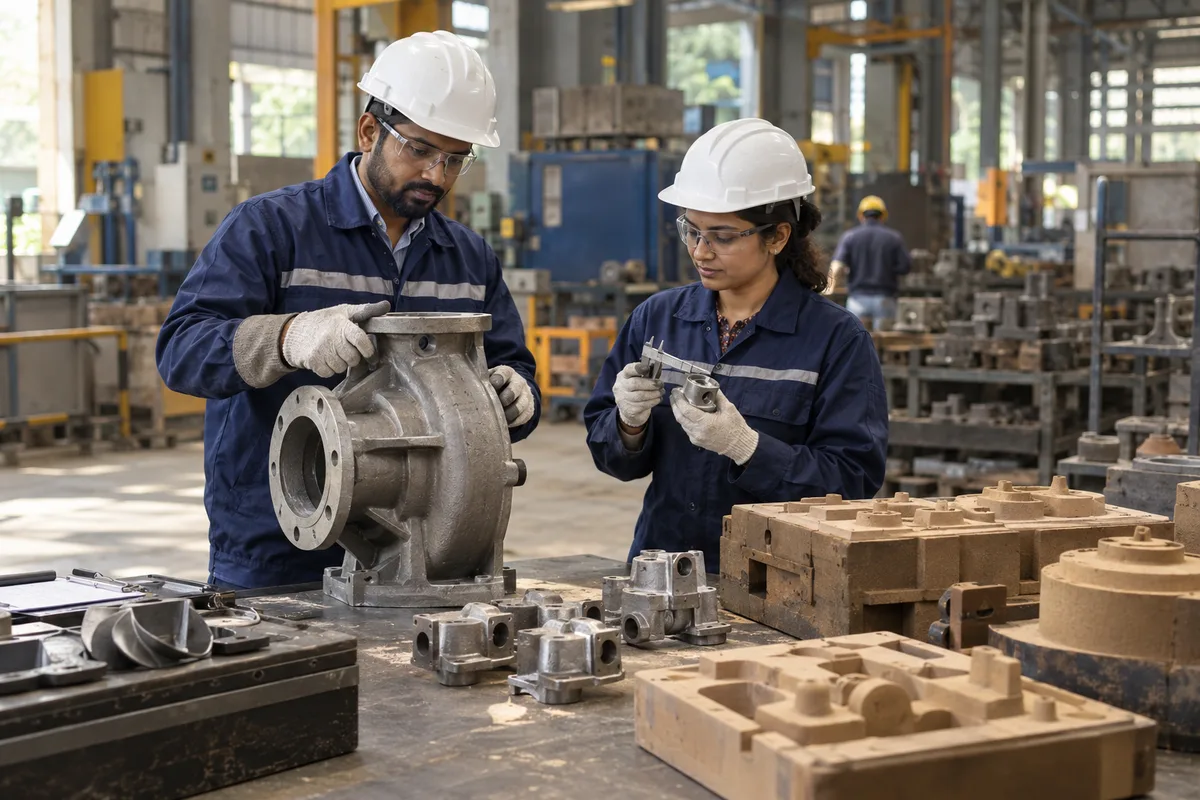
The pattern you choose changes the piece price. A wooden loose pattern is cheap to make, but hand moulding is slower and the castings need more fettling. A metal match plate costs more and runs on the moulding line, faster and more consistently. Which is cheaper depends on how many castings the buyer will buy.
So quote both, and let the totals decide. All figures below are illustrative, for one gearbox housing, and are not market rates.
| Wooden loose pattern, hand moulded | Aluminium match plate, machine moulded | |
|---|---|---|
| Pattern and two core boxes | ₹60,000 | ₹2,40,000 |
| Piece price | ₹1,450 | ₹1,180 |
| Total for 300 castings | ₹4,95,000 | ₹5,94,000 |
| Total for 1,500 castings | ₹22,35,000 | ₹20,10,000 |
| What to expect | Shorter life, dimensions drift as it wears | Long runs, repeatable dimensions |
The two routes cross at about 670 castings. Below that, the wooden pattern wins. Above it, the match plate does. Put that sentence in the quotation. It answers the question the buyer's manager will ask, and a rival who quoted only one route has left it open.
The lines that sit above the piece price
- Pattern and core boxes, with the material and the number of core boxes. A rival quoting one box then visibly quotes less.
- Ownership. Paid in full, the pattern belongs to the buyer. It carries the buyer's part number and stays at your foundry.
- Modifications for a drawing revision are priced when the revision arrives.
- A first-year total at the buyer's quantity, pattern plus castings, for each route.
- For a pressure or gravity die-cast part, the die, its cavities and the shot life your records support.
Fuller wording on ownership, life, transfer and idle tooling is set out for forging dies in die ownership and die life, and most of it carries over to patterns. For where tooling sits in the wider offer, see what to put in an RFQ reply.
When the buyer brings a pattern
A pattern arriving from another foundry is not free tooling. Inspect it before you quote anything into the price. Check that it fits your moulding boxes or your line. Check its condition, the core boxes and the core prints. Then check the shrinkage allowance: a pattern made for one metal may carry the wrong allowance for another, and the castings come out of size.
Report what you find in writing, with the cost of any repair or of mounting it on a match plate. Say plainly that your dimensional responsibility starts from your first approved samples, not from the pattern's history. Heard before the order, this can be planned for. One who hears it after the first rejection feels misled.
Imagine: a Samalkha foundry and a gearbox housing
Imagine a grey iron foundry in Samalkha, Haryana, quoting a gearbox housing for a farm machinery maker in Sonipat. The details are illustrative.
The foundry kept its quote simple: one piece price, with the cost of a metal match plate spread over the first 500 castings and not mentioned. A rival quoted a lower piece price and "pattern extra". Purchase compared the two piece prices and chose the rival. The pattern bill arrived later, and the purchase head had to explain it to the owner.
The next enquiry from the same maker was for a bracket. This time the Samalkha foundry quoted the table above in its own figures. Both routes were priced, with totals at the maker's stated yearly quantity, a line for the two core boxes, and the ownership sentence. The purchase head, stung once by "pattern extra", could now compare like with like, chose the wooden route for a trial lot and asked for the match plate price to stand for when volume grew. The foundry gave up the larger tooling payment for now.
When one line is enough
A repeat part on a pattern you already hold needs no tooling block. Refer to the pattern by its number and state its condition. Standard castings sold from your own patterns need only "pattern ours, no charge". If the buyer pushes for the pattern cost to be dropped, do not cut it. Offer the cheaper route instead, with its shorter life stated. Then the negotiation is about the route, not the rupees.
Re-price one lost quote as a total
Take a casting quote you lost on piece price. Rebuild it with both pattern routes and first-year totals. If your total would have beaten the winner's, you have found where your quotes lose. The rest of the foundry's selling job is on the casting and foundry page, and the quotation itself is proposal development. To set this up for your own quotes, tell us what you need.