Notes for owners · Sales management
Pricing detailing and care packages so customers pick the middle one
How a car detailing studio can set three named tiers with plain inclusions and result photos, so a customer can choose a package in one visit and the middle one earns its place.
The GullySales team · Updated 17 Oct 2026 · 6 min read
On this page
- The reply that loses the customer
- Step one: sort the customers, not the services
- Step two: write what is inside, in the customer's words
- Step three: the reply, rebuilt
- Step four: put photographs where adjectives were
- What to say when a customer asks for a discount
- When this reply does not fit
- Rewrite your own reply today
A customer sends one line on WhatsApp: "Full detailing price?" A bare number or a long list of services can lose the customer. A better reply names three packages, says what is inside each, shows a result, and lets the customer choose. This post takes one invented reply, shows the version that fails, and rebuilds it step by step until the middle package is the sensible pick.
The reply that loses the customer
Here is how an invented studio in Cuttack answers.
Full detailing ₹14,000. Ceramic ₹25,000. Interior cleaning ₹4,500. Rubbing polish ₹6,000. Let me know which you want.
Four prices, no sizes, no inclusions, and a closing line that hands the whole decision back. The customer has no way to rank "full detailing" against "rubbing polish", so the only thing left to compare is the numbers, against the studio near the office. The figures are made up, and the silence that follows is easy to mistake for lost interest.
Step one: sort the customers, not the services
Before rewriting, decide who you are writing to. There are really three car owners at your door.
- The one who wants a clean, tidy car and nothing more.
- The one with a car two or three years old who wants it to look good through a year of city driving.
- The one who wants the best finish you can give, and will pay for hours of machine work.
Each gets a package with a name that is easy to say aloud. Clean, Care and Complete will do, or any three words a customer can repeat at home without checking a note.
Three, not five: three can be compared at a glance. If a sixth service matters, sell it as an add-on to a package, not a new column. Make Care the package you are glad to sell most days, at a margin you like, and make Complete visibly more thorough, not only dearer. A top package that is poor value is a decoy, and customers can tell.
Step two: write what is inside, in the customer's words
Describe results, not chemistry. Under each name, put four or five short lines.
Clean: exterior wash and dry, interior vacuum and wipe, basic protective finish, a photo of the car at handover.
Care: everything in Clean, plus paint decontamination, a longer-lasting finish, and care for leather or fabric inside.
Complete: everything in Care, plus machine correction of visible swirls and your premium coating.
Do not promise how long a finish lasts unless you can stand behind it, and say that results depend on the car's condition and how it is looked after. A lifespan you cannot honour is the quickest way to a complaint.
Step three: the reply, rebuilt
Now the same enquiry, answered again.
Namaste. Which car is it, and roughly how old? We do three packages: Clean, Care and Complete. I am sending one image with what is in each and the price for hatchback, sedan and SUV. If you tell me how you use the car, I will tell you honestly which one suits it.
Attach the image with the three columns and a row of sizes. On the image, the hatchback row might read: Clean ₹2,500, Care ₹6,500, Complete ₹14,000 (invented figures; price from your own cost per car and hours). Count what changed. The reply asks a question before it quotes, which makes it a conversation. It offers a recommendation without hiding the others. It mentions that sizes cost different amounts, so there is no surprise later. And it says "tell me how you use the car", which invites exactly the detail that lets you suggest a package.
One caution: do not write "most owners choose Care" unless your own job cards show it. Whether the middle package becomes your commonest pick is something to read from the cards over a few months, not to assume. In the Cuttack case the first month brings fewer replies than hoped, because some customers still want only a price, and the studio keeps a plain price line for them.
Step four: put photographs where adjectives were
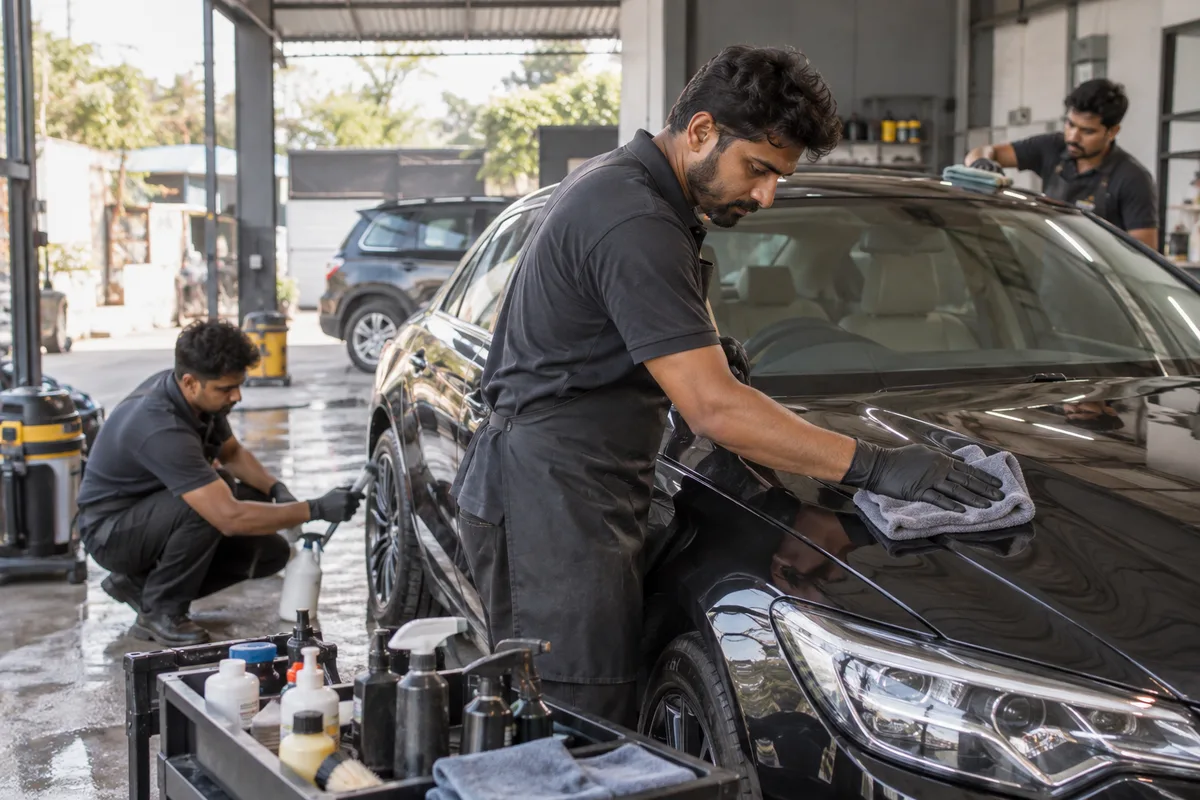
One photograph of a bonnet before and after correction explains the top package better than a paragraph. Take them for every job, in the same light and from the same angle, and keep a folder for each package. Ask the owner before you post any picture that shows a number plate, and cover it.
If you have no photographs of the top package yet, do not offer it. An untested premium package, priced high, teaches you nothing and risks a complaint. Start with two packages and add the third when the pictures exist.
What to say when a customer asks for a discount
The customer who answers "too costly" is usually comparing a package with a cheaper one, not asking you to bleed. Reply by changing the contents, not the price.
I cannot reduce Care, but I can move you to Clean, or drop the leather care and keep the rest. Which would you prefer?
A cut teaches the next customer to ask, and the one after that. A smaller package keeps your price list honest. More wording is in answering the lower-rate request.
When this reply does not fit
If almost all your work is one product, such as a single coating sold at one price with one warranty, a three-column image is decoration. Fleets and dealerships buying detailing for delivery cars want one rate and one standard, negotiated once. Not a menu. And if the middle package is cheap for you to deliver but dear for the customer, the customer may sense it. The structure only works when Care gives something real that Clean lacks.
Rewrite your own reply today
Open your last ten WhatsApp quotes. Find the one that looks like the Cuttack reply, and rewrite it using the four steps. Then send it to the next customer who asks. The detailing studio pages cover the wider picture, and pricing and packaging strategy is the service for the structure. To work it out for your studio, tell us what you need.
Related services
Industries