Notes for owners · Industry playbooks
What parents check before choosing a gymnastics academy
Parents judge the mats, the pit, the beam height and the supervision before the coach. Show the hall online and half the visit is decided.
The GullySales team · Updated 13 Nov 2026 · 7 min read
On this page
- The walk-through a parent does, in order
- Put the hall online, because the visit is decided before it is booked
- Three parents, three products, three pages
- Say the honest thing about injuries
- The showcase is your enrolment event
- What do parents ask about the coaches?
- What do they ask about the fee?
- How do you speak to the child?
- What do parents ask about the other children?
- Keeping the family after the first term
- What do they ask about progress and levels?
- What do they ask about kit and the day itself?
- What to do next
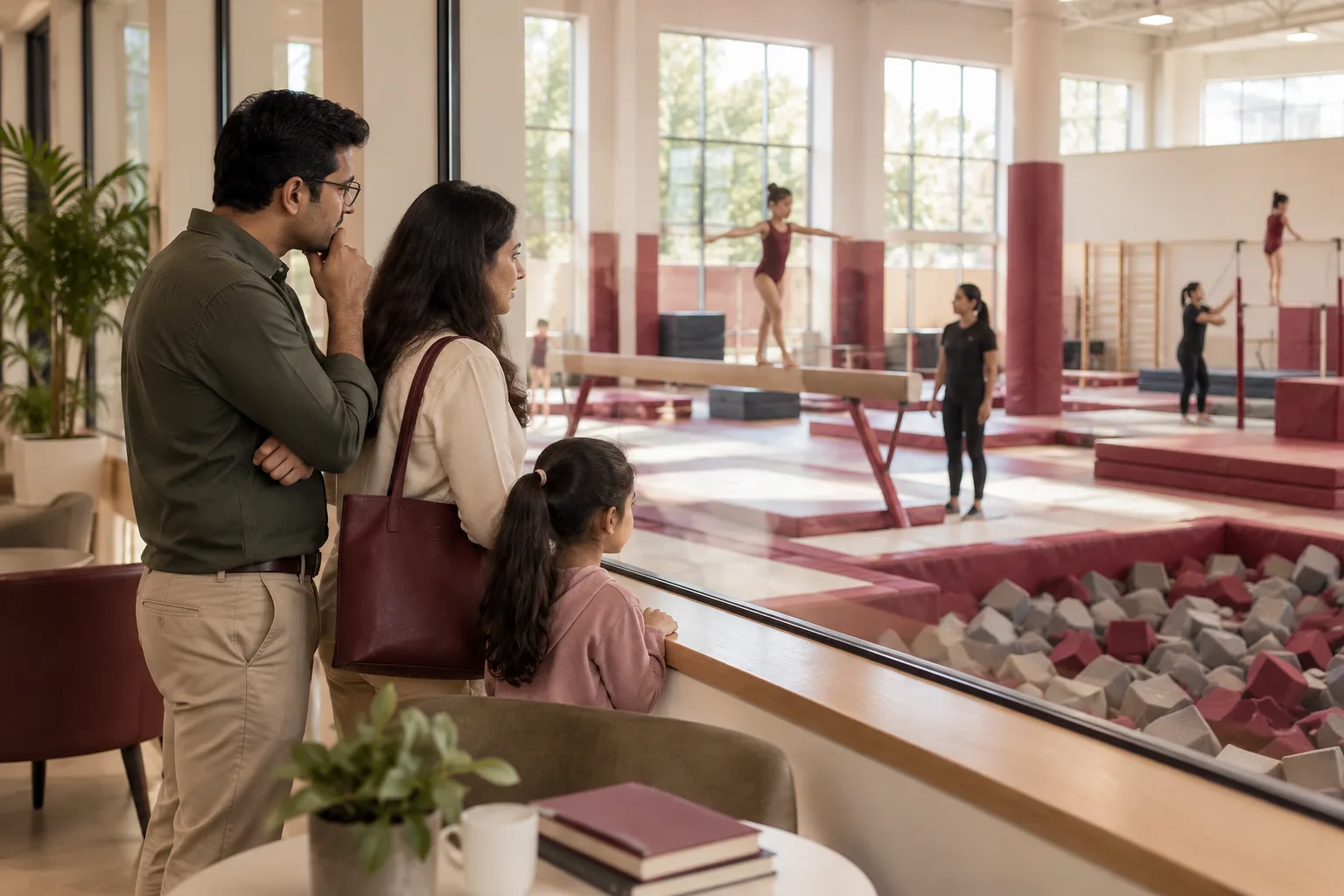
A parent choosing a gymnastics academy checks the equipment before the coaching. They look at the thickness of the mats, whether the beam is low for beginners, what is under the bars, how clean the floor is and whether anyone is actually watching the children at the far end of the hall. Then they ask what happens if their daughter falls. Answer that walk-through online, with photographs and a plain safety note, and most of the decision is made before they arrive.
The walk-through a parent does, in order
- The floor and the matting, and whether the mats are taped down or sliding about.
- The height of the beam the beginners use, and what is on the ground beside it.
- The landing area under the bars and the vault.
- The pit, if there is one, and how often it is turned over.
- How many children are on the floor and how many adults.
- The waiting area, the drinking water and the toilet.
- Whether the coach notices a child who is struggling at the back.
None of that is marketing. It is your hall on a Tuesday evening, and the academy that photographs it honestly is the one the parent shortlists.
Put the hall online, because the visit is decided before it is booked
Most gymnastics websites show a logo, a stock photograph of a girl on a beam and a contact form. A parent cannot tell whether the hall is a basement with a mat or a proper set-up with apparatus.
Shoot six photographs in daylight: floor, beam, bars, landing area, waiting space, toilet. Add a short video walking from the door to the floor, narrated by a coach saying what each piece of equipment is for. Then write the ratio for each batch beside the timing. A video like that takes one morning and answers the question that otherwise needs a visit.
Three parents, three products, three pages
| Programme | Who the buyer is | What they want to read |
|---|---|---|
| Toddler and preschool | A mother of a two to four year old | Whether they stay, how long the session is, what happens if the child cries |
| Recreational, school age | A parent after an after-school activity | Timings against school hours, ratio, what the child learns in a term |
| Competitive squad | A parent of a selected child | Training hours, who coaches, competitions entered, what is expected of the family |
Write a page for each and say who it is not for. A toddler page that admits this is not a competitive class, it is forty minutes of climbing and rolling, will bring you the right parent and save your coaches an argument later.
Say the honest thing about injuries
Gymnastics involves falling. Pretending otherwise insults the parent standing in front of you, who has already thought about it.
Write down what you do: how a skill is broken into stages, what mats and spotting are used at each stage, when a child is allowed to try something alone, who is trained in first aid and what the procedure is when somebody is hurt. Say that you tell the parent the same day, every time. That page will do more for enrolments than any photograph of a medal.
For example, an academy in a converted warehouse in Kukatpally, Hyderabad, running toddler, recreational and squad batches. The particulars are made up. Parents arrive at the door already uneasy because the entrance is through a service lane, and nobody has thought to photograph the inside, which is bright and well equipped. The entrance is not the problem. The absence of a single photograph is.
The showcase is your enrolment event
Twice a year the hall fills with grandparents and cousins holding phones. Those guests are the warmest audience you will ever have.
Ask every family to bring one guest and take the guest's name at the door. Put a coach on the trial desk, not a flyer on a table. Offer the guests a dated trial slot rather than come any time, because a dated offer is kept and a vague one is not. Send the photographs out the next day with the consent you collected, and ring the guest list that week. More on how the parts connect is on our page for gymnastics academies.
What do parents ask about the coaches?
A parent watches the coach more closely than the apparatus. They want to know who qualified the coach, whether the coach has worked with children of this age, and how the coach speaks to a child who is scared. Put each coach on the website with a photograph, a name, the qualifications they hold as they appear on the certificate, and a line about the age groups they teach. Do not exaggerate. A coach introduced honestly is easier for a nervous child to meet.
Say who is in the hall for each batch and what happens when the regular coach is away. If a substitute is used, tell parents on the day. A parent who finds out later feels deceived.
What do they ask about the fee?
The fee is a decision for the whole household. Say what a term costs, what is included, what is extra (competition entries, costume, a leotard, a registration fee) and what happens if the child misses classes through illness. Explain the trial: what it costs, what the child does in it, and how the parent hears the coach's opinion afterwards. A parent who knows the full cost on the first call does not feel tricked at the second.
How do you speak to the child?
The child has a say. A trial class works when the coach crouches to the child's height, learns the name, and lets the child try the lowest beam before anything else. Warn the parent not to promise a treat for being brave. A child who feels pushed on the first day does not return. Ask the parent to wait where the child can see them, and to leave the coaching to the coach.
After the trial, the coach tells the parent one thing the child did well, in plain words, and one thing to work on. Parents remember the first.
What do parents ask about the other children?
Parents look at the other children in the hall: how old they are, how they behave, whether the older ones help the younger. They ask about batch size and whether children of different levels share the floor. Describe how batches are formed by age and level, and what the child will do if the others are further ahead. A hall where children encourage each other is something a parent notices within a minute.
Keeping the family after the first term
Children drop out when they feel stuck and parents stop seeing progress. Tell parents what skills the term covers, and send a short note at the end of the term naming what the child has learned. Hold a small display for families where each child shows one thing. Ask parents for feedback and do something with the answers. A family that feels informed renews its place without being chased.
What do they ask about progress and levels?
Parents like a clear ladder. Tell them the names of the levels, what a child can do at each, and who decides when a child moves up. Say that children move at different speeds and that the coach explains why. A parent who knows the next step can see progress in the child's work, and a child who can name the next skill has a reason to come back. Put the ladder on one page, with a photograph for each level, and give a printed copy to every family at the trial.
What do they ask about kit and the day itself?
On the first visit parents ask what the child should wear, whether hair must be tied back, what to eat beforehand and whether a parent can stay. Answer these in the booking message: comfortable clothes without zips, hair tied, a light snack an hour before, a water bottle. Say where parents wait and whether they can watch. A parent who arrives knowing these things is calm, and a calm parent makes a calm child.
What to do next
Start with the photographs, because they cost nothing but a morning and they are what a parent sees first. Then the three pages. Then the safety note, written with your head coach in the coach's own words rather than yours.
Skip the Olympic pathway language entirely. A small academy promising elite progression invites a comparison it cannot win, and the parent you actually want is choosing between you and a dance class, not between you and a national centre. Skip paid promotion as well until the photographs exist, because sending a parent from an advertisement to an empty website wastes the click.
Then ring the families whose children finished a level last term and never came back, and ask why. Those answers are the most useful hour you will spend. If you want the whole path from enquiry to enrolment looked at properly, tell us what you need and that is where we start.
Put the reading to work
Try this with your own records.
Define the organisations or buyers you can serve and the reasons they would consider a conversation. Bring examples of accepted and rejected prospects so the selection rule is visible.
How to review the result
Review why a prospect was selected and what was learned from the response. Count held, relevant conversations separately from contacts found, messages sent, or meetings booked.