Used car dealers · Buyer persona
Know which kind of buyer walks in before the first car is shown.
A buyer persona for a used car dealer describes who is buying, what the car must do for them and what makes them hesitate. GullySales builds personas from your own sales records and desk notes, then uses them to shape replies, photographs and the order cars are shown in.
Scope, fee, reporting and term are agreed in writing after we have read your brief and spoken to you.

What buyer persona means
A buyer persona is a plain description of the kind of customer who actually buys from you. It includes what they search, what worries them and who else they ask before deciding. GullySales builds this from real enquiries and past sales rather than a generic template, then uses it to write every page and advert.
Last updated 14 Nov 2026.
For used car dealers
Where it usually goes wrong, and what we would do.
“The first-time buyer and the upgrader want different things”
A first-time buyer asks about the monthly figure, running cost and who will service the car. An upgrader asks about the previous owner and the market value of the old car. One script for both loses each of them.
“The person paying is not always the person asking”
A son researches online, a father decides, and a spouse judges the interior. The enquiry may come from one person while the decision is made by three. Replies that address only the sender miss the people who decide.
“Budget is stated as a monthly figure”
Some buyers think in the instalment they can carry, not the price of the car. A persona that records the monthly range tells the desk which cars to show and which to leave in the yard.
“Business buyers want the car to earn”
A taxi operator, a delivery owner or a small trader asks about mileage, fuel type and how fast the car can be back on the road. Their questions differ sharply from a family buying for weekend use.
What we do
What we deliver for used car dealers.
The work available for this need. We agree the deliverables and responsibilities for your engagement in writing.
Persona sheets from your sales records
Two to four buyer types drawn from the last sold cars, covering budget, car type, finance need, who decided and what delayed the purchase.
Result: You can match any recent buyer to a sheet.
Questions each persona asks
A list of the doubts and objections for each type, with the answer your desk gives and the proof that backs it.
Result: A new salesperson can answer as the senior one does.
Stock matched to personas
A tag on each car showing which buyer type it suits, so the right car is shown first.
Result: The first car shown is chosen, not guessed.
Reply templates per persona
First messages that open with the point that buyer type cares about: instalment, history, resale or running cost.
Result: Replies sound written for the person who enquired.
Where each persona comes from
A note on which portal, ad or referral brings each buyer type to you, based on your lead records.
Result: You can see which source brings which buyer.
A review rule for updating
A short check against new sales so the sheets change when the buyers do.
Result: The sheets reflect recent sales, not an old guess.
How the result is measured
- Enquiry match to persona
- Conversion rate by persona
- Content aligned to persona
Recorded as a baseline before work starts, so every later report has an honest comparison.
Who is asking
Six kinds of buyer walk into a used car lot, and each asks something else first.
- First-time buyer moving from a two-wheeler
- Wants to know what is safe to buy, what the monthly cost will be and who will explain the papers. Show a simple budget and a patient walk-through.
- Upgrader with a car to exchange
- Asks first what the old car is worth and how the exchange affects the price. Value the car in front of the buyer and keep both prices clear.
- Parent buying for a son or daughter
- The person paying is not the person driving. Ask what the driver needs, and give the parent the condition note and the running cost.
- Business buyer needing a car that earns
- A taxi or small-business buyer who asks about running cost and resale. Show the service record and the cost of the commonly replaced parts.
- Buyer who has seen the car on a portal
- Arrives with a price in mind and a doubt about the photographs. Welcome the visit and show the car as it stands.
- Buyer sent by a broker or a friend
- Expects the price and treatment the referrer described. Greet by the referrer's name and keep the promise.
Who it is for
This is written for these used car dealers.
- Independent used car dealers
- Multi-brand pre-owned showrooms
- Dealers specialising in one segment
- Franchise pre-owned outlets
- Online-first used car sellers
- Dealers who also broker and consign
Before you decide
When this may not be the right fit.
- You have sold few cars so far, and the sales records do not yet show a pattern a persona could be built from
- You want one script for every buyer, but a persona is only useful if the desk says something different to each kind
Before you decide
Agree the work. Know how to judge it.
Buyer personas for used car dealers: use these checks to prepare, choose the scope, and review what changes.
Bring the right evidence
Write the decision the research must support, such as entering a market or choosing a buyer group. Separate what you know from sales records from what the team currently assumes.
Make the scope clear
Agree which buyers to speak to, which sources to review, and what access you can provide. Include lost enquiries and people who chose another supplier, where they are willing to take part.
Check the work in use
Look for source dates, sample limitations, and evidence that disagrees with the preferred answer. A recommendation should show how it follows from the findings.
Know when to change course
Do not treat a few positive conversations as proof of demand. Test the proposed offer with an actual buying decision before committing to a wider launch.
These are discussion points, not a fixed package. GullySales confirms the deliverables, responsibilities, fee, and term in writing after reading your brief and speaking with you.
Before we start
What to have ready before the work starts.
The records, access and decisions this work needs from used car dealers. Anything missing is noted in the written scope, with who will supply it.
- The sales book with the car and buyer details
- We need a sample of the sales book with names masked, showing the car, price band and how it was paid for. Photographs are acceptable. Without it, personas rest on memory of recent, loud sales.
- Notes on lost enquiries
- The lost enquiries teach more than the sales. A column of reasons is enough. If none exist, salespeople start one now, and the lost-enquiry reading waits for it.
- Consent to phone three recent buyers
- You must first message those buyers and ask whether they agree to a short call. We never ring anyone without that. If none agree, the sheets rely on records and say so.
- Which buyer the lot wants more of
- Tell us which cars and buyers the lot wants to attract. Without a view, we weigh by volume of sales, and you correct us later.
- A salesperson for a mock call
- One salesperson rehearses the reply cards with us. Without a mock call, the cards read well on paper and fail at the first real enquiry. A short call of this kind also shows us how the dealership sounds to a first-time buyer.
How it works
How the buyer persona work runs
The work itself, in order. How an engagement starts, from your brief to a written scope, is set out on our method page.
- 1
Sort last season's sales by who chose
We take the sales book and ask the salespeople for a sample of buyers: who chose the car, who paid, who attended the visit and what the budget was as an instalment. You choose the sample so it includes quick sales and slow ones. The result is a set of real cases behind each persona.
- 2
Read the lost enquiries for what stopped the sale
We read the enquiries that did not become sales and the notes the salespeople made, looking for what the buyer was still weighing. You help us separate real doubts from silence. The step ends with a list of reasons in buyers' own words, grouped by kind of buyer.
- 3
Ask three recent buyers what they compared
With your permission we phone a few buyers and ask which cars they compared, who they asked and what decided them. You approve who is contacted. Notes are kept without names. The result is a handful of accounts that correct our guesses.
- 4
Write one sheet for each kind of buyer
We write the first-time buyer, the upgrader, the family and the small business, each stating what the car must do, who else is in the decision and what makes them hesitate. The salespeople correct what rings false against buyers they remember, and you sign off the set only after each sheet has been read aloud at the desk and recognised.
- 5
Match the stock and replies to each sheet
We mark which cars on the lot suit which sheet and write a first reply for each, speaking in the buyer's terms, such as the instalment the buyer can carry. A salesperson tries them. You decide what must never be said. The step ends with a reply card per persona.
- 6
Check the sheets against new enquiries
A salesperson marks the sheet each new enquiry fits and notes whether the reply worked. We read the marks against the earlier record at a point you choose. You see which sheets hold and which need rewriting, and where enquiries ended in a sale.
Where this fits
Three pieces of sales work, in this order.
This work sits inside sales process design, at stage 0, foundation. The audit comes before it, and sales management keeps it running.
Step 1
Sales audit
Find where deals are being lost and what to fix first.
Start here if you cannot say where orders are lost.
Step 2 · you are here
Sales process design
One written way to sell, from first enquiry to repeat order.
Start here if every salesperson sells differently.
Step 3
Sales management
A target, a review routine and someone who owns the number.
Start here if the team has targets and no routine.
FAQ
Questions owners ask before they call.
Not here? More answers, or ask on WhatsApp.
How do I find out who my buyers are?
Is a buyer persona just a list of past buyers?
How many personas does a lot need?
Should the personas differ by car segment?
How do we use a persona on the lot floor?
Do the personas change with the car segment?
How much does it cost?
How long is the contract?
How soon will we see results?
Who will actually do the work?
From the blog
Further reading for used car dealers.
 5 min read · 6 Oct 2026How used car dealers move ageing stockA used car that sits unsold costs you every day. Find out why it is not selling, fix the cause before cutting the price, and reach buyers who asked.
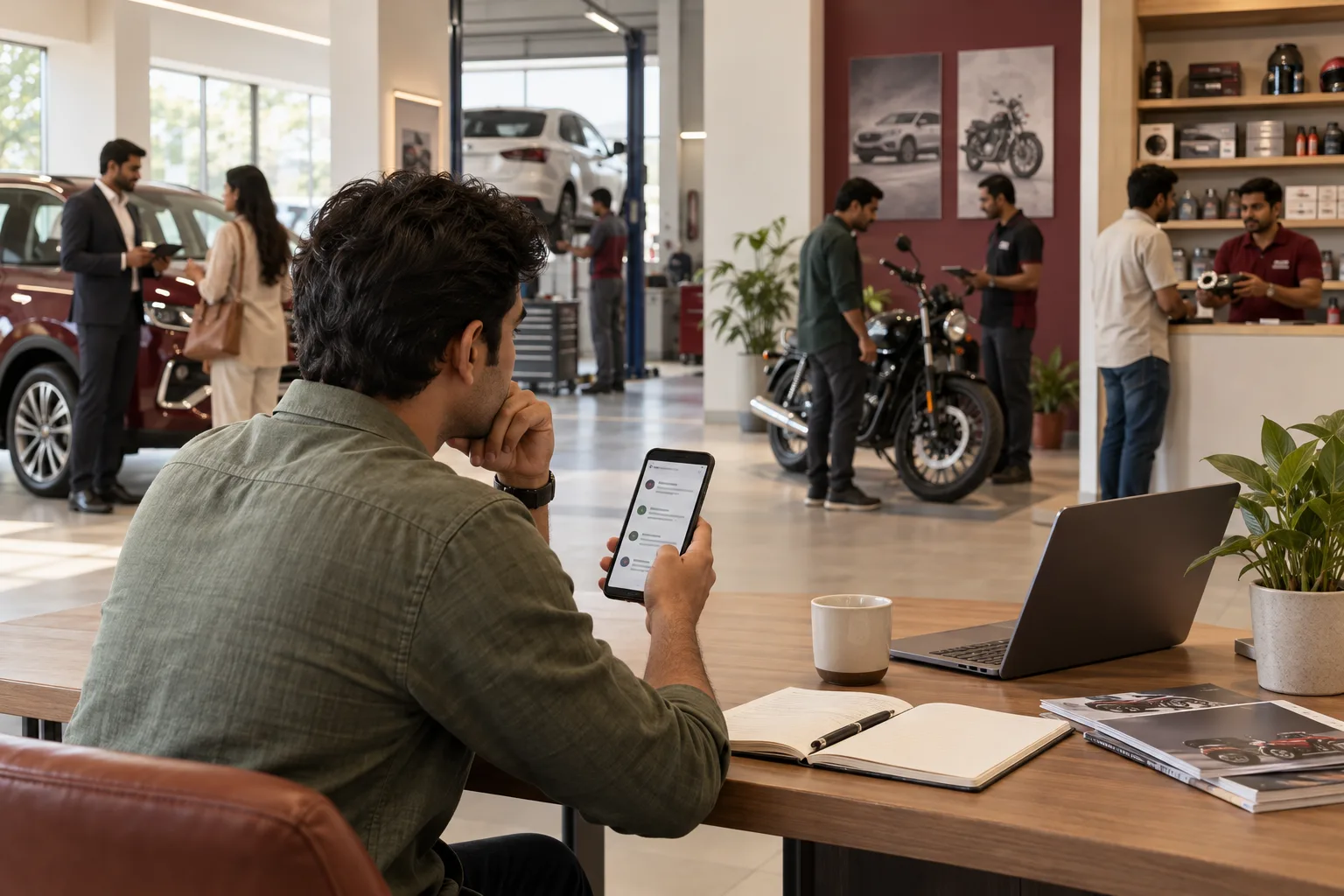 6 min read · 6 Oct 2026How buyers choose a showroom, workshop or parts counterCar, bike, repair and parts buyers send one enquiry to several sellers and pick the first clear answer. See what each buyer checks and where you lose them.
 7 min read · 19 Feb 2026How used car dealers should answer portal enquiriesThe same portal enquiry reaches three dealers. The one who replies first with photographs, ownership details and an EMI figure gets the test drive.
More for used car dealers
Related work to consider.
Closest to this: strategy and research
Also for used car dealers
Or start from the overview: sales and marketing for used car dealers.
Your next practical step
Tell us what you are trying to grow, and we will read it before we call.
Eight short steps, mostly taps. Skip anything you would rather answer on the call.