Coaching centres and tutors · Geographic market research
Open the second branch where your students already live, not where rent is cheap.
Geographic market research for a coaching centre compares localities, towns or districts to decide where a new branch, a new batch timing or an online push belongs. GullySales maps where your students come from today, checks the schools and rival institutes around each candidate area, and writes a ranked list with the gaps in the evidence stated.
Scope, fee, reporting and term are agreed in writing after we have read your brief and spoken to you.
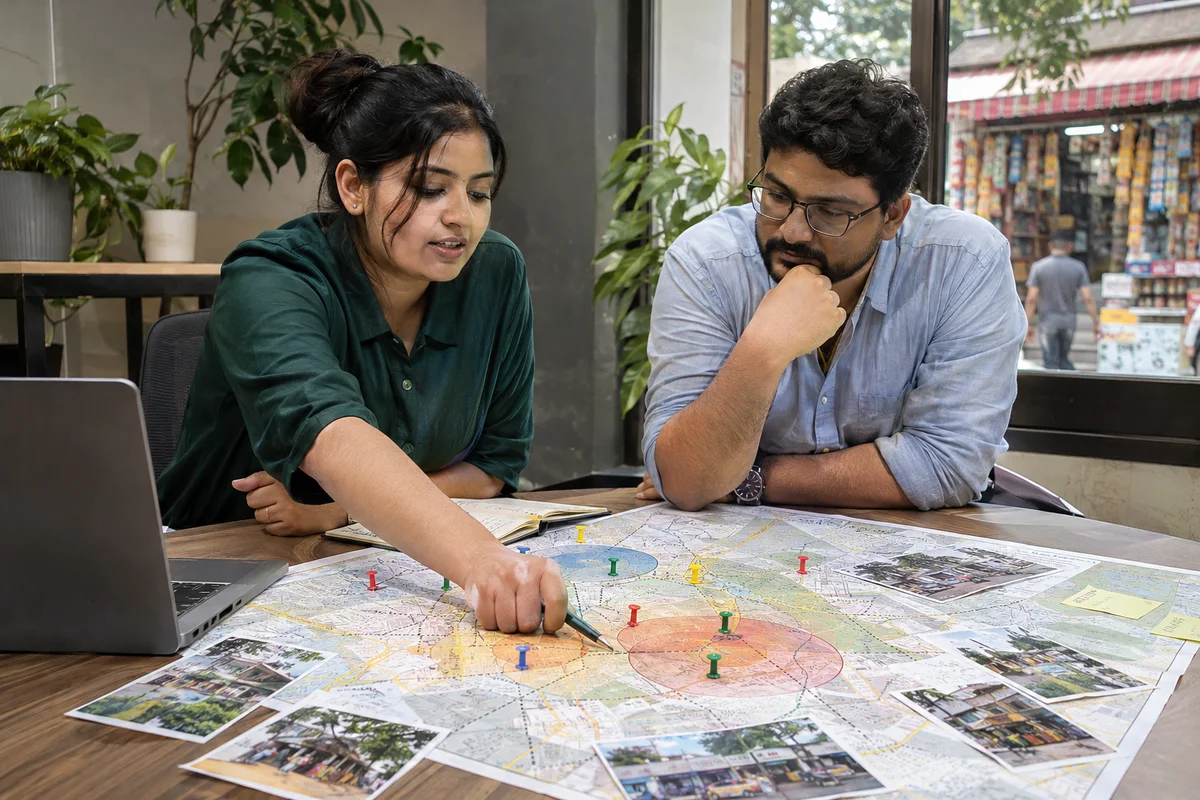
What geographic market research means
Geographic market research compares cities, districts or states to decide where a business should open, supply or push next. GullySales gathers local demand signals, competitor and dealer presence, language and delivery reach for each place, and writes a ranked shortlist with the reasons and the gaps in the evidence.
Also for coaching centres and tutors
- Digital marketing for coaching centres and tutors
- Buyer persona for coaching centres
- Annual marketing planning for coaching centres and tutors
- Workshop and seminar marketing for coaching centres and tutors
- Customer acquisition strategy for coaching centres and tutors
- Marketing data management for coaching centres and tutors
- Pricing research for coaching centres and tutors
- Apartment advertising for coaching centres and tutors
Sales and marketing for coaching centres and tutors, the overview.
Last updated 14 Nov 2026. Rules for this trade differ by state and professional body, and they change. We describe restrictions in general terms, so check the current position with your own council or adviser before you publish anything.
For coaching centres and tutors
Where it usually goes wrong, and what we would do.
“Students travel by school bus, auto and cycle, not by map distance”
A centre two kilometres away across a railway line or a flyover may be harder to reach than one four kilometres down a straight road. The catchment is drawn by how the child gets home after school, and only a visit to the route shows it.
“The nearest schools decide the batch timings”
A school that finishes late in the afternoon pushes tuition into the evening. A branch near a school with early dismissal can run a daytime batch. Research starts at the school gate, with the timetable of each school in the area.
“A crowded street of institutes can be a signal or a trap”
A lane full of tuition boards shows that parents already look there. It also shows that a new name competes for attention on the same pavement. Whether it helps depends on what the other centres teach and which boards and exams they cover.
“Entrance coaching travels further than school tuition”
An aspirant will take a bus or a train for a respected faculty, and may move to a hostel. For that, the question is less about the next locality and more about which towns send students and where they stay.
What we do
What we deliver for coaching centres and tutors.
The work available for this need. We agree the deliverables and responsibilities for your engagement in writing.
Student origin map
The addresses of your current students plotted by locality from your admission register, with the nearest school and the travel mode noted where families tell you.
Result: You see the real catchment of your existing centre.
Area comparison sheet
Two to five candidate localities or towns compared on schools within reach, boards followed, the institutes already present and the courses they list, from public listings, school websites and site visits.
Result: Each candidate is judged on the same questions.
Competitor walk and call notes
A visit or enquiry call to each rival centre for its published batch timings, teaching method and the way it presents fees, written as a record and not as a ranking of quality.
Result: You know what a parent in that area hears before reaching you.
Language and board fit
A note on which medium of instruction and which board, CBSE, ICSE or the state board, dominates each area's schools, set against what you teach.
Result: A branch is not opened in front of the wrong syllabus.
Ranked shortlist with reasons
A written recommendation naming the places in order, the evidence behind each position, and what remains unverified, such as a lease or a faculty hire only you can confirm.
Result: A decision document you can take to your partners.
How the result is measured
- Places compared and sources used for each
- Existing orders and enquiries by place, from your own records
- Competitors and dealers verified by call or visit
Recorded as a baseline before work starts, so every later report has an honest comparison.
Who it is for
This is written for these coaching centres and tutors.
- School tuition centres for CBSE, ICSE and state boards
- Home tutors and individual subject teachers
- JEE and NEET entrance coaching institutes
- State entrance coaching for KCET, MHT CET and similar exams
- Government exam coaching for UPSC, state PSC, bank and SSC exams
- Commerce coaching for CA, CS and CMA foundation levels
- Language, spoken English and IELTS or PTE coaching centres
- Study abroad and overseas education consultants
- College admission and career counselling advisers
- Online and hybrid tutoring businesses
Before you decide
Agree the work. Know how to judge it.
Geographic market research for coaching centres and tutors: use these checks to prepare, choose the scope, and review what changes.
Bring the right evidence
Write the decision the research must support, such as entering a market or choosing a buyer group. Separate what you know from sales records from what the team currently assumes.
Make the scope clear
Agree which buyers to speak to, which sources to review, and what access you can provide. Include lost enquiries and people who chose another supplier, where they are willing to take part.
Check the work in use
Look for source dates, sample limitations, and evidence that disagrees with the preferred answer. A recommendation should show how it follows from the findings.
Know when to change course
Do not treat a few positive conversations as proof of demand. Test the proposed offer with an actual buying decision before committing to a wider launch.
These are discussion points, not a fixed package. GullySales confirms the deliverables, responsibilities, fee, and term in writing after reading your brief and speaking with you.
Before we start
What to have ready before the work starts.
The records, access and decisions this work needs from coaching centres and tutors. Anything missing is noted in the written scope, with who will supply it.
- Present students by home and school
- Provide the register with each student's home locality and school. A column added by the counsellor is acceptable. A parent's workplace, if the counsellor knows it, also helps, since some families choose a centre near work. Without it, the map of where students come from is drawn from guesswork, and a new place may look attractive only because it is near the owner's house.
- The places you are already considering
- Write the localities, towns or districts you have in mind and why. An owner's list is the right start. If you have none, we begin with places where current students already live, and the research is narrower but is based on the register.
- What a new branch could cost you
- Tell us the limits of what you can consider, such as a rent you cannot cross or teachers who cannot travel. A rough sentence is enough. Without limits, the research ranks places you could never afford to open, and the work ends in a list you cannot use.
- The teachers' travel and timing limits
- Say which teachers can teach at another site, at what hours and how far they will travel. Only they and the owner know. Include the days they teach elsewhere, if any, and any exam duty. If this is unknown, a place may rank first on demand and fail on staffing in the first month.
- Permission to phone rival institutes
- Decide whether we may call nearby centres as a parent would to ask about batches and fees, and what we say if asked who is calling. The owner alone gives this approval. When it is declined, we rely on published information and visits, and rival batch sizes are less certain.
How it works
How the geographic market research work runs
The work itself, in order. How an engagement starts, from your brief to a written scope, is set out on our method page.
- 1
Write the decision the research must settle
Before any map is drawn we sit with the owner and write the decision in one sentence, such as whether a second branch belongs in a named locality, whether a batch timing suits a school's closing hour or whether an online push is worth building. You choose the places to be compared. We also write what would make you drop a place at once, such as no feeder school within reach of a bus route. The question and the shortlist of places are signed before work starts, so that evidence is gathered for a decision.
- 2
Map the addresses of present students
From the register we place every current and past student on a street map by home and by school, and mark how each travels, whether by school bus, auto, cycle or on foot. You correct the map where you know a family has moved. Students who travel by school bus are marked separately from those who come on their own, because the bus route sets their reach. What exists afterwards is a picture of how far your students really come, which is different from the circle on the map.
- 3
Count schools and timings per place
For each place on the shortlist we list the schools nearby, the boards they follow, the hours classes end and the exam classes they run, from the schools' own notice boards and published lists. You add what you know from teaching. The result is a sheet comparing places by who is there to teach and when the children are free.
- 4
Walk the streets and phone the rivals
We visit each place on foot at the hour children leave school and note the institutes, their boards, their batch sizes and how crowded the road is, and the counsellor phones a few as a parent would. You decide whether a crowded road is a sign of demand or a warning. We photograph hoardings and boards only where they are public, and we do not enter any centre uninvited. The notes are dated and written without names of persons.
- 5
Score the places against your own centre
We score each place on the facts gathered: students already nearby, schools within reach, language and board fit, rival presence and how easily your teachers can get there. You change a score where you hold information we do not. Places where your teachers would have to travel far are marked, since staffing decides what can be opened. Scores come with the reason beside them, so the owner can argue with the reasoning and not the number.
- 6
Rank the shortlist and name a step
We present the places in order with what is known, what is not known and the one cheap thing to try before committing, such as a demo class or a stall. You decide. The work ends with a written reading of the evidence and no promise of student numbers, and the next step is something you can start without waiting for us.
Where this fits
Three pieces of sales work, in this order.
This work sits inside sales process design, at stage 0, foundation. The audit comes before it, and sales management keeps it running.
Step 1
Sales audit
Find where deals are being lost and what to fix first.
Start here if you cannot say where orders are lost.
Step 2 · you are here
Sales process design
One written way to sell, from first enquiry to repeat order.
Start here if every salesperson sells differently.
Step 3
Sales management
A target, a review routine and someone who owns the number.
Start here if the team has targets and no routine.
FAQ
Questions owners ask before they call.
Not here? More answers, or ask on WhatsApp.
Can you tell us the number of students a new area will give us?
Is this useful for a home tutor with no premises?
Can this research choose between two towns?
How current is the information about rival centres?
How much does it cost?
How long is the contract?
How soon will we see results?
Who will actually do the work?
What do you need from us?
What if we are not happy with the work?
From the blog
Further reading for coaching centres and tutors.
 5 min read · 6 Oct 2026How families and companies choose between institutesA parent, a student, a candidate and an HR head each pick an institute differently. Who decides, what each checks and what admissions should have ready.
 8 min read · 21 Sept 2026Radio advertising in BengaluruWho listens to radio in Bangalore, and where: the evening traffic crawl, the auto driver's station, shop counters with FM on, and reach past the city.
 8 min read · 21 Sept 2026Metro advertising in BengaluruNamma Metro sells three audiences under one name: people in the station, people in the train and drivers under the viaduct. Which to buy, and why.
More for coaching centres and tutors
Related work to consider.
Closest to this: strategy and research
- Digital marketing for coaching centres and tutors
- Buyer persona for coaching centres
- Annual marketing planning for coaching centres and tutors
- Workshop and seminar marketing for coaching centres and tutors
- Customer acquisition strategy for coaching centres and tutors
- Marketing data management for coaching centres and tutors
- Pricing research for coaching centres and tutors
Also for coaching centres and tutors
Or start from the overview: sales and marketing for coaching centres and tutors.
Your next practical step
Tell us what you are trying to grow, and we will read it before we call.
Eight short steps, mostly taps. Skip anything you would rather answer on the call.