Coaching centres and tutors · Metro advertising
Put one course and one exit on the wall the student walks past on the way to class.
Metro advertising for a coaching centre places a panel at the station exit, on the platform or inside the train where students and young professionals travel to class. GullySales matches stations to your students' routes, books through the metro's appointed agency and records which passengers responded.
Scope, fee, reporting and term are agreed in writing after we have read your brief and spoken to you.

What metro advertising means
Metro advertising buys space in metro stations or trains, including pillar wraps, platform panels, and screens near the gates. GullySales selects stations around your buyers' journeys, checks availability with the appointed advertising agency, coordinates booking and artwork approval, and puts a response route on the advertisement so your team can record enquiries.
Also for coaching centres and tutors
- Apartment advertising for coaching centres and tutors
- Newspaper advertising for coaching centres and tutors
- Outdoor advertising for coaching centres and tutors
- PPC advertising for coaching centres and tutors
- Brochure and flyer distribution for coaching centres and tutors
- Door-to-door promotional campaigns for coaching centres and tutors
- Billboard advertising for coaching centres and tutors
- Auto rickshaw advertising for coaching centres and tutors
Sales and marketing for coaching centres and tutors, the overview.
Last updated 14 Nov 2026. Rules for this trade differ by state and professional body, and they change. We describe restrictions in general terms, so check the current position with your own council or adviser before you publish anything.
For coaching centres and tutors
Where it usually goes wrong, and what we would do.
“The student travels, and the parent does not”
Metro advertising reaches the person making the journey, who is the student or the working learner. For senior school, entrance and college-level coaching, that reader has a say in the choice and is the one who first sees your name. For a tuition centre serving small children, the parent decides and rarely rides the metro to your door, so the station may be the wrong place to spend.
“A station is useful only near a journey to your door”
A panel at an interchange with heavy traffic is not a good buy if none of your students pass through it. The right station is the one where students get off to reach the centre, or the one on the route from the colleges and schools around you. We start from where your current students board and alight, and let the station list follow that.
“Reading time on a platform is short and uneven”
A student waiting for a train has a few moments with a platform panel. A passenger walking through the gates has fewer. The message must name one course, one place and one next step, and it must survive being read in motion. Long lists of subjects, a row of batch timings and a wall of small print are ignored and sometimes cannot be read at all.
“The metro authority controls the property and the wording”
The metro authority owns the space and sells advertising through an appointed agency, with its own rules on content and approval. Claims about results, ranks and admissions are examined by authorities, and education advertising rules differ by state and profession, so your own adviser decides the wording. A panel that fails the approval stage costs production time and sits unused when the batch opens.
What we do
What we deliver for coaching centres and tutors.
The work available for this need. We agree the deliverables and responsibilities for your engagement in writing.
Station and exit shortlist
A written list links each station to your students' routes, naming the exit nearest your centre and the exits students use from nearby schools and colleges. You can see why a station is on the list, which exit matters and why other stations were left off, with the evidence taken from your own enrolment records.
Result: Each station on the list can be justified by a route your students take.
Format comparison for the same period
Pillar wraps, concourse panels, platform positions, escalator-side boards and in-train panels are compared for the same display period, with quoted rates and the sort of reading position each creates. An in-train panel travels beyond one catchment and is assessed separately from a station-exit panel.
Result: Two positions can be compared on the same table, same dates and same terms.
Rights and agency check
We ask which party holds the advertising rights for each surface, what those rights cover and when they end. The booking names the party supplying the placement instead of assuming one agency controls every surface in the network. You see this in writing before any payment is made.
Result: The booking names the exact party supplying each placement.
Booking and production schedule
The agreed site, format, rate and display period are recorded with the dates for artwork and printed material. You approve the purchase against that record. The installation arrangements supplied by the agency, including who mounts the panel, are written beside the schedule.
Result: The schedule gives a dated deadline for every artwork and material step.
Artwork and approval pack
A proof and production files follow the supplied sizes and material specifications. Any claim about results or admissions goes to your own adviser, and the supporting documents go through the appointed agency for authority approval. Nothing is printed until your sign-off and the agency's approval are both in hand.
Result: The approved proof and the printed panel carry the same wording.
Installation evidence and response record
Dated photographs show the panel in place at the start and part-way through the display. A campaign phone number, QR code or station-specific batch code gives interested students a next step, and the record shows which responses were genuine enquiries and which became demo attendees or admissions.
Result: You can match each station panel to the responses it produced.
How the result is measured
- Booked positions and creative verified through dated photographs
- Display days delivered against display days purchased
- Campaign calls and scans, reported as responses rather than sales
Recorded as a baseline before work starts, so every later report has an honest comparison.
Who it is for
This is written for these coaching centres and tutors.
- School tuition centres for CBSE, ICSE and state boards
- Home tutors and individual subject teachers
- JEE and NEET entrance coaching institutes
- State entrance coaching for KCET, MHT CET and similar exams
- Government exam coaching for UPSC, state PSC, bank and SSC exams
- Commerce coaching for CA, CS and CMA foundation levels
- Language, spoken English and IELTS or PTE coaching centres
- Study abroad and overseas education consultants
- College admission and career counselling advisers
- Online and hybrid tutoring businesses
Before you decide
Agree the work. Know how to judge it.
Metro advertising for coaching centres and tutors: use these checks to prepare, choose the scope, and review what changes.
Bring the right evidence
State the buyer group, catchment, and dates that matter to the offer. Ask for the proposed inventory and available evidence about its audience, with the source and date shown.
Make the scope clear
Agree the exact placements, formats, booking period, and proof of delivery. Separate media charges from design, production, permissions, and installation where these apply.
Check the work in use
Compare delivery evidence with the agreed booking and record enquiries through a distinct response route where practical. Treat audience estimates separately from measured responses.
Know when to change course
Do not buy a placement only because it is discounted. If the location or audience does not fit the buyer, revisit the plan before committing production costs.
These are discussion points, not a fixed package. GullySales confirms the deliverables, responsibilities, fee, and term in writing after reading your brief and speaking with you.
Before we start
What to have ready before the work starts.
The records, access and decisions this work needs from coaching centres and tutors. Anything missing is noted in the written scope, with who will supply it.
- Where your students board and alight
- Collect the nearest stations of a sample of current students, with no names attached. This is the evidence that turns a station list into a recommendation. Without it, we would choose by the busiest stations and could place your panel where thousands pass and nobody is travelling to your centre.
- A single course for the panel
- Decide which course or batch the panel will promote. A metro panel holds one clear message and a single place to act. If you wish to advertise a different course at another station, we prepare separate artwork and separate response codes, so each result is traced to one panel.
- The route from the exit to your door
- Write down how a student reaches the centre from the exit, by walking directions and landmarks. A student who cannot find the door loses patience. The panel carries one short direction, and the centre's own signboard must carry the same name and colour so the match is obvious on arrival.
- Dates of your admission window
- Give the date your batch opens and the date admissions close. The display period is booked around these dates, because a panel running after the batch fills advertises something unavailable. If the dates are not fixed, we ask you to settle them before we approach the agency.
- Your adviser's view on claims
- Ask your own adviser what the panel may say about results, ranks and admissions in your state. Education advertising rules differ by profession and state. We prepare artwork to the wording you approve, and nothing about outcomes is added by us. A panel stating only the course, the venue and the demo date needs little review.
How it works
How the metro advertising work runs
The work itself, in order. How an engagement starts, from your brief to a written scope, is set out on our method page.
- 1
Agree which students the station must reach
After your requirements brief and conversation, we agree the scope, fee and term in writing. The planning question is which students ride the metro, to which station, at what time of day. A school-going child, a college student and a working learner use the system differently, so the course and the message are fixed first.
- 2
Map station routes from your enrolment list
We take the localities or nearest stations your current students name and compare them with the lines and exits available. Stations with no link to your students are dropped. If your centre sits beside a station, the exit nearest the door becomes the priority, since a panel on the wrong exit sends students the wrong way.
- 3
Check available positions with the agency
The appointed agency supplies the positions open for your dates and their specifications. You receive a recommendation comparing the sites actually on offer, with a view on reading time at each, instead of a commitment to a whole line. We also note any dates the agency reserves for its own bookings.
- 4
Approve the booking and the artwork together
You authorise the placement and commercial terms before booking. Installation and production deadlines are confirmed so the artwork follows the booked schedule. The proof and its claims go to your adviser, and the agency coordinates authority approval. A requested revision comes back to you for sign-off before production proceeds.
- 5
Install, photograph and brief the call handler
Material is delivered for the agreed mounting arrangements, followed by photographic evidence. Before the display starts, your enquiry handler receives the campaign reference and instructions for recording each caller's station and course interest. A response that is not recorded cannot be matched to a panel.
- 6
Compare display days and enquiries to the baseline
We compare the delivered display days with the booking, and the responses with the enquiry record kept before the campaign began. Your own admission records show which enquiries were genuine and which led to a demo. That comparison decides whether to repeat the station, change the position or leave the metro for another route.
Where this fits
Three pieces of sales work, in this order.
This work sits inside sales process design, at stage 1, prospecting and lead generation. The audit comes before it, and sales management keeps it running.
Step 1
Sales audit
Find where deals are being lost and what to fix first.
Start here if you cannot say where orders are lost.
Step 2 · you are here
Sales process design
One written way to sell, from first enquiry to repeat order.
Start here if every salesperson sells differently.
Step 3
Sales management
A target, a review routine and someone who owns the number.
Start here if the team has targets and no routine.
FAQ
Questions owners ask before they call.
Not here? More answers, or ask on WhatsApp.
Does metro advertising suit a small tuition centre?
Which coaching courses suit station panels best?
Can the panel show our toppers and results?
Should we choose a station panel or an in-train panel?
How do we tell which panel brought a student?
What if our city has no metro?
How much does it cost?
How long is the contract?
Who will actually do the work?
What do you need from us?
From the blog
Further reading for coaching centres and tutors.
 8 min read · 21 Sept 2026Metro advertising in BengaluruNamma Metro sells three audiences under one name: people in the station, people in the train and drivers under the viaduct. Which to buy, and why.
 7 min read · 21 Sept 2026How to design metro and transit advertisingA commuter stands still in front of a platform panel for four minutes and passes the same one twice a day for a month. Design for the sixth viewing.
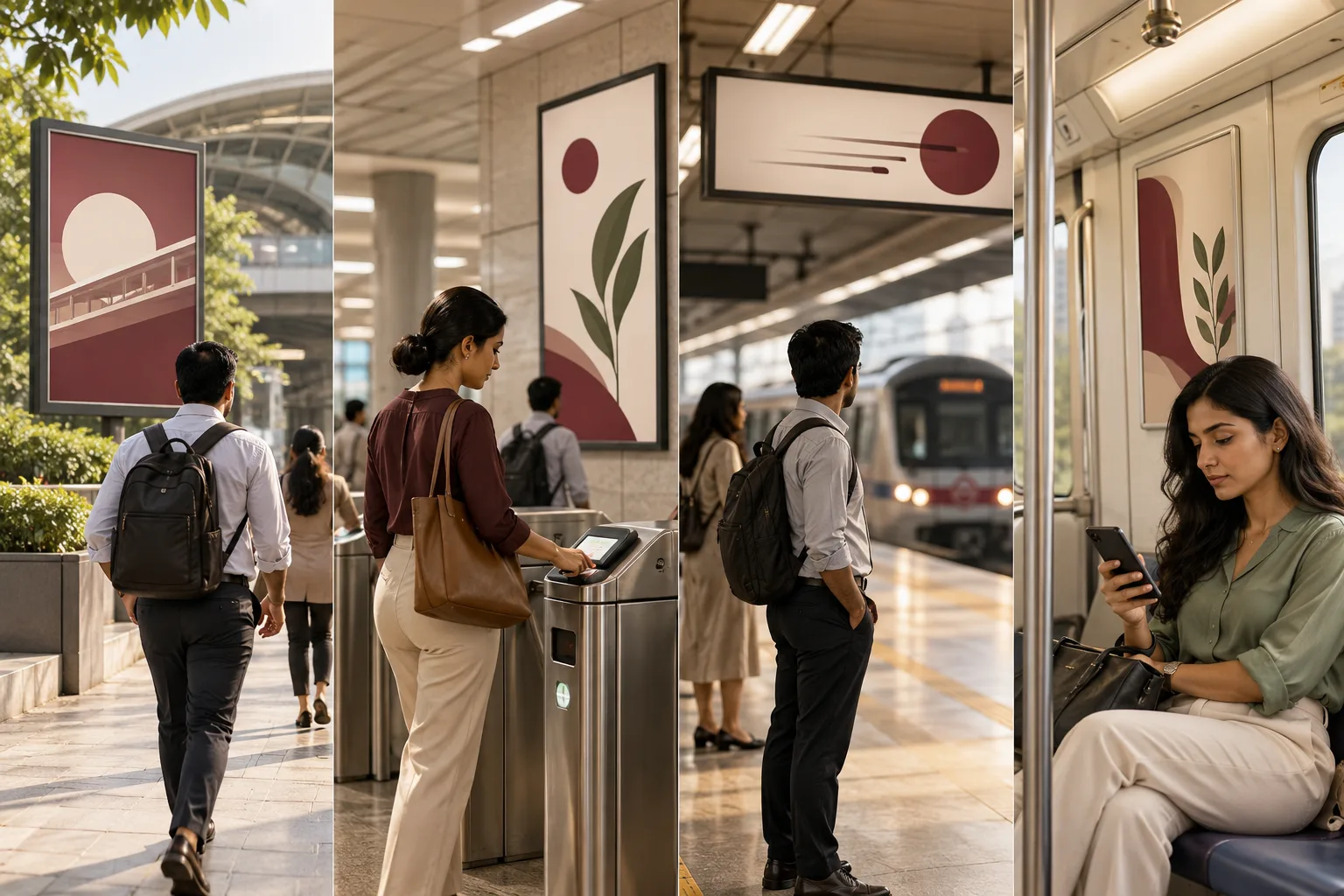 7 min read · 21 Sept 2026How to advertise to metro commutersA commuter is a mode, not a person. The journey has four still moments, each needing different creative, so one design across a station fails.
More for coaching centres and tutors
Related work to consider.
Closest to this: paid and media
- Apartment advertising for coaching centres and tutors
- Newspaper advertising for coaching centres and tutors
- Outdoor advertising for coaching centres and tutors
- PPC advertising for coaching centres and tutors
- Brochure and flyer distribution for coaching centres and tutors
- Door-to-door promotional campaigns for coaching centres and tutors
- Billboard advertising for coaching centres and tutors
- Auto rickshaw advertising for coaching centres and tutors
Also for coaching centres and tutors
Or start from the overview: sales and marketing for coaching centres and tutors.
Your next practical step
Tell us what you are trying to grow, and we will read it before we call.
Eight short steps, mostly taps. Skip anything you would rather answer on the call.