Dental clinics · Appointment reminders and no-show reduction
Fill the chair you booked by reminding patients before the slot is lost.
Appointment reminders for a dental clinic are the messages and desk routines that turn a booked chair slot into an attended visit, an early cancellation or a moved appointment. GullySales writes the reminders, connects them to your booking record where the tool allows, and reads attendance against the figures you recorded first.
Scope, fee, reporting and term are agreed in writing after we have read your brief and spoken to you.

What appointment reminders and no-show reduction means
Appointment reminders and no-show reduction is the work of turning a booked slot into an attended visit, an early cancellation or a rearranged appointment through timely messages and clear replies. GullySales writes the reminders, connects them to your booking records where supported, and measures attendance against your starting position rather than treating messages sent as the result.
Also for dental clinics
- Email marketing for dental clinics
- WhatsApp marketing for dental clinics
- AI follow-up and communication for dental clinics
- SMS marketing for dental clinics
- Promotional email copywriting for dental clinics
- Lead nurturing email sequence writing for dental clinics
- WhatsApp marketing and follow-up message writing for dental clinics
- SMS marketing copywriting for dental clinics
Sales and marketing for dental clinics, the overview.
Last updated 14 Nov 2026. Rules for this trade differ by state and professional body, and they change. We describe restrictions in general terms, so check the current position with your own council or adviser before you publish anything.
For dental clinics
Where it usually goes wrong, and what we would do.
“An empty chair costs the whole slot, not part of it”
A dental slot carries the dentist, the assistant, the sterilised tray and the room. When a patient fails to arrive, none of that can be sold back an hour later. A walk-in toothache rarely fits the time that opened up, so the gap stays. The clinic needs to hear about a cancellation early enough to offer the slot to someone on a waiting list, and a reminder is only useful if it gives the patient an easy way to say so.
“Multi-visit treatment loses patients between visits”
A root canal, a crown, an implant or a course of aligner reviews depends on the patient returning for the next stage. The first visit relieves the pain, and the second feels optional. A reminder for stage two must name the reason the visit matters in plain words, without frightening the patient or promising an outcome. When the clinical team writes that reason down, the front desk stops improvising it on a busy phone.
“The reminder reaches a shared phone”
Dental patients include children, older relatives and family members who share one handset. A message that names the treatment can be read by the wrong person. The wording needs a plain approach: clinic name, day, time, and a way to reply. Anything about the procedure stays on the call or in the clinic. Your own adviser decides how health information may appear in messages where you practise.
“Replies arrive where nobody is looking”
A patient answers a reminder to ask for another evening, and the answer lands on a personal phone or an unwatched inbox. The booking stays as it was, the dentist prepares for someone who has already said they cannot come, and the patient assumes the change was accepted. One named person must own every reply and update the appointment book before the day closes.
What we do
What we deliver for dental clinics.
The work available for this need. We agree the deliverables and responsibilities for your engagement in writing.
Attendance baseline from your appointment book
A sheet that separates attended visits, early cancellations, moved appointments and missed visits for the period you choose. Walk-ins and emergency slots are listed apart so they do not distort the figures. You check the sheet against your own book before any message changes.
Result: You can open the book and agree every line of the starting record.
Reminder timing plan by treatment type
A written schedule that treats a routine check-up differently from a surgical visit or a long restorative sitting. Booking lead time and the time needed to refill a cancelled slot decide when each message goes. You review an example for each type before anything is switched on.
Result: Each treatment type has a named timing you can read on one page.
Approved reminder and reply wording
Reminder, confirmation and rescheduling messages in the languages your patients use, with the clinic name, day, time and a plain way to answer. Preparation notes, such as bringing earlier X-rays or a medicine list, are kept separate. Your lead dentist signs off the text.
Result: No message goes out that the dentist has not read.
Permission and stop record
A note of how each patient agreed to receive messages and how a stop request is handled so the number leaves later sends. Your own adviser reviews the wording for the place you practise. We prepare the record and the clinic holds it.
Result: A stopped number can be shown to be excluded from the next send.
Waiting list and cancelled-slot routine
A short desk routine for an opened slot: who is called first, what the patient is told, and who updates the book once a replacement accepts. Patients who agreed to short-notice visits are listed with their consent noted.
Result: A cancelled slot has a named person and an order of calls.
Recall list for due check-ups and unfinished plans
A list built from your records of patients whose next check-up date has passed, and of treatment plans agreed but not completed. Your clinical team confirms who should be contacted and how. Nothing is sent to a record that lacks permission.
Result: The list can be traced line by line to a patient record.
How the result is measured
- No-show rate against the baseline, by day and appointment type
- Confirmed, cancelled or moved bookings traced to reminder replies
- Cancelled slots refilled and subsequently attended
Recorded as a baseline before work starts, so every later report has an honest comparison.
Who it is for
This is written for these dental clinics.
- Single-dentist clinics
- Multi-chair general dental clinics
- Orthodontic and aligner-only practices
- Implant and oral surgery centres
- Cosmetic and smile-design clinics
- Paediatric dental clinics
- Dental clinics inside a multi-speciality centre
- Multi-branch dental groups
- New clinics in their first year
Before you decide
Agree the work. Know how to judge it.
Appointment reminders and no-show reduction for dental clinics: use these checks to prepare, choose the scope, and review what changes.
Bring the right evidence
Trace recent enquiries from arrival to the last recorded action. Include a won enquiry, an unsuitable one, and one that went quiet, with personal details removed for the initial discussion.
Make the scope clear
Agree who accepts each enquiry, what makes it qualified, and how ownership changes. Include a rule for missed replies and a clear reason for closing an enquiry.
Check the work in use
Pick an enquiry at random and ask the team to find its owner, latest conversation, and next action. Check that the record agrees with what actually happened.
Know when to change course
If no one has capacity to respond, assign that responsibility before buying more leads. Automation can support the owner, but it cannot replace an unresolved handover.
These are discussion points, not a fixed package. GullySales confirms the deliverables, responsibilities, fee, and term in writing after reading your brief and speaking with you.
Before we start
What to have ready before the work starts.
The records, access and decisions this work needs from dental clinics. Anything missing is noted in the written scope, with who will supply it.
- Appointment book for a recent period
- We need a record that shows what was booked and what actually happened. A diary that notes only bookings tells us nothing about attendance. When the book is missing or kept in several places, the baseline is guessed, and a guess cannot be compared with anything later.
- Name of the desk owner for replies
- One person at the clinic must read every reply and update the book. Without a named owner, a message that asks to move a visit sits unread and the chair is still held for someone who will not come. The person can change by shift, but the role cannot be left open.
- Patient permission records
- Reminders go only to patients who agreed to receive them. We need to see how that agreement is recorded today, whether on a registration form, a booking page or in the chat. When the record is missing, we leave those numbers out and the first send is smaller than you hoped.
- Treatment plans and recall dates
- Recall messages depend on a recorded next-visit date or an agreed treatment plan that is not finished. If dates live only in the dentist's memory, there is nothing to send against. Even a simple list of patients whose next stage is due gives the work a starting point.
- A waiting list of willing patients
- Refilling a cancelled slot needs patients who have said they can come at short notice. Ask at the desk over the next few bookings and note the answer with the date. When nobody has agreed, an opened slot has no one to call and the cancellation simply becomes an empty hour.
How it works
How the appointment reminders and no-show reduction work runs
The work itself, in order. How an engagement starts, from your brief to a written scope, is set out on our method page.
- 1
Reading the appointment book with the desk
The first meeting is with the front desk and the owner, with the appointment book open. We look at how a booking, a cancellation and a missed visit are recorded today, who changes an entry, and which tool holds the record. The written scope names the approver, the records we may see and the fee and term agreed before work begins.
- 2
Recording the starting attendance figures
Before any reminder changes, the desk and we list attended, cancelled, moved and missed visits for a period you choose. Emergency and walk-in slots are shown apart. Nothing is improved on paper at this stage; the point is to fix a starting record that the clinic itself agrees is true.
- 3
Sorting visits by treatment and lead time
A check-up booked the same week needs a different message from a surgical visit booked long ahead. We group your booking types, note the preparation each needs and mark the ones where a personal call from the desk should come before any message. The dentist reviews the grouping.
- 4
Writing and approving the messages
We draft the reminders, confirmations and rescheduling replies in your patients' languages and keep clinical detail out of anything a family member might read on a shared handset. The lead dentist approves the wording, and your own adviser checks permission handling before a single message is sent.
- 5
Testing a booking from entry to reply
Using a test patient, we book, change and cancel an appointment and watch the reminder follow the booking. We check that a moved visit drops its old reminder, that the reply reaches the named desk person, and that the book is updated. Anything that fails is fixed before real patients receive a message.
- 6
Reading attendance against the baseline
At the review you set with us, the desk's attendance record is compared with the starting figures. We separate missed visits from refilled slots and look at which treatment types still leave gaps. Message counts are shown only as background; the clinic decides what to change next from the book itself.
Where this fits
Three pieces of sales work, in this order.
This work sits inside sales process design, at stage 1, prospecting and lead generation. The audit comes before it, and sales management keeps it running.
Step 1
Sales audit
Find where deals are being lost and what to fix first.
Start here if you cannot say where orders are lost.
Step 2 · you are here
Sales process design
One written way to sell, from first enquiry to repeat order.
Start here if every salesperson sells differently.
Step 3
Sales management
A target, a review routine and someone who owns the number.
Start here if the team has targets and no routine.
FAQ
Questions owners ask before they call.
Not here? More answers, or ask on WhatsApp.
How do I reduce no-shows at my dental clinic?
Which patients should get a call and not a message?
Can reminders mention the treatment?
Will reminders bring back patients who stopped coming?
What if my booking software cannot send messages?
Do you charge a penalty to patients who miss visits?
How long is the contract?
How soon will we see results?
Who will actually do the work?
What do you need from us?
From the blog
Further reading for dental clinics.
 6 min read · 10 Oct 2026How clinics can improve the journey from online enquiry to appointmentClinics lose enquiries between the first message and the booked slot. Trace the journey, find the gap and fix it with a simple checklist.
 8 min read · 21 Sept 2026How to advertise to working professionalsNo platform sells a working professional audience. Reach them by place and hour: the commute, the lunch break, after nine at night, and salary week.
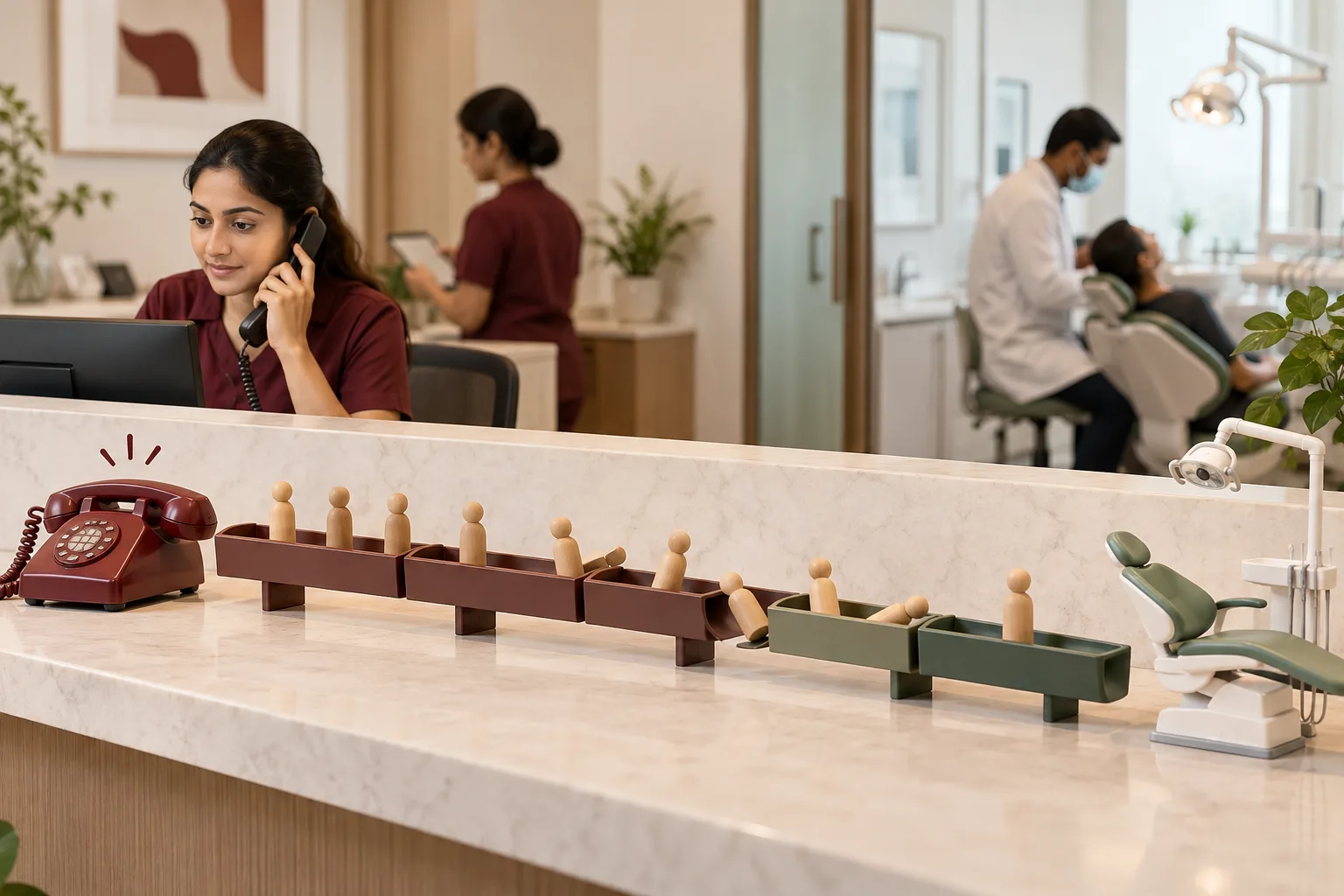 7 min read · 5 Nov 2024How to get more dental appointmentsMost practices lose people between the phone ringing and the dental chair. See the funnel, where it leaks and how to fix each gap.
More for dental clinics
Related work to consider.
Closest to this: messaging and automation
- Email marketing for dental clinics
- WhatsApp marketing for dental clinics
- AI follow-up and communication for dental clinics
- SMS marketing for dental clinics
- Promotional email copywriting for dental clinics
- Lead nurturing email sequence writing for dental clinics
- WhatsApp marketing and follow-up message writing for dental clinics
- SMS marketing copywriting for dental clinics
Also for dental clinics
Or start from the overview: sales and marketing for dental clinics.
Your next practical step
Tell us what you are trying to grow, and we will read it before we call.
Eight short steps, mostly taps. Skip anything you would rather answer on the call.