Locksmiths · Branding
Look like the locksmith a stranger would trust to let in at midnight.
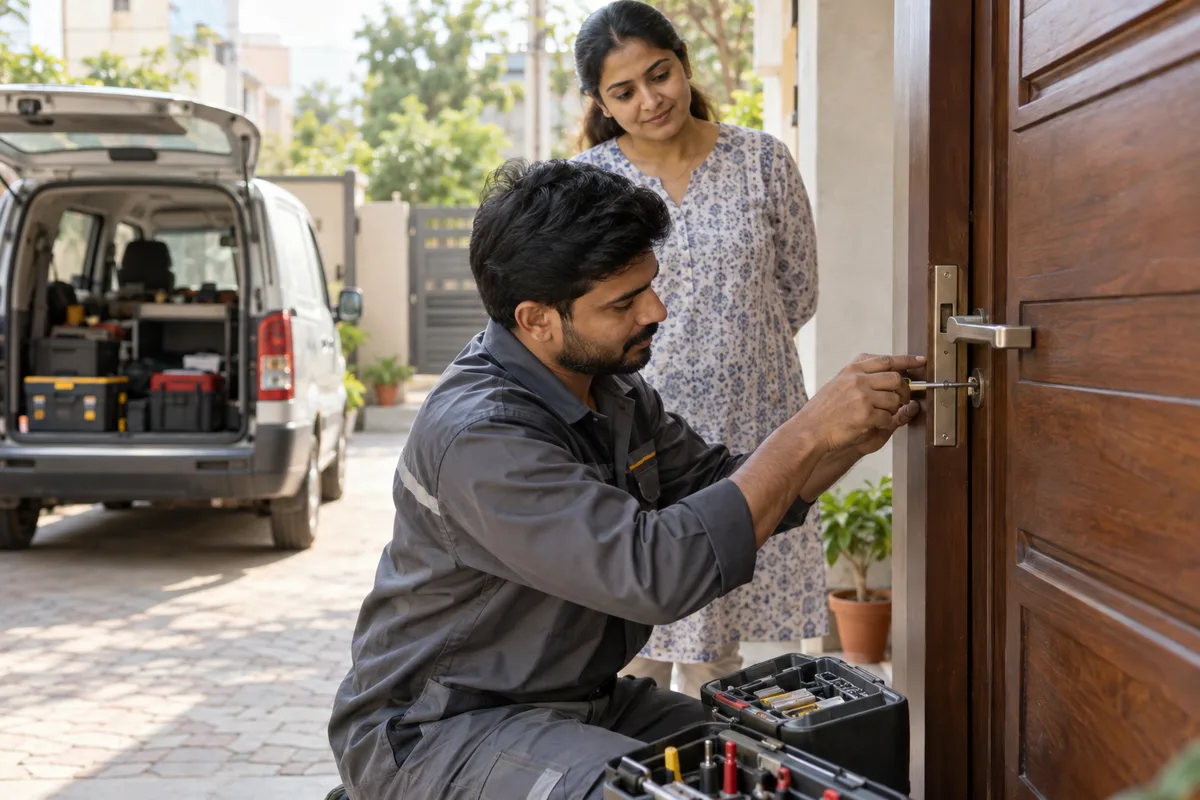
Branding for a locksmith means a consistent name, verified photos and a marked vehicle, since trust is what a customer judges before letting someone in.
Scope, fee, reporting and term are agreed in writing after we have read your brief and spoken to you.
What branding means
Branding is what a customer remembers about your business beyond the product, including your name, colours, tone of voice and what you are known for locally. GullySales sets or corrects this once and applies it consistently across your website, signage and adverts so the business looks like one company everywhere.
Last updated 14 Nov 2026.
For locksmiths
Where it usually goes wrong, and what we would do.
“A marked vehicle is the branding that matters most”
A liveried van outside a customer's home reassures neighbours and reads as an established business, not a stranger.
“One name and number everywhere”
A locksmith listed under different names on Google and WhatsApp confuses a customer trying to call back the same person.
“Verification badges go on the listing too”
Police clearance or licensing displayed online answers the trust question before the technician arrives.
What we do
What we deliver for locksmiths.
The work available for this need. We agree the deliverables and responsibilities for your engagement in writing.
Vehicle livery design and layout
A simple, consistent design for the van or scooter signage, so it reads as an established business outside a customer's home or office.
Result: A neighbour sees a recognisable business, not a stranger's vehicle.
One name and number fixed across every listing
The business name, phone number and WhatsApp number corrected and matched across Google, Justdial and any other directory.
Result: A customer calling back finds the same number every time.
Verification badge placement on the profile
Police clearance, licensing or training certificates displayed clearly on the Business Profile and website, not left in a drawer.
Result: The trust question gets answered before the technician ever knocks.
A simple logo and colour treatment
A basic logo and colour scheme applied to the vehicle, uniform and listings, kept plain enough to print cheaply and consistently.
Result: The business looks the same wherever a customer encounters it.
A technician photo and ID card set
A photograph and simple ID card for each technician, shown on the profile so a customer can confirm who is arriving.
Result: A customer feels safer letting in someone they can recognise.
How the result is measured
- Recognition in customer feedback
- Consistency across channels
- Repeat enquiries by name
Recorded as a baseline before work starts, so every later report has an honest comparison.
Positioning in one sentence
The sentence a locksmith can fill in so a locked-out customer trusts the name on the van.
We open and fit [doors, cars or digital locks] for [home owners, offices or societies] in [area], and unlike [a number from a poster] we [show an ID and quote before work].
- Who it is for
- A family locked out at night, a landlord changing locks between tenants, a society committee, a car owner without a spare key. Pick the one you most want. The words on the board differ for each.
- What you do
- Door opening, lock change, key duplication, car key programming, digital lock fitting. Name the two you most want to be called for in the words a person types into search, not 'security services'.
- What the customer gets that the next locksmith does not
- It may be a call-out charge told on the phone, an ID card shown at the door, or a receipt with your name. Pick what a nervous person at a closed door will want to see before letting you start.
- The proof you can show
- A verified listing with real photographs of your van, any police verification certificate you hold, an ID card with a photograph, and reviews from named localities.
- Words customers ignore
- 'Best', 'cheap' and 'fast' are on every board and sticker. Replace them with something checkable, such as 'call-out charge told on the phone' or 'ID shown at the door'.
- The name and tagline test
- Read the name, number and area from across a road on the van. If a stranger in a parked car cannot read it, the sign has failed. Keep the same wording on the listing, the van and the receipt book.
Who it is for
This is written for these locksmiths.
- Emergency and 24-hour locksmiths
- Automotive locksmiths and key programming specialists
- Residential lock and security installers
- Commercial and office locksmith services
- Safe installation and repair specialists
- Smart lock and digital security installers
- Society and RWA-contracted locksmiths
Before you decide
When this may not be the right fit.
- You have not settled one trading name and number, so a new identity would add a third version to the board, the van and the listing.
- Your technicians work from unmarked vehicles with no uniform or card, and a new logo would not change what the customer sees at the door.
Before you decide
Agree the work. Know how to judge it.
Branding for locksmiths: use these checks to prepare, choose the scope, and review what changes.
Bring the right evidence
Collect the sales presentation, website, quotations, and other material buyers actually see. Mark where the description of the business changes or where a claim has no supporting evidence.
Make the scope clear
Agree whether the work concerns the offer, the words, the visual identity, or all of them. List the formats that need updating and who owns the final approval.
Check the work in use
Test the proposed direction on a real sales page or proposal. A buyer should be able to tell who the offer is for, what is different, and what evidence supports it.
Know when to change course
A new identity will not fix an unresolved service problem. Put the delivery issue right before making a stronger public promise about it.
These are discussion points, not a fixed package. GullySales confirms the deliverables, responsibilities, fee, and term in writing after reading your brief and speaking with you.
Before we start
What to have ready before the work starts.
The records, access and decisions this work needs from locksmiths. Anything missing is noted in the written scope, with who will supply it.
- Clear photographs of every vehicle
- The livery layout depends on the real shape of the panels, the mudguards and any existing lettering. Phone photographs from four sides in daylight are enough. Without them we design on guesswork, and the first fitting may find the number does not fit above the wheel arch.
- Your sign painter's name and availability
- Whoever fits the vinyl or paints the panel must be part of the layout talk. Their material and their limits decide what size lettering is possible. If you have no regular painter, tell us, and we write the artwork brief so you can take it to any shop.
- Passport photographs of each technician
- The ID card and the profile photo set need a plain, well-lit picture of every person who goes to a door. Phone photos taken against a plain wall are fine. A technician without a photo is left out of the set, and a customer asking for ID gets nothing to check.
- Login to the Maps and directory listings
- Changing a name, a number or a photo needs owner access. Some listings were created by a former employee or a cousin, and nobody remembers the password. If access is missing, the plan includes the claim steps first, and the name change waits until the claim is complete.
- Your decision on the one trading name
- Only the owner can say whether the business is called by the shop name, the family name or the name on the licence. We can show the options, but we cannot choose. Until it is settled, every other piece of branding work stays on hold, because each depends on the name.
How it works
How the branding work runs
The work itself, in order. How an engagement starts, from your brief to a written scope, is set out on our method page.
- 1
Photograph the van from the kerb
We start with the vehicle, because that is the first thing a stranger at the door sees. You send photographs of the van or bike from the front, back and both sides, parked as a customer would see it. We note what is painted, what is stuck on and what is missing. You tell us which vehicles are actually used for night calls, so the livery goes where it matters.
- 2
Collect every name and number in use
We ask for the visiting cards, the signboard, the Maps listing, the directory entries and the number staff give out on the phone. Laid side by side, they show where the shop name differs from the listing name. You decide which single name and which single number the business will answer to from now on, and we record that decision in writing.
- 3
Draw the livery with the painter
We lay out the van panels on paper with the sign painter or sticker vendor you already use, so the design suits what they can fit and fix. The name, the number and the word locksmith go large on the doors. You approve the layout before any vinyl is cut, because a mistake on a van is expensive to undo.
- 4
Prepare the technician ID card set
We design the ID card each technician wears and the matching photo block for the listing. You supply a clear passport-style photograph of each technician and the name that should appear. We check the card shows the business name and number exactly as on the van, so a customer comparing the two finds them identical.
- 5
Place the badges and the profile photos
We upload the van photographs, the technician photographs and the logo to the Maps profile and to each directory, and apply whatever verification the platform currently offers. You sit with us while the phone verification call or code arrives. We check the profile from a customer's phone before calling the step done.
- 6
Compare enquiries against the earlier record
Before any change, we note how many calls reached the business and how many of those were turned away at the door for lack of trust, using your call log and your own memory of refusals. After the livery and listing change, we read the same log again. We report what moved in calls and jobs booked, and what did not.
Where this fits
Three pieces of sales work, in this order.
This work sits inside sales process design, at stage 1, prospecting and lead generation. The audit comes before it, and sales management keeps it running.
Step 1
Sales audit
Find where deals are being lost and what to fix first.
Start here if you cannot say where orders are lost.
Step 2 · you are here
Sales process design
One written way to sell, from first enquiry to repeat order.
Start here if every salesperson sells differently.
Step 3
Sales management
A target, a review routine and someone who owns the number.
Start here if the team has targets and no routine.
FAQ
Questions owners ask before they call.
Not here? More answers, or ask on WhatsApp.
Do we need a logo?
How does this help emergency calls?
Should our name include '24 hours' even if we are not always available?
Can we use a name like 'AAA Locksmith' to appear first in directories?
What if our vans are old and not worth repainting?
Who decides what the technician ID card says?
How much does it cost?
How soon will we see results?
Who will actually do the work?
What do you need from us?

More for locksmiths
Related work to consider.
Or start from the overview: sales and marketing for locksmiths.
Your next practical step
Tell us what you are trying to grow, and we will read it before we call.
Eight short steps, mostly taps. Skip anything you would rather answer on the call.