Locksmiths · Buyer journey
Know the difference between an 11pm emergency and a planned upgrade.
Buyer journey mapping for a locksmith separates the emergency call, decided in minutes, from planned work like a digital lock upgrade, decided over days.
Scope, fee, reporting and term are agreed in writing after we have read your brief and spoken to you.
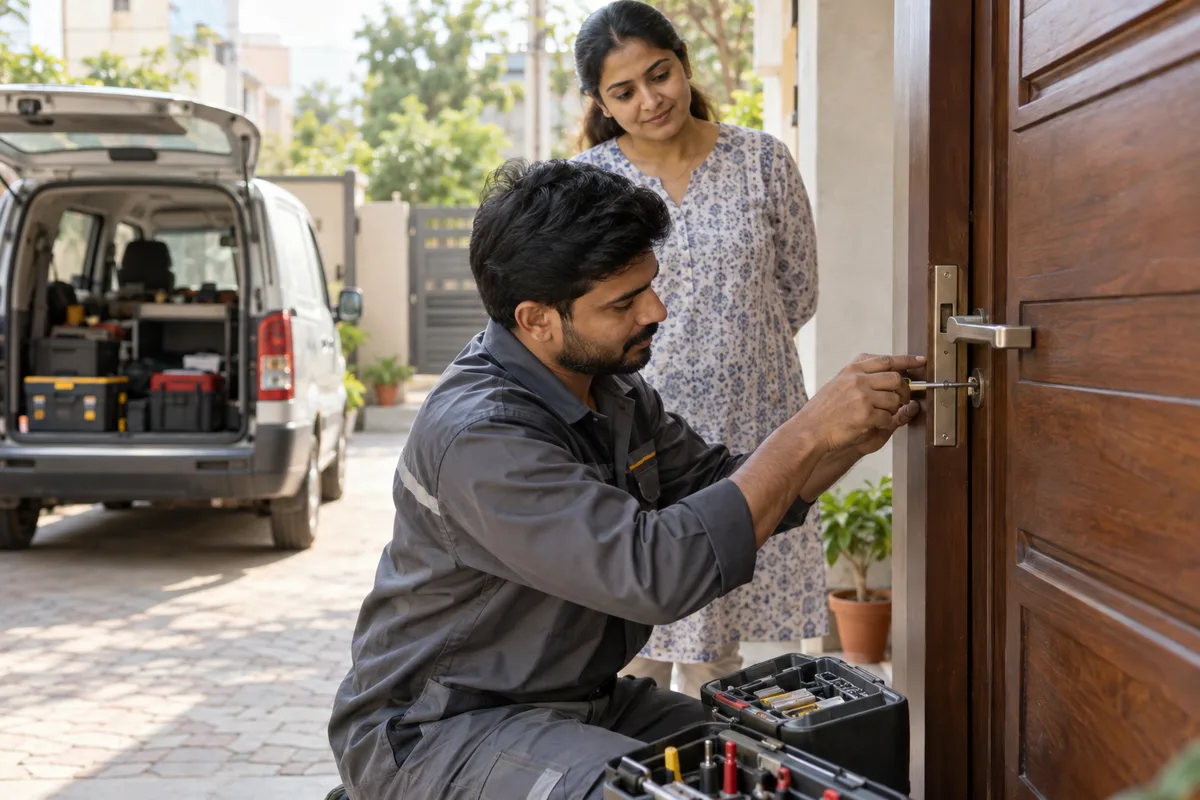
What buyer journey means
The buyer journey is the sequence of steps a customer actually takes, from first hearing about you to deciding to buy, which is rarely a single visit or call. GullySales maps this sequence for your business and checks that something useful happens at each step instead of only at the final call.
Last updated 14 Nov 2026.
For locksmiths
Where it usually goes wrong, and what we would do.
“The emergency journey has almost no comparison step”
A locked-out customer calls the first credible result, so ranking and a fast answer matter more than persuasion.
“Planned work goes through a proper comparison”
A digital lock customer checks reviews and past installation photos over several days before booking.
“The follow-up after an emergency opens a second journey”
A customer relieved after a lockout is a good prospect for a security upgrade discussed a few days later.
What we do
What we deliver for locksmiths.
The work available for this need. We agree the deliverables and responsibilities for your engagement in writing.
A written map of the emergency call path
The exact steps from a locked-out search to an answered call and a confirmed arrival time, written down so nothing depends on memory.
Result: Every emergency call follows the same fast path, whoever answers.
A separate map for planned upgrade decisions
The steps a digital lock or CCTV customer takes, from comparing reviews and photos to booking, mapped separately from the emergency path.
Result: Planned enquiries get the proof they are actually looking for.
A follow-up trigger after every emergency job
A defined point, right after a lockout is fixed, when a security upgrade is mentioned, tied to the end of the emergency journey.
Result: A relieved customer gets asked about the next step at the right moment.
A journey-based content checklist
A checklist matching each journey stage, emergency or planned, to the page or message that should exist for it.
Result: Nothing in either journey is left without the content it needs.
How the result is measured
- Drop-off rate by step
- Time from first contact to sale
- Steps with no content
Recorded as a baseline before work starts, so every later report has an honest comparison.
Stages of the customer's journey
What happens between a locked door and a paid job, for an emergency call and for a planned upgrade.
- Locked out and searching
- The person is outside a door, perhaps at night, searching on a phone. Keep the Maps listing's hours, service area and call button correct, since they pick whoever answers and is nearby.
- The call and the price question
- The first thing asked is the cost and when you can arrive. Give a call-out range and an arrival time in the first minute, and note the landmark, the type of lock and the door.
- Arrival and proof of identity
- A stranger arriving at a door has to look trustworthy. Have the technician show an ID card and a printed job slip with the quoted price before touching the lock.
- After the door opens
- The customer is relieved and the lock may be old or weak. Mention a replacement or upgrade once, in writing, leave the decision to them, and save the number for the next call.
- Planned work, such as a digital lock
- This buyer compares reviews, photos of fitted doors and brands over several days, sometimes with a spouse. Keep a gallery of fitted doors and a page per brand with warranty terms.
- Site visit and booking
- For planned work, a visit measures the door and checks the frame. Send the quote in writing with the model, fitting and warranty terms, and ask for a date to follow up.
Who it is for
This is written for these locksmiths.
- Emergency and 24-hour locksmiths
- Automotive locksmiths and key programming specialists
- Residential lock and security installers
- Commercial and office locksmith services
- Safe installation and repair specialists
- Smart lock and digital security installers
- Society and RWA-contracted locksmiths
Before you decide
When this may not be the right fit.
- You have no record of how recent customers found you, so the journey would be drawn from guesses about calls you do not track.
- You take only emergency lockouts, which have almost no comparison step, and a mapped journey for planned work would describe jobs you decline.
Before you decide
Agree the work. Know how to judge it.
Buyer journey mapping for locksmiths: use these checks to prepare, choose the scope, and review what changes.
Bring the right evidence
Write the decision the research must support, such as entering a market or choosing a buyer group. Separate what you know from sales records from what the team currently assumes.
Make the scope clear
Agree which buyers to speak to, which sources to review, and what access you can provide. Include lost enquiries and people who chose another supplier, where they are willing to take part.
Check the work in use
Look for source dates, sample limitations, and evidence that disagrees with the preferred answer. A recommendation should show how it follows from the findings.
Know when to change course
Do not treat a few positive conversations as proof of demand. Test the proposed offer with an actual buying decision before committing to a wider launch.
These are discussion points, not a fixed package. GullySales confirms the deliverables, responsibilities, fee, and term in writing after reading your brief and speaking with you.
Before we start
What to have ready before the work starts.
The records, access and decisions this work needs from locksmiths. Anything missing is noted in the written scope, with who will supply it.
- The phone call log for emergencies
- The emergency map is built from real calls, not from guesses. A screenshot of the call history, with the missed ones marked, is enough. If calls arrive on a personal mobile, we need that history as well. Without it the map shows how we think callers behave, not how yours do.
- Copies of quotes sent for planned work
- Digital locks, CCTV and safes are quoted in writing or on WhatsApp. We need the last few, whether accepted or ignored. They show what you offered, to whom and how the customer replied. A planned-work map drawn without them has no stage where people drop out.
- Thirty minutes with the call handler
- The person who answers at night must be in the room. They may be the owner, a family member or a helper. Their answers on what callers ask first and what makes a caller cancel are the core of the emergency path. Without them, we map only what you remember.
- Names of societies and offices served
- A third path exists where a committee or facility manager decides. We need to know which buildings you have worked in, who signed off and how the decision was made. Missing names leave that path as a single line, and the plan treats those clients as ordinary customers.
- Your own view of which jobs pay best
- A map is only useful if the stages that matter are the ones that earn. You should be ready to say which jobs bring the highest profit and which tie up a van for little. If you cannot say, we mark that as a gap and the first review sets it.
How it works
How the buyer journey work runs
The work itself, in order. How an engagement starts, from your brief to a written scope, is set out on our method page.
- 1
Replay the last emergency calls
We begin with the recent calls in your phone log, picking a handful where the caller was locked out. For each we ask what the person said first, what they asked next and how the call ended. You tell us from memory what the caller sounded like. We draw the path from search to arrival on one sheet.
- 2
Sort the quotes into planned work
We pull out the jobs that were not emergencies: a digital lock fitted, a CCTV set, a safe moved. You show us the quotes sent and the ones that went quiet. We trace who asked, who else was consulted and what they compared. The planned path gets its own sheet, because it runs on proof and not on speed.
- 3
Interview the person who answers calls
Whoever picks up at night knows where callers hesitate. We sit with that person and go through the calls in order. They tell us which questions callers ask before agreeing to wait. We mark each hesitation on the map, and you decide which ones can be answered on the phone and which only on arrival.
- 4
Mark the second journey after a lockout
Once a door is open, the customer sees the weak lock that let it be forced. We map that moment as the start of a second path. You tell us what the technician actually says at the door and what the customer is told. We write the trigger that sends a follow-up message to someone just helped.
- 5
Turn the maps into a content checklist
Each point where a buyer looks for proof becomes a line on a checklist: a photo of a fitted lock, a short answer on the listing, a page on digital lock options. You choose which lines are worth the effort now. We hand over the checklist in order of which stage loses the largest number of people.
- 6
Check the maps against new calls
After the maps are in use, we read the new calls and quotes against the baseline of calls and booked jobs from before. We look for the hesitation points that have changed and the quote stages that still stall. You see where the map was right, where it was wrong and what we redraw.
Where this fits
Three pieces of sales work, in this order.
This work sits inside sales process design, at stage 1, prospecting and lead generation. The audit comes before it, and sales management keeps it running.
Step 1
Sales audit
Find where deals are being lost and what to fix first.
Start here if you cannot say where orders are lost.
Step 2 · you are here
Sales process design
One written way to sell, from first enquiry to repeat order.
Start here if every salesperson sells differently.
Step 3
Sales management
A target, a review routine and someone who owns the number.
Start here if the team has targets and no routine.
FAQ
Questions owners ask before they call.
Not here? More answers, or ask on WhatsApp.
Why map this separately from other trades?
Does a small locksmith need this mapped formally?
Who else has a say when a family or a society chooses a new lock?
A customer asked for a digital lock quote and never replied. What should we do?
Can the maps be kept on paper, or do they need software?
Do we map customers who call about the wrong thing?
How much does it cost?
How soon will we see results?
Who will actually do the work?
What do you need from us?

More for locksmiths
Related work to consider.
Closest to this: strategy and research
Also for locksmiths
Or start from the overview: sales and marketing for locksmiths.
Your next practical step
Tell us what you are trying to grow, and we will read it before we call.
Eight short steps, mostly taps. Skip anything you would rather answer on the call.