Shoe repair shops · CRM
Keep a record of every pair, so the next message names the right shoe.
A CRM for a shoe repair shop is a simple record of who left what, what was done and when to speak to the customer again, kept in a sheet or app the counter staff will use. GullySales sets up the fields, the habit and the reminders.
Scope, fee, reporting and term are agreed in writing after we have read your brief and spoken to you.
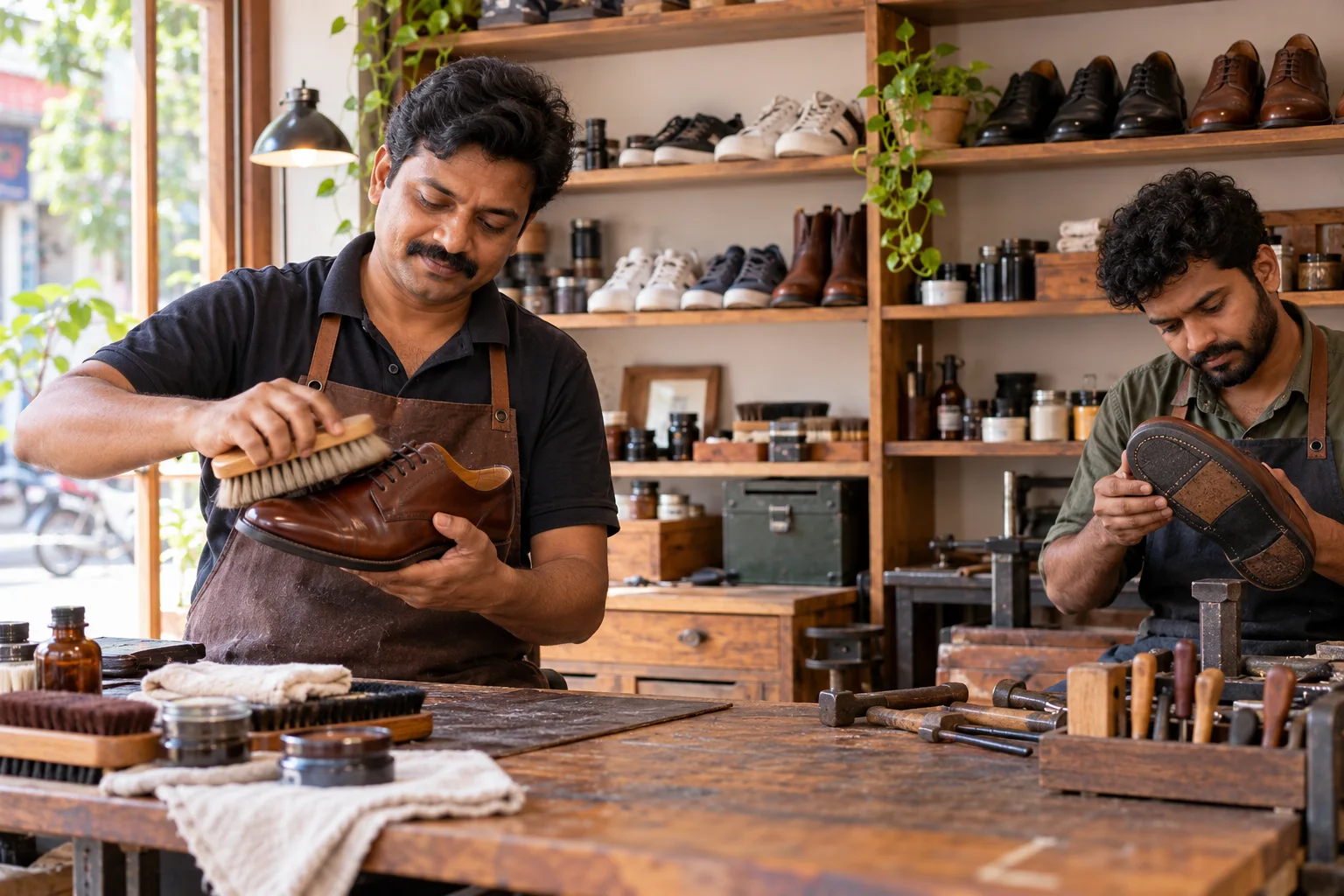
What CRM means
A CRM is the record where every enquiry, call and quote is kept against a customer, replacing separate notebooks, spreadsheets and memory. GullySales sets up or cleans an existing CRM and reports from it by enquiry outcome rather than by activity logged.
Last updated 14 Nov 2026.
For shoe repair shops
Where it usually goes wrong, and what we would do.
“A paper token ties the shoe but not the person”
The token matches a pair to a heap on the shelf. It does not say who owns the pair once it is collected, so the shop has no phone number to message about the second pair in the cupboard.
“The item history is the useful field”
Brown brogues resoled, a bag handle restitched, school shoes mended: that one line lets a later message name the right item. A message that names the pair is read; a general offer is ignored.
“Batch customers need an account view”
A school, a plant or an office has a contact, an agreed rate, a collection day and a last batch. Held in one place, these let the next visit start where the last one ended.
“A register left blank is worse than no register”
A register with an overlong list of columns is left blank by the second busy day. Few fields, filled at drop-off, beat a clever system filled in once.
What we do
What we deliver for shoe repair shops.
The work available for this need. We agree the deliverables and responsibilities for your engagement in writing.
A short list of fields
Name, phone, item, fault, repair, price agreed, source and date, kept to what can be typed at the counter in moments.
Result: A drop-off takes the same few seconds every time.
Stages from received to collected
Received, quoted, in work, ready and collected, so any person at the counter can see where a pair stands.
Result: No pair is lost between the bench and the shelf.
A reminder list for the second pair
A view that shows customers whose last repair is old enough to ask about another, with a message to send.
Result: A message names a real item.
An account sheet for schools and plants
Contact, agreed rate, collection day, last batch and the person who approves the bill.
Result: A batch buyer is greeted by name and history.
A choice between a sheet and an app
A shared spreadsheet or WhatsApp Business labels, picked for what your staff will use rather than for the number of features.
Result: The tool matches the habits at the counter.
How the result is measured
- Enquiries logged in the CRM
- Data completeness
- Reports generated from CRM data
Recorded as a baseline before work starts, so every later report has an honest comparison.
Fields worth keeping
What a repair shop's record should hold beyond a token number.
- Item and material
- Written by whoever takes the shoe. Lets the next message name the pair and tells the bench what to stock.
- Repair done and date
- Noted when the job is handed over. Starts the check for a failed repair and the list for a seasonal reminder.
- Customer type
- Walk-in, parent, office or plant. Shows which customers return and which need an approach.
- Phone number and permission to message
- Asked at the counter. Without a yes recorded, no reminder or offer should be sent.
- Collected or waiting
- Ticked by the desk. Gives the list of unclaimed pairs and the order for the shelf.
- Account name for batch buyers
- Set for a school, office or plant. Groups pairs under one contact and one bill.
Who it is for
This is written for these shoe repair shops.
- Footpath and kiosk cobblers with long-standing local customers
- Shoe repair shops in markets and near railway or bus stations
- Repair counters in malls and commercial streets
- Resoling and restoration specialists for leather shoes
- Bag, belt and zip repair workshops
- Safety shoe and boot repair for factories
- School shoe repair near large schools
- Shoe repair shops that also polish, dye and clean
Before you decide
When this may not be the right fit.
- Tokens are not written at all, so the first step is a token slip, not a system
- The shop has one person at the bench who will not stop to write an entry
- You have fewer regulars than you can name from memory and no plan to grow the list
Before you decide
Agree the work. Know how to judge it.
CRM for shoe repair shops: use these checks to prepare, choose the scope, and review what changes.
Bring the right evidence
List the records your team uses and show how an enquiry becomes an order today. Bring examples of duplicate entries, missing owners, and reports that require manual correction.
Make the scope clear
Agree the stages, required fields, access roles, and integrations before configuring the system. Separate software subscriptions from setup, data work, and training.
Check the work in use
Ask the people who will use the CRM to complete a real handover and find the next action without help. Check that the management report can be traced back to individual records.
Know when to change course
If the process is unclear, buying a more complex CRM adds more places for confusion. Start with the minimum fields and rules the team can use consistently.
These are discussion points, not a fixed package. GullySales confirms the deliverables, responsibilities, fee, and term in writing after reading your brief and speaking with you.
Before we start
What to have ready before the work starts.
The records, access and decisions this work needs from shoe repair shops. Anything missing is noted in the written scope, with who will supply it.
- The paper tokens and bench book
- We need the way pairs are tagged now, so the new fields fit your habits. If you use numbered paper stubs, bring a bundle. Without them, we design around a blank notebook and the first fields may need adjusting.
- A decision on who keeps the record
- Name one person who is responsible for the file, even if several people write in it. Records without an owner decay. If you cannot name one, we keep the setup minimal and you review it yourself.
- A phone or computer at the counter
- The tool must sit where the pair is received. A shared phone propped on the bench can serve. If nothing is at hand, we design a paper-first routine and enter the details onto a sheet at a set time.
- Your list of batch accounts
- Write the schools, offices and plants that send pairs, with the contact for each and how they pay. It fills the account sheet on the first day. Without it, accounts are entered as they next appear.
- A rule for storing customer numbers
- Decide who may see the sheet and where it is kept, since it holds customers' numbers. If it sits on a personal phone, it leaves with the phone. We suggest a shared login the owner controls, and ask you to confirm.
How it works
How the CRM work runs
The work itself, in order. How an engagement starts, from your brief to a written scope, is set out on our method page.
- 1
Follow one pair from counter to collection
We trace a single pair through your day: how it is received, tagged, mended, stored and handed back, and where the customer's name and number are written. You show us each point where a detail is lost. What emerges is a map of the journey, with the moments a record must be made.
- 2
Choose between a sheet and an app
We set out what a shared sheet, a free phone app and a paid tool would each need from your staff, and what each would cost in effort. You choose the one the counter will actually use. We prefer the simpler tool, since a register that is skipped is worse than none, and we write down what you would need to change if the shop later outgrows the sheet and wants an app.
- 3
Set the fields staff will fill
We agree a short list: name, number, the item, the repair, the date promised and the token number. You decide which to make compulsory. Each extra field costs the counter a few seconds, so we cut anything that is not used to chase a pair or call a customer back.
- 4
Build stages from received to collected
We set stages such as received, in repair, ready, collected and unclaimed, and agree what moves a pair to the next one. You decide who updates each stage. We test the sheet with ten of your real tokens, and you correct the stages that did not match your bench.
- 5
Add an account view for batch customers
We build a separate sheet for schools, offices and plants, listing each account, its contact, the pairs sent and what is billed. You tell us how each account pays. The view lets you see an account's history without searching through individual tokens.
- 6
Hand over and read the first records
We train the counter staff on the sheet with you present, and agree who checks entries and who owns the file. After a period of use, we read the records against the bench book kept before, and you see how many pairs are traceable by name. Gaps in entries are discussed with the staff who made them, so the reasons are understood and the fields or stages can be adjusted to fit the real rush at the counter.
Where this fits
Three pieces of sales work, in this order.
This work sits inside sales management. A target, a review routine and someone who owns the number.
Step 1
Sales audit
Find where deals are being lost and what to fix first.
Start here if you cannot say where orders are lost.
Step 2
Sales process design
One written way to sell, from first enquiry to repeat order.
Start here if every salesperson sells differently.
Step 3 · you are here
Sales management
A target, a review routine and someone who owns the number.
Start here if the team has targets and no routine.
FAQ
Questions owners ask before they call.
Not here? More answers, or ask on WhatsApp.
Do we need paid software?
What customer details should we keep?
Our staff forget to write things down. What then?
Our staff forget to write things down. What then?
What if our staff cannot read or write well in English?
Can the CRM tell us which customers have not returned?
How much does it cost?
How long is the contract?
How soon will we see results?
Who will actually do the work?
More for shoe repair shops
Related work to consider.
Closest to this: leads and follow-up
Also for shoe repair shops
Or start from the overview: sales and marketing for shoe repair shops.
Your next practical step
Tell us what you are trying to grow, and we will read it before we call.
Eight short steps, mostly taps. Skip anything you would rather answer on the call.