Coffee shops · Buyer persona
Treat the commuter, freelancer, home brewer and office manager as four different buyers.
A buyer persona for a coffee shop is a written picture of one type of customer: where they are when they decide, what they want from the visit and what makes them return or switch. GullySales works with the shop's own counter observations to describe each persona and match the offer to it.
Scope, fee, reporting and term are agreed in writing after we have read your brief and spoken to you.
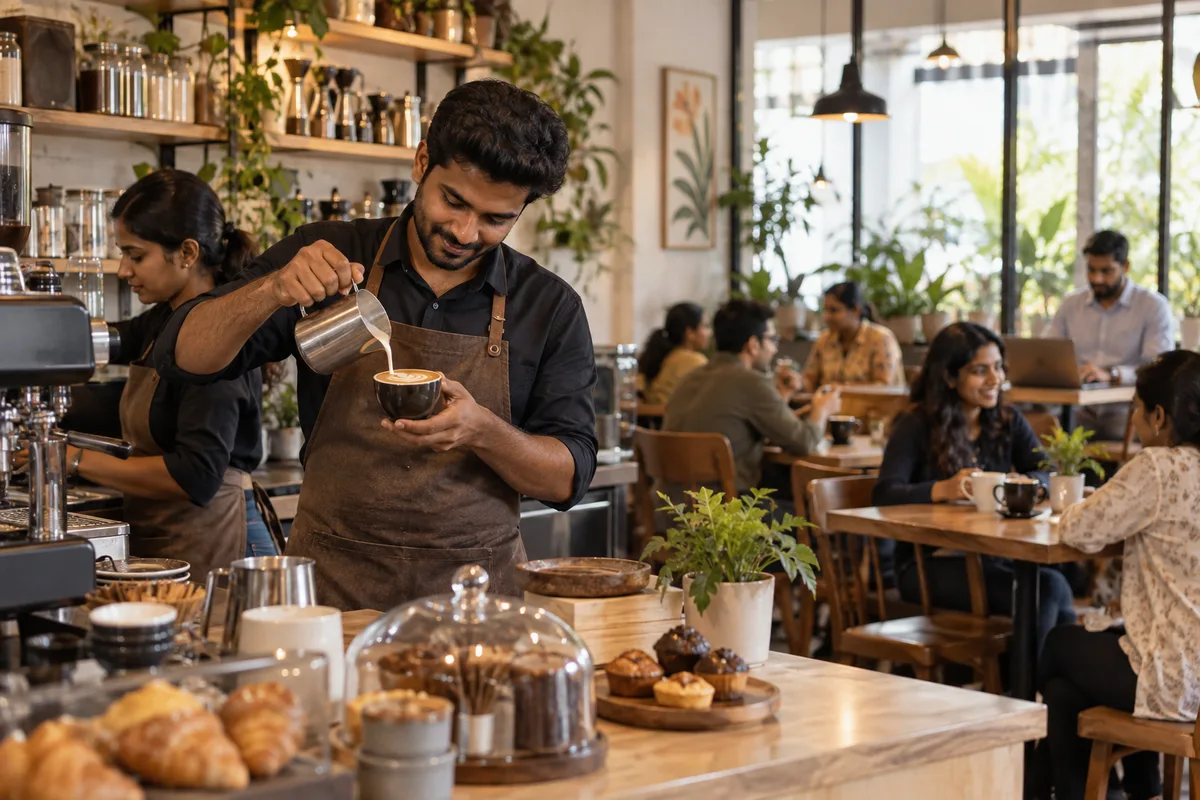
What buyer persona means
A buyer persona is a plain description of the kind of customer who actually buys from you. It includes what they search, what worries them and who else they ask before deciding. GullySales builds this from real enquiries and past sales rather than a generic template, then uses it to write every page and advert.
Last updated 14 Nov 2026.
For coffee shops
Where it usually goes wrong, and what we would do.
“The commuter buys speed and a known order”
This buyer wants the same drink in a few minutes before a train or a desk. Price matters less than a short wait and a barista who remembers. A loyalty offer built on lingering misses this person entirely.
“The freelancer buys a table”
A remote worker is renting a seat with a cup attached. Sockets, Wi-Fi, noise and a welcome for long stays decide the choice. Such a person may order two drinks across an afternoon, and will tell a group chat where to go.
“The home brewer buys knowledge”
This buyer already owns a grinder and wants to know the roast date, the origin and the best way to brew a particular bean. A shelf with no explanation loses them to an online roaster that provides it.
“The office manager buys reliability”
A person in charge of a pantry cares about supply, a machine that works, a clean invoice and a contact who replies. The coffee must be good, but a missed refill does the damage.
What we do
What we deliver for coffee shops.
The work available for this need. We agree the deliverables and responsibilities for your engagement in writing.
Four persona sheets
One page per buyer type, covering where they discover the shop, what they order, what they ask and what makes them leave.
Result: Each type of customer has a written description the team can share.
A counter observation log
A simple sheet where staff note who came in, at what hour and what they asked about for a stretch of days.
Result: The personas rest on what the counter saw.
An offer map
A table matching each persona to the offer that suits it: the quick order, the afternoon seat, the bean bag, the pantry plan.
Result: No offer is aimed at the wrong buyer.
Message wording for each persona
Short messages and post openings written in the language each buyer uses.
Result: A freelancer and an office manager hear from the shop in different words.
A review of the personas
A moment to revisit the sheets against actual sales and enquiries, and to drop or add a persona.
Result: The sheets match the shop as it is now.
How the result is measured
- Enquiry match to persona
- Conversion rate by persona
- Content aligned to persona
Recorded as a baseline before work starts, so every later report has an honest comparison.
Who is asking
The people who walk into or search for a coffee shop, and what each wants to know first.
- Commuter on the way to work
- Wants a known order, a short wait and a place near the exit. Asks whether the shop opens in time and takes digital payment.
- Freelancer looking for a table
- Wants a seat, a socket and wifi that holds. Asks how long a table may be kept and whether a laptop is welcome at peak hours.
- Home brewer choosing a bag
- Wants to know the origin, the roast and the grind for their kettle or press. Is buying knowledge as much as coffee.
- Office manager ordering for a pantry
- Wants a sample, a supply that does not lapse and one invoice. Answers to a finance head and fears an empty pantry.
- Event host looking for a room
- Wants the seating, the price for the room, the menu on offer and the hours the shop can be closed to others.
- Cafe owner buying wholesale beans
- Wants a consistent roast, a supply the roaster can hold and a price that leaves room. Asks for a sample of the same lot as the one they will receive.
Who it is for
This is written for these coffee shops.
- Specialty coffee shops with their own roast
- Independent neighbourhood coffee shops
- Coffee kiosks and carts near offices and metro stations
- Roaster-retailers selling beans online and in store
- Coffee shops inside co-working spaces and bookshops
- Chain coffee outlets opening in new cities
- Drive-through and highway coffee stops
- Cold-brew and brew-bar counters
Before you decide
When this may not be the right fit.
- The shop has opened only recently and holds no record of who comes, so a persona would be a guess.
- The shop serves one kind of customer and has no wish to reach another, so four personas would only add paper.
Before you decide
Agree the work. Know how to judge it.
Buyer personas for coffee shops: use these checks to prepare, choose the scope, and review what changes.
Bring the right evidence
Write the decision the research must support, such as entering a market or choosing a buyer group. Separate what you know from sales records from what the team currently assumes.
Make the scope clear
Agree which buyers to speak to, which sources to review, and what access you can provide. Include lost enquiries and people who chose another supplier, where they are willing to take part.
Check the work in use
Look for source dates, sample limitations, and evidence that disagrees with the preferred answer. A recommendation should show how it follows from the findings.
Know when to change course
Do not treat a few positive conversations as proof of demand. Test the proposed offer with an actual buying decision before committing to a wider launch.
These are discussion points, not a fixed package. GullySales confirms the deliverables, responsibilities, fee, and term in writing after reading your brief and speaking with you.
Before we start
What to have ready before the work starts.
The records, access and decisions this work needs from coffee shops. Anything missing is noted in the written scope, with who will supply it.
- A morning of the till record
- Till data for a recent busy period showing what was ordered and when. It tells us who comes at which hour. Even a printout for a few mornings is useful, because it shows hours, orders and basket size together. If the till cannot export it, a hand tally by staff for a few mornings will do.
- Introductions to five customers
- Names and a word of introduction to regulars willing to talk for a few minutes: a commuter, a remote worker, a bean buyer. They hear from us only if you allow it. They should be people who will say what they really think, not only the friendliest regulars, and they should know in advance why we are calling. If you cannot introduce anyone, the personas rest on observation alone and are marked as less certain.
- Barista notes on regulars
- What the team knows about their regulars: orders, habits, complaints, what makes them stay. Staff hold more than the owner does. A short note from each barista is enough, and a regular's name need not be written. Staff know which regular never sits, which group haggles and which commuter cancels the drink if the queue is long. A short written list from each barista is enough, and names need not be included.
- Records of office and bean enquiries
- Whatever you kept about offices that asked for pantry coffee and people who asked about beans, and what came of each. These show the buyers who decide away from the counter. Include any lost office or group, and why you think they went elsewhere. A guess is acceptable if it is marked as a guess, because the customer talks test it. Chat screenshots are acceptable, and names can be blurred.
- A quiet hour with the owner
- An hour in which the owner tells us who the shop is for and who it is not for. We need this to separate the customers you want from the ones you simply have. Without it, the personas drift toward whoever happens to walk in, and the shop cannot choose who to attract. Without it the personas drift toward whoever walks in.
How it works
How the buyer persona work runs
The work itself, in order. How an engagement starts, from your brief to a written scope, is set out on our method page.
- 1
Choose the customers worth describing
We lay out who comes in: commuters, freelancers, home brewers, office managers, groups. You choose the few whose visits carry weight to the shop's income, and one group you want to attract. Each description names its evidence, so you can see what it rests on. We write fewer personas than you expect, because each must rest on real visits and orders.
- 2
Watch the counter for a morning
We stand in or review footage and note who orders what, how long they stay, whether they sit and what they ask. Baristas add what they know of regulars. We note what they order, how long they stay and what they carry, and never take photographs of customers. The result is a log of observed behaviour, kept apart from our opinion about customers.
- 3
Ask five regulars why they chose you
With your introduction, we speak briefly to a few customers, such as a commuter, a freelancer and a bean buyer, asking how they found the shop, what they compared and what would send them elsewhere. We take notes in their own words. We also ask what they did the last time they were disappointed. You are not present, so they can be frank.
- 4
Draw each persona's decision
From the log and the talks we write who decides, where they are when they decide, what they ask and what they weigh. A freelancer weighs a table and a socket, a commuter weighs speed, a home brewer weighs knowledge. Each persona is written as a short account of one imagined but evidence-based person, with the questions they ask. Each persona is a short account in plain words.
- 5
Correct the personas with the team
The baristas and the owner read each persona and mark what is wrong. They know the regular who never sits and the group who always haggle. We rewrite until staff recognise real people. A persona the baristas call false means our notes missed something, so we go back to the log. A detail nobody can match to a visit is removed.
- 6
Match offers and messages to each one
We use the personas to rewrite the shop's signs, menu notes, bean descriptions and replies for each customer type, and to decide which offer meets which person first. Each persona also gets a note on what would make that customer stop coming, which tells you what to protect. After a season, we compare walk-in and bag figures with the starting log and revise the personas.
Where this fits
Three pieces of sales work, in this order.
This work sits inside sales process design, at stage 0, foundation. The audit comes before it, and sales management keeps it running.
Step 1
Sales audit
Find where deals are being lost and what to fix first.
Start here if you cannot say where orders are lost.
Step 2 · you are here
Sales process design
One written way to sell, from first enquiry to repeat order.
Start here if every salesperson sells differently.
Step 3
Sales management
A target, a review routine and someone who owns the number.
Start here if the team has targets and no routine.
FAQ
Questions owners ask before they call.
Not here? More answers, or ask on WhatsApp.
How many personas does a coffee shop need?
Where do the details come from?
Does a persona replace talking to customers?
Does a persona change between outlets?
Can one persona cover a commuter and a freelancer?
What if the personas do not match our regulars?
How long is the contract?
How soon will we see results?
Who will actually do the work?
What do you need from us?
More for coffee shops
Related work to consider.
Closest to this: strategy and research
Also for coffee shops
Or start from the overview: sales and marketing for coffee shops.
Your next practical step
Tell us what you are trying to grow, and we will read it before we call.
Eight short steps, mostly taps. Skip anything you would rather answer on the call.