Institutional food suppliers · CRM
Keep each kitchen's buyer, items, rates and dues in one record that survives a change of purchase manager.
A CRM for an institutional food supplier is the record of every kitchen you quote and supply: who orders, who decides, who pays, the items, the rates agreed, the credit given and what went wrong. GullySales sets up the fields and the routine, starting with a shared sheet if that is what fits, so the account does not leave with a salesman or a buyer.
A 90-minute audit call and a written, scored report. Turnaround, reporting and term are agreed in writing after the audit.
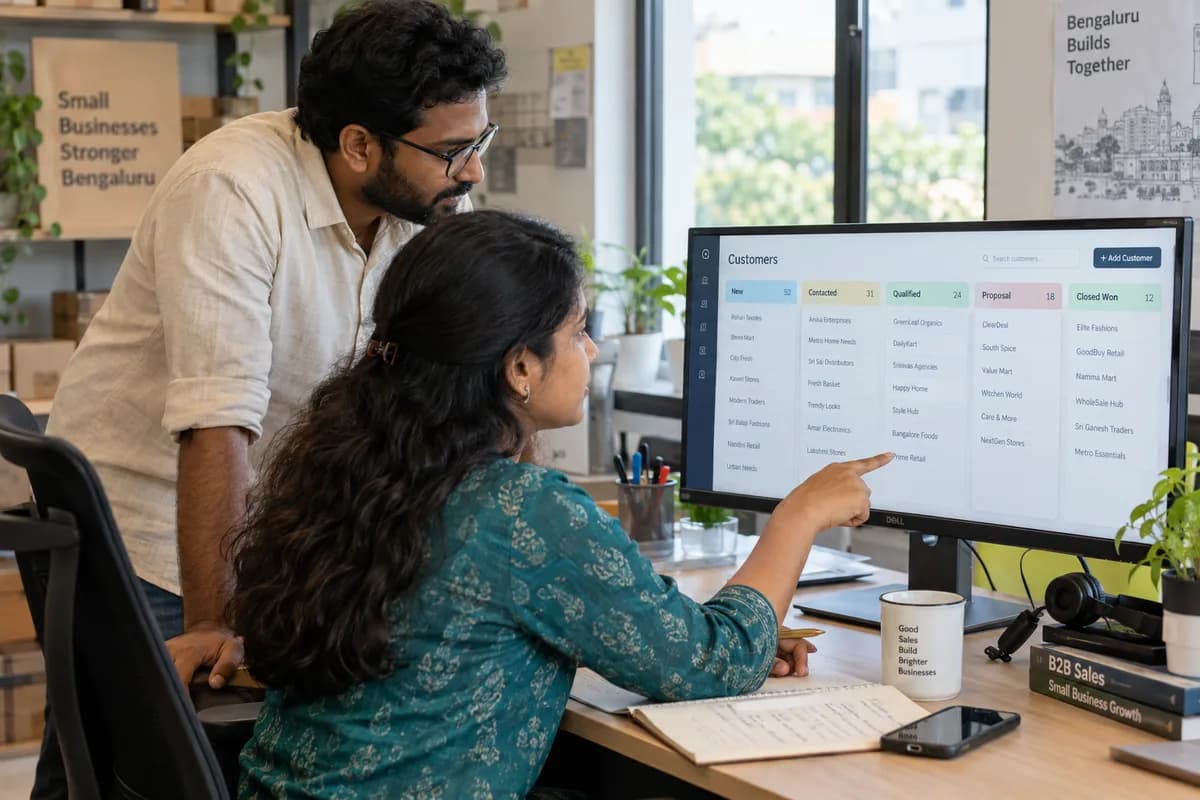
What CRM means
A CRM is the record where every enquiry, call and quote is kept against a customer, replacing separate notebooks, spreadsheets and memory. GullySales sets up or cleans an existing CRM and reports from it by enquiry outcome rather than by activity logged.
Also for institutional food suppliers
- Lead generation for institutional food suppliers
- SEO for institutional food suppliers
- Email marketing for institutional food suppliers
- WhatsApp marketing for institutional food suppliers
- Sales process for institutional food suppliers
- Sales management for institutional food suppliers
- Referral marketing for institutional food suppliers
- Website for institutional food suppliers
Sales and marketing for institutional food suppliers, the overview.
Last updated 6 Oct 2026.
For institutional food suppliers
Where it usually goes wrong, and what we would do.
“The account is a salesman's phone book”
The kitchen managers, the wardens and the chefs sit in one person's contacts. When he leaves, so does the relationship.
“Rates differ by kitchen and change”
A hostel gets one rate and a hotel another, and vegetable rates move. If the rate last quoted is not written down, the argument is won by whoever is louder.
“Orders, invoices and dues sit in different books”
Orders come on WhatsApp, invoices are in the billing software and dues are in the owner's head. A kitchen that is overdue gets quoted for a new supply by someone who does not know.
What we do
What we deliver for institutional food suppliers.
Every deliverable, what it covers for you, and the result it is there to produce. Nothing here is an extra.
A kitchen record with orderer, decider and payer
The kitchen manager, the purchase head and the accounts person named separately, with the meals cooked and the delivery hour.
Result: Any member of staff can pick up the account.
A rate history for each kitchen
Every rate, the date it was agreed, how long it holds and who agreed it.
Result: A rate dispute is settled from the record.
A delivery and rejection log
Each late van, short count, rejected bag and replacement, with the reason, linked to the kitchen and the item.
Result: A pattern shows before the kitchen leaves.
Dues on the same record
Credit terms agreed, invoices unpaid and the last payment received, visible to whoever takes the next order.
Result: A new order is never quoted blind to a late payment.
Renewal and tender dates
The end of each rate contract or standing arrangement, with a named owner for the renewal conversation.
Result: The next quotation is yours.
A rule for who updates what
The salesman, the driver, the billing clerk and the owner each have one thing to write, in one place.
Result: The record stays current without a big effort.
How the result is measured
- Enquiries logged in the CRM
- Data completeness
- Reports generated from CRM data
Recorded as a baseline before work starts, so every later report has an honest comparison.
What to record, and when
What a bulk food supplier should record about each kitchen, and whether software is needed yet.
- Who orders, who decides, who pays
- Name the kitchen manager, the purchase head and the accounts person separately. The chef who orders is rarely the person who releases the payment.
- Meals cooked and the delivery hour
- Record the head count the kitchen cooks for and the hour the van must arrive. Rice for a hostel and vegetables for a canteen are sized from these two lines.
- Items, rates and the date each was agreed
- Write every quoted rate with the date and how long it holds. A rate dispute is settled by the record, not by who remembers.
- Rejections and shortfalls
- Log each rejected bag, short crate or late van with the reason and what you replaced. Repeat entries for one kitchen mean the owner visits.
- Credit terms and what is overdue
- Keep the agreed credit period and the unpaid invoices on the same record. Whoever takes the next order sees whether the last one was paid.
- Do you need software yet?
- A supplier to a handful of kitchens can run on a shared sheet. Once several people quote, deliver and collect across many kitchens, a CRM linked to invoices stops the accounts living in one phone.
Who it is for
This is written for these institutional food suppliers.
- Rice, dal and grain suppliers for hostels and canteens
- Fresh vegetable and fruit suppliers
- Dairy, paneer and egg suppliers
- Meat, poultry and fish suppliers
- Edible oil, spice and grocery wholesalers
- Frozen and processed food suppliers for hotels and restaurants
- Suppliers to school meal and government hostel kitchens
- One-stop suppliers who deliver a kitchen's full list
Not for
It is not the right fit if.
- You want a guaranteed Google ranking or a guaranteed number of leads. Nobody honest can promise either.
- You need enquiries by next week and have nobody to answer them.
- You want posts and reach reported, not enquiries and orders.
How it works
From your first message to the first report.
No open-ended retainer. Every step gives you something in writing.
First
Free audit call
90 minutes with whoever handles your enquiries: how they arrive, how fast they are answered, where they are lost.
After the call
Written, scored report
Six areas scored, fixes ranked by return and cost. If you want our help, the scope, the fee and the reporting come with it, in writing.
Before work starts
Baseline recorded
Enquiries by source, reply time, conversion and cost per order, written down so every later report has an honest comparison.
After the baseline
The first fix goes live
Usually the cheapest one on the report: reply time, a follow-up sequence or the marketing-to-sales handover.
As agreed
Report against the baseline
What moved, what did not, and what changes next, in plain words. How often you get it is set in writing before work starts.
At renewal
Renew on the numbers
The term ends and you decide whether to continue from the results. The length is agreed in writing before anything starts.
How the work runs for institutional food suppliers
- 1
Look at the kitchens you supply
How enquiries arrive, who gets quoted, which kitchens reorder, what is overdue and what was said when one left.
- 2
Put the supplier pack together
The profile, the rate sheet, the sample set and the document file, written for the person who decides.
- 3
Run quote and trial in fixed steps
A reply routine, a trial delivery and a call afterwards, so a rate query becomes a standing order or a clear reason.
- 4
Record each kitchen
Buyer, rates, slot, credit, rejections and dues in one record the company owns.
- 5
Keep the account
Renewal dates, feedback after problems and an introduction from each happy kitchen to the next.
Proof
What happened when owners fixed this.
Real clients, the work we did, and the result as it was recorded. Where no number was recorded, none is claimed.
SB Engineering
- Situation
- Buyers searching for laser cutting and sheet metal work in Bengaluru were finding other suppliers first, because the company did not rank for the terms its own customers type.
- What we did
- The site redesigned for mobile
- Search work on the buyer's terms
- Content that shows the work
- Social channels managed
- Result
- Website traffic rose 60% within six months, against a target of 50%.
- High-quality leads rose 45%, with a rise in conversion rates alongside them.
- Fifteen target keywords moved up the rankings, five of them into the top three positions.
HOPO Hardware
- Situation
- There was no website or online platform of any kind, so nothing showed the products, their features or their technical specifications. A dealer who wanted a specification had to ask for it every time.
- What we did
- Website and product catalogue
- Logo and colour palette
- Printed stationery
- Social accounts opened
- Result
- No numbers were recorded for this engagement. The work is described in full in the case study.
Also worked with
Chord Road Hospital · Curtain Label · Difesa Security Services · Felicity Inn · Hands On CSR · Implevista · Kambar Group · Kalessi · Kerur Pain Clinic · LL Trust · Lucky Deals · Natural Gases · NavaShakthi Souhardha · NewCom Logistics · Proton Technical Services · Shakthi Foundation · Shakthi Group · Urbanest · Insyde Studio · Venkateshwara Laser Tech · Vivara Studios
Why us
Why owners pick GullySales over an agency.
Marketing and sales, as one job
Most agencies stop at the enquiry. We also fix what happens after it: the reply, the follow-up, the quote and the CRM.
The person on the first call does the work
No account managers in between. You are never handed to someone you have not met.
A baseline before anything starts
Your numbers are written down on day one, so every later report compares against something honest.
The fee in writing, split three ways
Our time, your media spend and production on separate lines. You always see what goes to us.
No guarantees we cannot keep
The term is agreed in writing and never a default twelve months. We never promise a ranking or a lead count, because nobody controls those.
One office, and we say so
Nagarbhavi, Bengaluru. We work across India by call and WhatsApp and travel when a session needs to be in person.
#257, 3rd floor, Sri Nanjundeshwara Complex, Nagarbhavi 8th Block, Outer Ring Road. How we work.
The offer
Start with a free audit of how you sell.
It is useful on its own, whether or not you hire us.
What you receive
- A 90-minute call with the person who will do the work
- A written, scored report on the six places orders leak
- Every fix ranked by what it returns and what it costs
- The one thing to do first, and why
- An honest line on whether you need outside help at all
- If you do, the scope and the fee in writing
No invoice. No obligation. No sales script.
FAQ
Questions owners ask before they call.
Not here? More answers, or ask on WhatsApp.
Our kitchens order on WhatsApp. How does that get into the record?
Our salesman will not fill it in. What works?
Can our billing software do this job?
Who owns the kitchen contacts if a salesman leaves?
Is it worth bidding on government hostel and school tenders?
Should we list on IndiaMART and JustDial?
How much does it cost?
How long is the contract?
How soon will we see results?
Who will actually do the work?
From the blog
Further reading for institutional food suppliers.
- 5 min read · 6 Oct 2026Why brokers stop showing your building to tenantsA broker shortlists the building whose availability, rent and terms are current and easy to forward. Here is what makes a commercial landlord drop off a broker's list, and how to stay on it.
- 6 min read · 6 Oct 2026How plot developers stop selling one plot twiceA plot offered to two families in the same weekend costs a developer trust and a sale. This post sets out a single plot register, a hold rule and a token routine that prevent it.
- 5 min read · 6 Oct 2026How diagnostic centres quote a corporate health campA corporate health camp is won in the quote and the chasing after it, not the first call. This post covers what to ask, what goes on the one page, and who follows up.
More for institutional food suppliers
Everything else we would do for you.
Closest to this: leads and follow-up
Also for institutional food suppliers
- SEO for institutional food suppliers
- Email marketing for institutional food suppliers
- WhatsApp marketing for institutional food suppliers
- Sales process for institutional food suppliers
- Sales management for institutional food suppliers
- Referral marketing for institutional food suppliers
- Website for institutional food suppliers
- Customer retention for institutional food suppliers
Or start from the overview: sales and marketing for institutional food suppliers.
Your next practical step
Get a free audit of how you sell, and a scored report of where the work is.
90 minutes. A written, scored report. No invoice and no obligation.