Modular kitchen manufacturers · Manufacturing
Spell out finish and hardware so showrooms, builders and designers can specify you.
A builder's purchase manager in Hyderabad has two hundred apartments to hand over and wants a kitchen for each, in two finishes, with a sample kitchen to walk through. Three factories have sent the same brochure.
Scope, fee, reporting and term are agreed in writing after we have read your brief and spoken to you.
In one paragraph
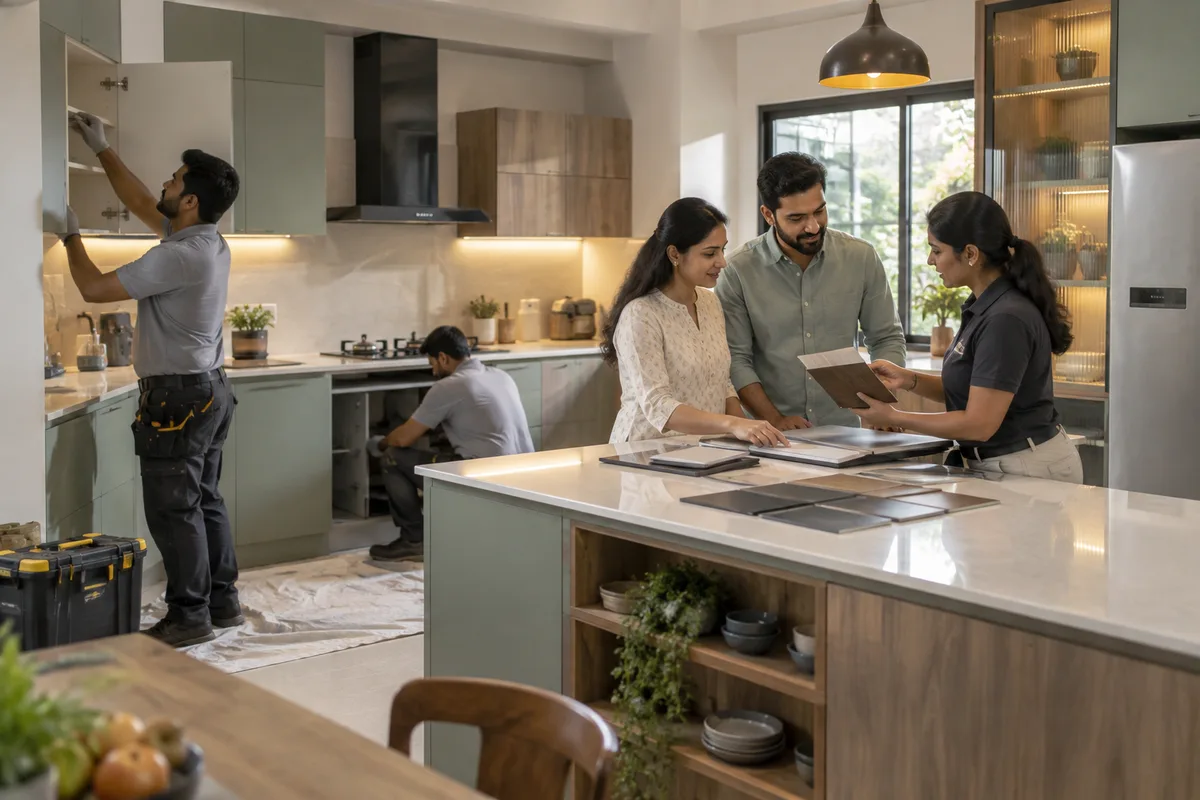
A modular kitchen manufacturer cuts, edge-bands, finishes and packs kitchen cabinets and shutters in a factory, then sells them through franchise showrooms, builders, interior designers and direct customers. GullySales builds the dealer and builder pipeline around your factory, so the kitchens you can make reach the people who specify them.
The one that sends a sample unit with the hardware named, a rate per apartment type and a person to call when a shutter arrives scratched is the one the purchase team can compare line by line. Kitchens are the most considered purchase in a home interior. The customer measures, compares, returns for a second visit and brings the family. The factory behind the showroom stays out of sight, yet each complaint about a hinge, a swollen carcass or a late delivery lands on it.
Last updated 18 Oct 2026.
How buyers decide
How modular kitchen manufacturers are chosen.
A showroom owner or kitchen studio picks a factory on finish quality, hardware choice, how well drawings convert into cutting lists, and whether the factory delivers when the customer's tiles are down. The first project is a test. If the cabinets arrive with the wrong shutter size, that dealer moves to the next factory.
Builders and developers buy by the project. The purchase team asks for a sample kitchen, a rate per type of flat and proof that the factory has done the same quantity before. Interior designers want a factory that can work from their own drawing and keep the finish the same across fifty homes.
Homeowners reach the factory only through its own brand. They search modular kitchen near me, read reviews, see the designs on Instagram and visit the experience centre before they commit.
The problem
What usually goes wrong for modular kitchen manufacturers.
What owners tell us on the first call, in their words.
“Our dealers are loyal until a cheaper factory visits”
A franchise showroom with ten kitchens a quarter has no contract to hold. A rival's rate card and a free sample are enough to move the owner.
“Builder enquiries go to whoever answers first”
Project enquiries arrive by phone to different people, nobody logs the unit count, and the quote goes out three days later with the wrong configuration.
“Designers send drawings that do not match our modules”
A drawing arrives in a size that is not in our standard range, and the back-and-forth over modifications costs more than the order is worth.
“Complaints reach us without a record”
A dealer calls about a hinge or a shutter and nobody knows which batch it was. The same fault returns from the same lot.
“Our brand means nothing to the end customer”
The homeowner knows the showroom's name and not ours. When a dealer leaves, the customers go with the showroom.
“Finish and hardware choices are explained on the phone”
Every dealer asks the same questions about plywood grades, laminate and hinge brands, and each hears a slightly different answer.
What we do
What we do for modular kitchen manufacturers.
Everything included for modular kitchen manufacturers.
A dealer proposition pack
A document for prospective showroom owners covering what the factory supplies, the minimum space, the design software, margin structure and what support the factory gives on site.
A builder project enquiry form
A form and quote sheet that records unit types, quantity, finish, hardware and handover schedule, so every project enquiry is quoted from the same facts.
A finish and hardware guide
A single guide to carcass boards, shutter finishes and hardware, explained in plain words and shown against the price tier they belong to.
A designer module catalogue
A catalogue of standard module sizes, edge options and customisation limits, with the process for sending a drawing and the changes that carry a charge.
A complaint and batch log
A simple register tying each complaint to the order, the batch and the dealer, with who replied and when it closed.
Brand pages for the end customer
A consumer site and Google Business Profile for each showroom, showing kitchens the factory built, so the buyer knows whose product it is.
How the result is measured
- Dealer enquiries and showrooms signed
- Builder project quotes sent and won
- Designer specifications received
- Reply time to project enquiries
- Orders per dealer after the first
- Complaints by batch and dealer
Recorded as a baseline before work starts, so every later report has an honest comparison.
Every service, written for modular kitchen manufacturers
Each has its own page: what it involves for modular kitchen manufacturers, what you get, and what it is measured on.
- Lead generationFind the showroom owners, builders and designers who would specify your kitchens.
- SEOLet a purchase head searching for a kitchen factory find your range and your finishes.
- Social media marketingUse social posts to show the factory floor and finished kitchens to dealers and builders.
- Content marketingWrite the guides a showroom owner or purchase head would forward to a colleague.
- Buyer personasWrite down who actually decides: the showroom owner, the purchase head or the designer.
- CRMRecord each dealer, builder and quote so no kitchen enquiry depends on one person's memory.
- Follow-up systemsPut a named person and a next date on every dealer, builder and designer enquiry.
- WhatsApp marketingSend catalogues, rate cards and sample photographs to dealers and builders where they already chat.
- Digital marketingPlan search, social, email and calls around the trade buyers who place kitchen orders.
- WebsiteBuild a site that lets a purchase head compare your finishes, hardware and projects at a glance.
Worth a page and a campaign of their own
Franchise and dealer showroom recruitment · Builder and developer project kitchens · Interior designer and architect supply · Laminate, acrylic and PU shutter ranges · Straight, L-shaped and parallel kitchen layouts · Hardware packs and accessories · Home appliance-ready kitchens with chimney and hob cut-outs · Replacement shutters for existing carcasses
Priority campaigns
Campaigns for what modular kitchen manufacturers most want to sell.
Each one planned around when your buyers decide, and measured against the baseline.
Dealer recruitment in uncovered cities
A target list of kitchen studios, hardware shops and furniture showrooms, a proposition pack and a series of calls and meetings tracked to a decision.
Builder sample kitchen invitation
A short outreach to purchase heads of residential developers, inviting them to see a sample kitchen and a past project at your factory or experience centre.
Designer specification campaign
A portfolio, module catalogue and sample board delivered to interior designers who work in your markets.
Modular kitchen search campaign
Search ads and pages for modular kitchen designs and price in each city a showroom serves, passing every enquiry to the nearest dealer with a reply deadline.
Festival and housewarming push
A campaign timed to the months when new homes are handed over and families renovate before a festival, with a booking date that lets the factory finish in time.
Beyond search
Where we reach buyers of modular kitchen manufacturers, beyond Google.
Search matters, but it is rarely the only way this industry's buyers find a supplier.
Kitchen studios and furniture dealers
A list of kitchen studios by town, with call notes kept per studio so each conversation resumes where it stopped.
Developers' purchase teams
Builders with projects nearing handover, and a sample-kitchen invitation addressed to the purchase head.
Interior designers and architects
A portfolio and module catalogue for designers working inside your delivery area.
Hardware and appliance brand partners
Shops that sell chimneys, hobs and hardware meet kitchen buyers at the moment of choosing, so a written referral arrangement is drawn up with each.
Who it is for
This is written for these modular kitchen manufacturers.
- Franchise-network modular kitchen brands with their own factory
- Contract manufacturers who make kitchens for other brands' showrooms
- Project-focused factories supplying builders and developers
- Regional factories supplying local kitchen studios and carpenters
- Factories offering PU, acrylic and laminate shutters at different price points
- Kitchen accessories and wardrobe makers adding kitchens to their range
- Small-town manufacturers selling directly through one showroom
- Export-oriented kitchen cabinet makers
Not for
It is not the right fit if.
- You want a guaranteed Google ranking or a guaranteed number of leads. Nobody honest can promise either.
- You need enquiries by next week and have nobody to answer them.
- You want posts and reach reported, not enquiries and orders.
How it works
From your first message to the first report.
No open-ended retainer. Every step gives you something in writing.
First
Your brief
You tell us what you need in a few short steps: your business, what you want, where enquiries come from and how they are handled.
After the brief
A conversation and a written scope
We read it, then talk with whoever handles your enquiries. If you want our help, the scope, the fee and the reporting come in writing, and nothing starts before you have read them.
Before work starts
Baseline recorded
The numbers this work is meant to move, such as enquiries, quotations, orders, visits or renewals, written down so every later report has an honest comparison.
After the baseline
The first fix goes live
The fix we agreed to start with is put in place and measured against the baseline, whether that is a reply, a follow-up, a page, a listing or the handover between marketing and sales.
As agreed
Report against the baseline
What moved, what did not, and what changes next, in plain words. How often you get it is set in writing before work starts.
At renewal
Renew on the numbers
The term ends and you decide whether to continue from the results. The length is agreed in writing before anything starts.
How the work runs for modular kitchen manufacturers
- 1
Walk the factory and list the shutter ranges and prices
The requirements brief is read first. Then a visit or call to the factory covers the shutter ranges it makes, how each is priced and which dealers have stayed.
- 2
Trace dealer and project enquiries from call to order
Dealer and project enquiries are traced from first contact to order, with a note of who held each quote and where it stalled.
- 3
Pick the lead channel and note today's dealer and project numbers
We decide whether dealers, builders or designers should lead, and record your current dealer and project numbers as the starting point.
- 4
Build the dealer pack, builder form and finish guide
The dealer pack, builder form, finish guide, showroom pages and outreach lists are built against the factory's own price tiers.
- 5
Compare dealers signed and quotes won with the start
Dealers signed, project quotes and orders are compared with the starting point, and the channel mix is adjusted from what the numbers show.
Why us
Why owners pick GullySales over an agency.
Marketing and sales, as one job
Most agencies stop at the enquiry. We also fix what happens after it: the reply, the follow-up, the quote and the CRM.
The person on the first call does the work
No account managers in between. You are never handed to someone you have not met.
A baseline before anything starts
Your numbers are written down on day one, so every later report compares against something honest.
The fee in writing, split three ways
Our time, your media spend and production on separate lines. You always see what goes to us.
No guarantees we cannot keep
The term is agreed in writing and never a default twelve months. We never promise a ranking or a lead count, because nobody controls those.
One office, and we say so
Nagarbhavi, Bengaluru. We work across India by call and WhatsApp and travel when a session needs to be in person.
#257, 3rd floor, Sri Nanjundeshwara Complex, Nagarbhavi 8th Block, Outer Ring Road. How we work.
Engagement options
Ways to work with us.
Pick the size of commitment that fits. Every option starts with your brief and a conversation.
Option 1
The conversation on its own
A call after you send your brief. It says honestly whether you need outside help, and many fixes are ones your own team can make.
Option 2
One fix, scoped
Start with the fix that matters most, such as reply time or follow-up. The fee is in writing before anything starts.
Option 3
An ongoing programme
We run the work, report against the baseline, and you renew on the numbers. The term and the reporting are agreed in writing first.
Option 4
Guidance for your own team or agency
We plan, brief and check the work of your in-house team or current agency, instead of replacing them.
Your brief
Tell us what you need, and we will read it before we call.
Eight short steps about your business, what you want and who decides. Most questions are a tap, and you can skip any you would rather answer on the call.
FAQ
Questions modular kitchen manufacturers ask before they call.
Not here? More answers, or ask on WhatsApp.
Should a kitchen factory sell direct to homeowners or only through dealers?
What is the difference between your work and a kitchen company's marketing?
How do we get builders to look at us before the tender?
Can you help us keep the dealers we already have?
Do you give us a price for all this?
How long is the contract?
How soon will we see results?
Who will actually do the work?
What do you need from us?
What if we are not happy with the work?
Part of Manufacturing. See the other industries in the sector.
Your next practical step
Tell us what you are trying to grow, and we will read it before we call.
Eight short steps, mostly taps. Skip anything you would rather answer on the call.