Auto parts manufacturers · Website
Build a catalogue site organised by part number and vehicle fit.
Website development for an auto parts manufacturer means a site structured around a searchable catalogue by part number and vehicle compatibility, with certification and MOQ stated clearly. It replaces a brochure site that only describes the company. GullySales builds this so distributors and export buyers can self-serve a quote request.
Scope, fee, reporting and term are agreed in writing after we have read your brief and spoken to you.
What website means
A website is the page a customer lands on after searching, clicking an advert or scanning a code, and it decides whether they call or leave. GullySales builds and maintains sites that load quickly, explain the offer plainly and make the enquiry form or phone number easy to find.
Also for auto parts manufacturers
- Answer engine optimisation for auto parts manufacturers
- Google Business Profile for auto parts manufacturers
- SEO for auto parts manufacturers
- Branding and identity for auto parts manufacturers
- Content marketing for auto parts manufacturers
- Digital marketing for auto parts manufacturers
- Email marketing for auto parts manufacturers
- Influencer marketing for auto parts manufacturers
Sales and marketing for auto parts manufacturers, the overview.
Last updated 5 Oct 2026.
For auto parts manufacturers
Where it usually goes wrong, and what we would do.
“A searchable catalogue beats a PDF download”
A distributor searching for a specific part number expects to find and filter it on the site, not download a large PDF.
“Certification and MOQ need their own visible section”
Buyers look for this information early, and burying it in a contact page loses enquiries that would otherwise convert.
“The quote form should ask for the part number first”
Starting with the exact requirement instead of general contact details gets the sales team a usable enquiry from the first message.
What we do
What we deliver for auto parts manufacturers.
Every deliverable, what it covers for you, and the result it is there to produce. Nothing here is an extra.
Searchable catalogue by part number and fitment
A catalogue a buyer can search and filter by part number and vehicle model, replacing a static PDF download.
Result: A buyer finds the exact part without downloading or scrolling a long file.
Dedicated certification and MOQ section
A clearly linked page stating your certifications, minimum order quantity and lead time, instead of burying it in a contact page.
Result: A buyer gets this information without having to ask.
Quote request form starting with the part number
A form asking for the exact part number and quantity first, before general contact details.
Result: The sales team receives a usable enquiry from the first message.
Export buyer section with sample process explained
A page setting out how to request a sample, what certification is provided, and how shipping is handled.
Result: A first-time export buyer understands the process before writing an email.
Site enquiry report against the baseline
A report of enquiries by part category and page, checked against the baseline recorded at the start.
Result: You know which catalogue page is actually generating enquiries.
How the result is measured
- Page load time
- Bounce rate
- Enquiries from the website
Recorded as a baseline before work starts, so every later report has an honest comparison.
What the page must show
What an auto parts manufacturer's website must show before a buyer sends an enquiry.
- Part number, cross-reference and fitment
- Let a buyer search by your part number and, where you are allowed to, by the OEM reference and vehicle model. A distributor with a list in hand will not scroll a category page.
- Material, dimensions and drawing for each part
- Show the material grade, key dimensions, surface treatment and, where it is not confidential, a drawing. A purchase engineer wants to know the part is right before asking for a price.
- Certificates with number and validity
- Show the ISO 9001 or IATF 16949 certificate you really hold, with its number, scope and validity. Do not list one that belongs only to a sister plant or lapsed.
- MOQ, packing and the dispatch point
- State the minimum order per part, how it is packed, where it dispatches from and the usual lead time your plant can keep. A buyer with a stock plan needs these before a sample.
- Export papers a foreign buyer asks for
- Name your IEC, the HS code for the main parts, the ports you ship from and the Incoterms you quote. An importer reading your page should not need to email to learn whether you export properly.
- The plant and the inspection room
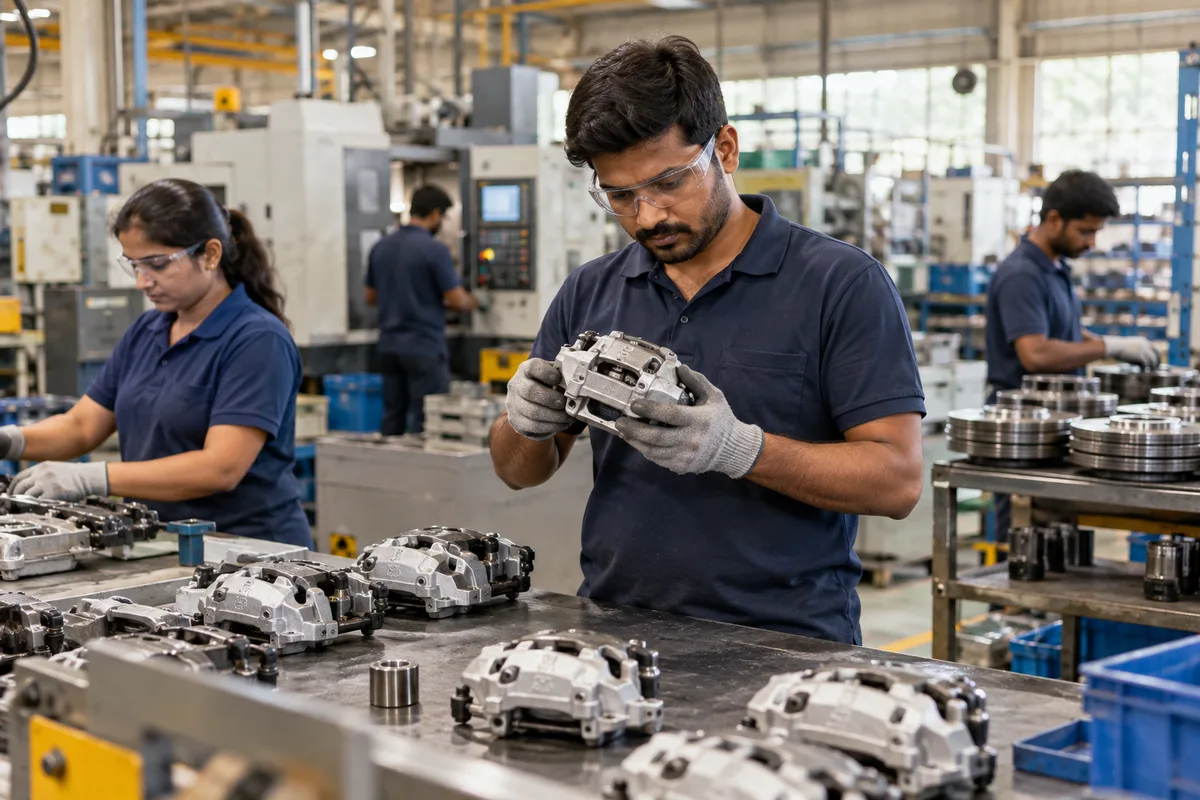
- Photograph the machines, the gauges and the inspection area with real staff at work. An OEM auditor is often shortlisting from the website before any plant visit.
Who it is for
This is written for these auto parts manufacturers.
- Component manufacturers supplying OEMs
- Aftermarket spare parts manufacturers
- Export-focused parts manufacturers
- Tier 2 and Tier 3 component suppliers
- Two-wheeler parts manufacturers
- Commercial vehicle parts manufacturers
- Casting and forging units supplying parts
- Manufacturers with an in-house aftermarket brand
Not for
It is not the right fit if.
- Your part data is spread across drawings, sheets and memory, so a searchable catalogue would publish figures nobody has verified.
- Your range changes every few months and nobody owns updates, so the site would fall behind the price list.
How it works
How the website work runs
The work itself, in order. How an engagement starts, from your brief to a written scope, is set out on our method page.
- 1
Confirm structure and content
We agree the page list, what each page must answer, and who supplies the text and photographs, before any design starts.
- 2
Design the templates
The home page, a service page, a location page and the enquiry page are designed first, on phone and desktop, and shown to you.
- 3
Build and test
The site is built and checked on real phones and the common browsers. Every form, call button and WhatsApp link is tested end to end.
- 4
Load real content
Actual copy, images and information replace placeholders. Pages are read through once by you, since you spot wrong details we cannot.
- 5
Check before launch
Tracking, page titles, the sitemap and the privacy page are checked on the staging site. If an old site exists, its addresses are mapped so old links still land somewhere.
- 6
Launch and hand over access
The site goes live and we record the domain, hosting, content login and analytics in your name. The first live enquiry is traced to confirm tracking works.
Where this fits
Three pieces of sales work, in this order.
This work sits inside sales process design, at stage 1, prospecting and lead generation. The audit comes before it, and sales management keeps it running.
Step 1
Sales audit
Find where deals are being lost and what to fix first.
Start here if you cannot say where orders are lost.
Step 2 · you are here
Sales process design
One written way to sell, from first enquiry to repeat order.
Start here if every salesperson sells differently.
Step 3
Sales management
A target, a review routine and someone who owns the number.
Start here if the team has targets and no routine.
FAQ
Questions owners ask before they call.
Not here? More answers, or ask on WhatsApp.
How long does this take to build?
Can our old catalogue content be reused?
Should the catalogue show prices?
Can we show the OEM brands we supply?
How long is the contract?
Who will actually do the work?
What do you need from us?
What if we are not happy with the work?
From the blog
Further reading for auto parts manufacturers.
 6 min read · 10 Oct 2026How manufacturers can generate enquiries from relevant business buyersRelevant RFQs come from buyers who can verify you: product pages with real specifications, listings that match what you make, and a way to screen requests quickly.
 6 min read · 6 Oct 2026How buyers choose a showroom, workshop or parts counterCar, bike, repair and parts buyers send one enquiry to several sellers and pick the first clear answer. This post lists what each buyer checks, and where a dealer or workshop quietly loses them.
 5 min read · 26 Sept 2026Certifications buyers ask for: ISO, test reports and what to show on the websiteShow each certificate with its number, scope, issuing body and validity date, and link the PDF, so a buyer's quality team can check you before they ring.
More for auto parts manufacturers
Everything else we would do for you.
Closest to this: search and visibility
Also for auto parts manufacturers
Or start from the overview: sales and marketing for auto parts manufacturers.
Your next practical step
Tell us what you are trying to grow, and we will read it before we call.
Eight short steps, mostly taps. Skip anything you would rather answer on the call.