Battery manufacturers · Dealer network brand visibility
A customer with a dead battery should find your genuine dealer, not a lookalike shop.
For a battery maker, dealer network brand visibility means every authorised outlet carries your name the same way on the board, the counter and the map, so a stranded customer can tell who sells the real product. GullySales writes the outlet standard and the dealer record, then lines up listings and dealer pages against them.
Scope, fee, reporting and term are agreed in writing after we have read your brief and spoken to you.
What dealer network brand visibility means
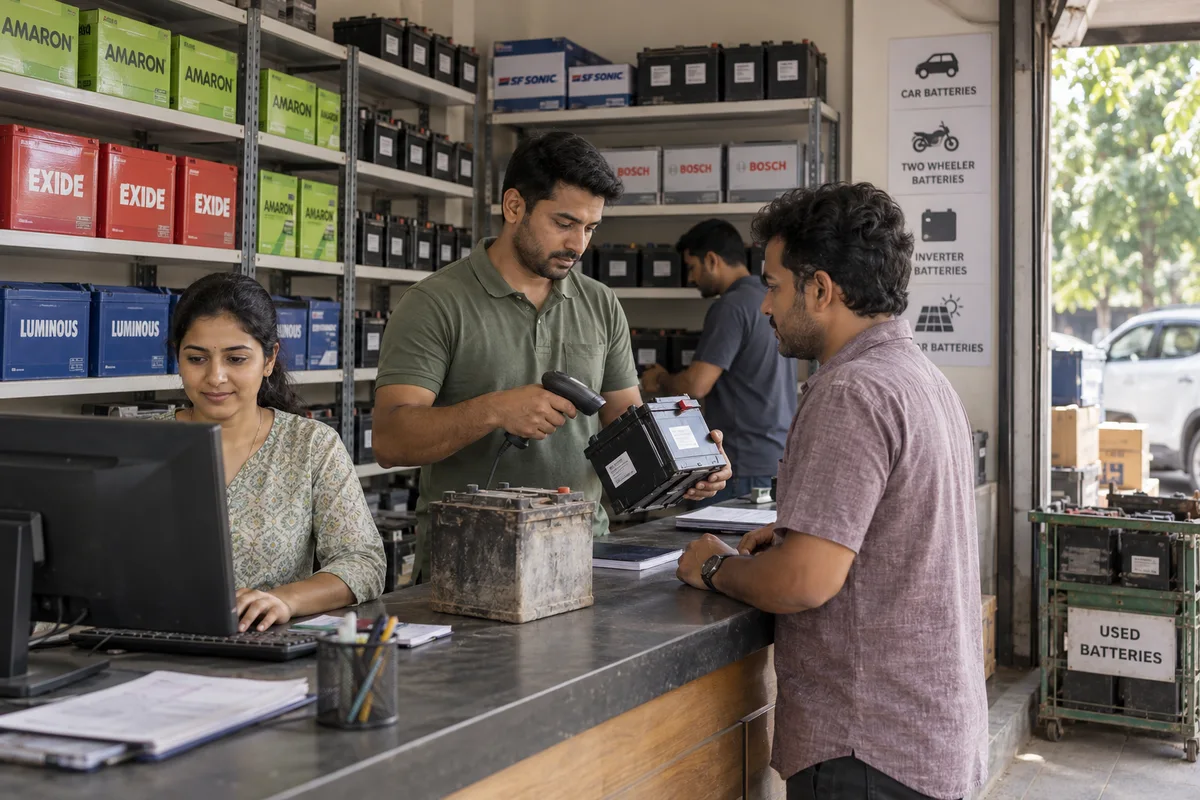
Dealer network brand visibility makes your brand look consistent and findable at every dealer outlet, on the street and online. GullySales sets the shop-front standard, the dealer brand kit and one agreed dealer record, aligns listings and locator pages to it, and checks each outlet against the standard by visit or photo.
Also for battery manufacturers
- Lead generation for battery manufacturers
- SEO for battery manufacturers
- Social media marketing for battery manufacturers
- Content marketing for battery manufacturers
- Buyer personas for battery manufacturers
- CRM for battery manufacturers
- Follow-up systems for battery manufacturers
- WhatsApp marketing for battery manufacturers
Sales and marketing for battery manufacturers, the overview.
Last updated 18 Oct 2026.
For battery manufacturers
Where it usually goes wrong, and what we would do.
“The board is the first proof of a genuine battery”
A customer in a hurry walks into the shop whose board looks like the one on the carton. Where dealers painted their own signs years ago, a copycat seller with a similar logo gets the same walk-in, and the maker hears about it only when a fake fails.
“Maps lists the dealer by a name nobody printed”
A search for inverter batteries near me returns a shop under an old trade name, a personal mobile number and a pin on the wrong lane. The call goes to a family member who does not stock the brand. The enquiry is lost before any dealer scheme has a chance to work.
“One shop sells four brands, so the brand corner decides”
The dealer will not give a whole wall to one battery maker. What remains is a rack, a shelf strip or a hanging poster, and its placement and wording decide whether the brand is noticed. A standard that asks for a full showroom will be ignored; one that fixes a small, clear corner can be followed.
“Exchange and warranty boards need the same words everywhere”
If one counter shows an old-battery exchange offer and the next shows none, customers compare and complain. The maker's scheme reads as unreliable when it is only displayed unevenly. Shared wording on the exchange and claim boards removes that argument at the counter.
What we do
What we deliver for battery manufacturers.
The work available for this need. We agree the deliverables and responsibilities for your engagement in writing.
Battery dealer outlet standard
A written standard for the fascia, the brand corner, the rack, the exchange and warranty notice and the delivery vehicle, with sizes, placement and what must not appear beside rival brands. Your brand owner signs it before dealers see it.
Result: A dealer and a printer can read the same page and make the same board.
Dealer brand kit
Master files for boards, rack strips, stickers, uniforms and vehicle branding in the formats a local printer asks for, with a named person who approves any variation.
Result: A printer in a small town can start work from the kit without a call to head office.
One dealer record
A sheet holding each outlet's trading name, address, map pin, phone, hours, product range and the person who confirms changes. Every listing and web page is written from this sheet.
Result: The name and number on the board, the map and your website match the sheet.
Listing alignment, including multi-brand shops
Google and directory entries checked against the record, with duplicates and wrong names listed. Where a shop sells several brands, the naming follows the platform's current rules on dealers and resellers, and the dealer submits changes under its own login.
Result: A list shows which dealers are correct, which are duplicated and which are still open.
Genuine-dealer locator page
A page on your site that lists authorised outlets from the record, with a plain note on how to tell a genuine battery and whom to call about a suspected copy.
Result: A customer can check a shop against your list before buying.
Outlet check and correction list
A visit or dated photos of board, brand corner, exchange notice and vehicle, marked against the standard. Each failing item has an owner and a note of who pays.
Result: Head office can see which dealers still carry old signs and why.
How the result is measured
- Outlets matching the written standard, by touchpoint
- Dealers with correct name, address and phone on Google and directories
- Duplicate or outdated dealer listings still open
Recorded as a baseline before work starts, so every later report has an honest comparison.
Who it is for
This is written for these battery manufacturers.
- Automotive and two-wheeler battery makers selling through dealers
- Inverter and home UPS battery makers
- Tubular and industrial battery makers for telecom, forklifts and power backup
- E-rickshaw and low-speed EV battery makers
- Lithium-ion pack assemblers for EVs and energy storage
- Solar storage battery makers
- Battery makers supplying OEMs under their brand name
- Small battery and cell makers for consumer devices
Before you decide
Agree the work. Know how to judge it.
Dealer network brand visibility for battery manufacturers: use these checks to prepare, choose the scope, and review what changes.
Bring the right evidence
Map existing partners, their territories, and the customers they serve. Review active selling and repeat orders separately from the number of partners signed up.
Make the scope clear
Agree partner fit, territory rules, onboarding, and support responsibilities. Clarify how direct enquiries and partner enquiries are assigned before starting recruitment.
Check the work in use
Follow a partner enquiry through to an order and the next purchase. Check whether the partner has the product knowledge and material needed to sell without repeated intervention.
Know when to change course
If current partners cannot sell because supply or support is weak, resolve that before recruiting more. A bigger network can spread the same problem further.
These are discussion points, not a fixed package. GullySales confirms the deliverables, responsibilities, fee, and term in writing after reading your brief and speaking with you.
How it works
How the dealer network brand visibility work runs
The work itself, in order. How an engagement starts, from your brief to a written scope, is set out on our method page.
- 1
Network and standard scope
After your requirements brief and a conversation, we agree which dealers and which touchpoints are in. The written scope names your approver and records the fee and term.
- 2
Outlet and listing baseline
We gather photos of current boards and vehicles and search for each dealer online. The baseline records what exists before anything changes.
- 3
Standard and kit sign-off
We draft the outlet standard, the dealer brand kit and the dealer record. Your brand owner approves the standard, and your channel head agrees what dealers must change and what they may keep.
- 4
Dealer briefing and corrections
Dealers receive the kit and a short briefing in their language. Each dealer confirms its record and confirms or corrects its listing under its own login.
- 5
Outlet check and review
We mark each outlet against the standard from visits or photos. Your channel sales owner receives the correction list and decides which dealers need a follow-up.
Where this fits
Three pieces of sales work, in this order.
This work sits inside sales process design, at stage 1, prospecting and lead generation. The audit comes before it, and sales management keeps it running.
Step 1
Sales audit
Find where deals are being lost and what to fix first.
Start here if you cannot say where orders are lost.
Step 2 · you are here
Sales process design
One written way to sell, from first enquiry to repeat order.
Start here if every salesperson sells differently.
Step 3
Sales management
A target, a review routine and someone who owns the number.
Start here if the team has targets and no routine.
FAQ
Questions owners ask before they call.
Not here? More answers, or ask on WhatsApp.
Our dealers also sell rival batteries. Can a standard still work?
Who pays for new boards at the dealer?
Can you help us deal with shops selling copies of our label?
How much does it cost?
How long is the contract?
How soon will we see results?
Who will actually do the work?
What do you need from us?
What if we are not happy with the work?
More for battery manufacturers
Related work to consider.
Or start from the overview: sales and marketing for battery manufacturers.
Your next practical step
Tell us what you are trying to grow, and we will read it before we call.
Eight short steps, mostly taps. Skip anything you would rather answer on the call.