Garment manufacturers · Search engine optimisation
Brand founders search for a low minimum order quantity, not for a factory.
SEO for a garment unit decides who a D2C founder or a sourcing team finds when they search for a private label manufacturer in your product and your cluster. GullySales builds a page for each product you make, puts the minimum order quantity where buyers look, and gets the factory indexed.
Scope, fee, reporting and term are agreed in writing after we have read your brief and spoken to you.
What search engine optimisation means
Search engine optimisation (SEO) is the work of getting your website to appear when a buyer searches Google for what you sell. GullySales builds pages around real search terms, fixes technical issues that block ranking, and tracks which searches actually bring enquiries.
Also for garment manufacturers
- Local SEO for garment manufacturers
- Website for garment manufacturers
- PPC ads for garment manufacturers
- Lead generation for garment manufacturers
- Digital marketing for garment manufacturers
- Reputation management for garment manufacturers
- Branding for garment manufacturers
- Social media marketing for garment manufacturers
Sales and marketing for garment manufacturers, the overview.
Last updated 5 Oct 2026.
For garment manufacturers
Where it usually goes wrong, and what we would do.
“The cluster name is half the search”
Buyers type Tiruppur, Ludhiana, Bengaluru or Delhi NCR alongside the product, because the cluster tells them the fabric, the price and the lead time. A heading with no cluster in it misses that search.
“Minimum order quantity is the filter, so publish it”
A founder with a budget for three hundred pieces will not write to a unit that hides its minimum. Stating it loses only the enquiries you would have turned down.
“One products page covering nine categories ranks for none”
Knitted polos, women's kurtas, kids' wear and activewear are separate searches with separate fabric questions. A page listing all of them answers none.
What we do
What we deliver for garment manufacturers.
Every deliverable, what it covers for you, and the result it is there to produce. Nothing here is an extra.
A page for each product type you make
Knitted T-shirts and polos, shirts, bottoms, kurtas, kids' wear and activewear, each covering fabric, GSM ranges, sizes, minimum quantity and sampling time.
Result: A brand searching for its own product finds your unit.
The cluster and the city in every heading
Product pages written with your cluster named where buyers type it, plus a page on sourcing from that cluster with lead times and fabric access.
Result: You appear in the search that includes the place.
Minimum quantity and sampling published plainly
Your minimum by product, the sampling charge and turnaround, and what changes when fabric has to be knitted for the order.
Result: Enquiries arrive from buyers who can meet your minimum.
The factory shown rather than described
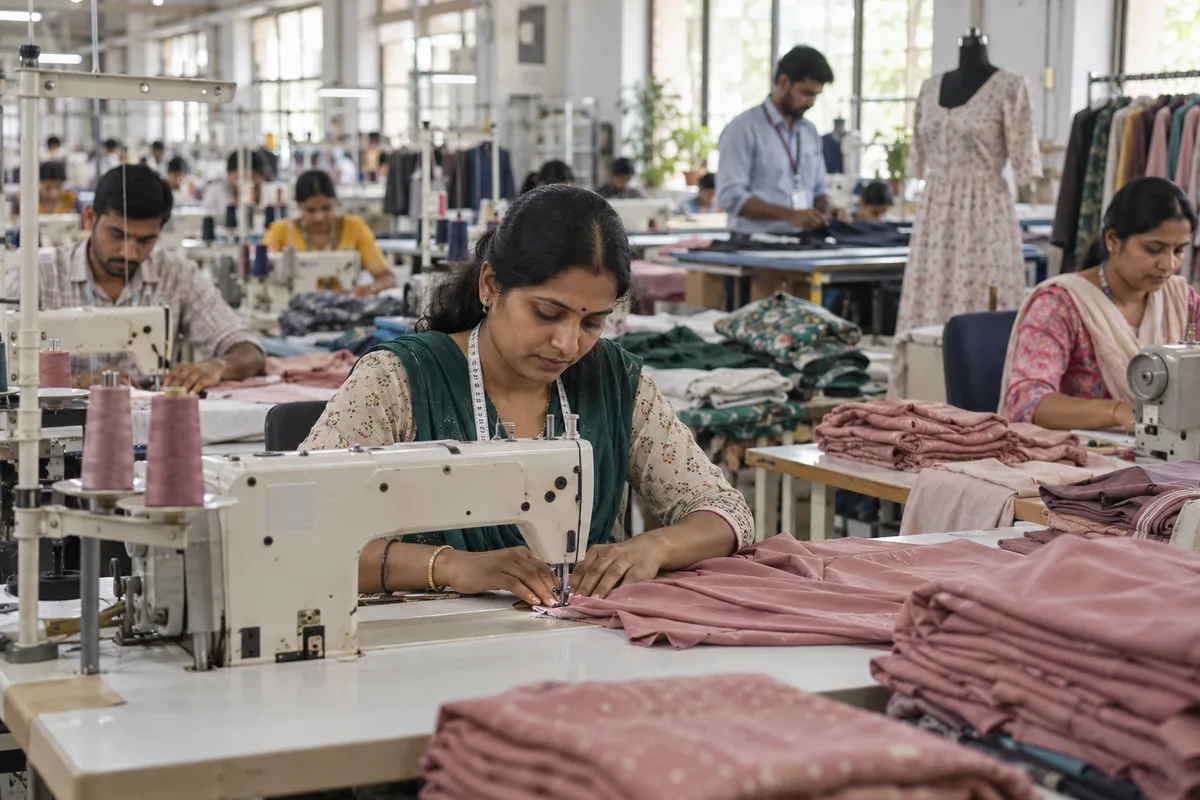
Photographs and short video of cutting, stitching, printing and finishing, with machine counts and monthly capacity written beside them.
Result: A buyer gets their answer without a phone call.
Technical faults cleared off the site
A slow site, heavy factory images and pages search engines cannot read properly, fixed so your product pages stand a chance.
Result: The pages you wrote become findable.
A report by product page
Positions, visits and enquiries for each product page, set against the starting baseline.
Result: You can see which product deserves more pages.
How the result is measured
- Ranking positions
- Organic traffic
- Enquiries from organic search
Recorded as a baseline before work starts, so every later report has an honest comparison.
Searches your buyers type
What a brand or a sourcing team types when looking for a factory, and the page that answers it.
- T-shirt manufacturer in Tiruppur private label
- A product page. State the fabrics and GSM you knit, the print and embroidery you do in-house, the minimum quantity and how sampling is handled.
- minimum order quantity for kurta manufacturing
- An order-size page. Give the minimum per style and per colour, how mixed sizes are counted and what changes for a small first order.
- kids wear manufacturer for export from Ludhiana
- A kids wear page. Describe the tests and certificates for children's garments that you actually hold, and the buyers' checks your unit has passed.
- activewear manufacturer for a D2C brand
- An activewear page. List the fabrics, the stitching types and the samples you have made for sportswear, and how a tech pack is costed.
- garment manufacturer with BSCI or WRAP certificate
- A compliance page. State only the certificates you hold with their dates, and say what a buyer can ask to see on a factory visit.
- uniform manufacturer for corporate bulk order
- A uniform page. Show the cloth and fits you offer, how sizes are collected from staff and how repeat orders are handled.
Who it is for
This is written for these garment manufacturers.
- Knitwear and T-shirt manufacturers
- Woven shirt and trouser manufacturers
- Women's ethnic wear manufacturers
- Kids' wear manufacturers
- Export-oriented garment units
- Private label and contract manufacturers for D2C brands
- Corporate, promotional and uniform garment makers
- Activewear and athleisure manufacturers
- Job work and CMT units
Not for
It is not the right fit if.
- You have no fixed minimum order or sampling terms, so a page built for search would draw enquiries you cannot answer the same way twice.
- Your lines are fully booked for the season and you do not want new buyers, so more search enquiries would only be declined.
- The factory has no photographs or product samples to show, and a search page without proof reads like a trader's listing.
How it works
How the search engine optimisation work runs
The work itself, in order. How an engagement starts, from your brief to a written scope, is set out on our method page.
- 1
Audit and baseline
We record where the site stands today: positions, traffic, technical faults and the enquiries search currently produces. Nothing starts until this number is written down.
- 2
Decide what to rank for
We map the searches your buyers use, in your words and theirs, and pick the ones worth the effort for your margin and your capacity.
- 3
Fix the foundations
Technical faults first, because the cheapest gains are there. Then the Business Profile and directory consistency.
- 4
Build the pages
A page for each thing you do, written to answer the question it is searched for, with a clear next step at the end.
- 5
Publish and earn mentions
Content goes out on the calendar. Links and mentions are earned from real relationships, not bought.
- 6
Measure, report, adjust
At an interval agreed in writing we report what moved and what did not, and change the plan when the numbers say so.
Where this fits
Three pieces of sales work, in this order.
This work sits inside sales process design, at stage 1, prospecting and lead generation. The audit comes before it, and sales management keeps it running.
Step 1
Sales audit
Find where deals are being lost and what to fix first.
Start here if you cannot say where orders are lost.
Step 2 · you are here
Sales process design
One written way to sell, from first enquiry to repeat order.
Start here if every salesperson sells differently.
Step 3
Sales management
A target, a review routine and someone who owns the number.
Start here if the team has targets and no routine.
FAQ
Questions owners ask before they call.
Not here? More answers, or ask on WhatsApp.
Do garment buyers actually use Google?
What should a manufacturer's website show first?
Should we name the brands we make for?
Should job work and CMT get a separate page?
How much does it cost?
How long is the contract?
How soon will we see results?
Who will actually do the work?
What do you need from us?
What if we are not happy with the work?
From the blog
Further reading for garment manufacturers.

More for garment manufacturers
Everything else we would do for you.
Closest to this: search and visibility
Also for garment manufacturers
Or start from the overview: sales and marketing for garment manufacturers.
Your next practical step
Tell us what you are trying to grow, and we will read it before we call.
Eight short steps, mostly taps. Skip anything you would rather answer on the call.