Printing businesses · Branding
The shop that prints everyone else's brand usually has none of its own.
Branding for a printing business is the name, the sample folder and the board outside that make a buyer choose you over the press two doors down. GullySales fixes what your shop is known for, then builds the identity, the sample kit and the quotation that carry it.
Scope, fee, reporting and term are agreed in writing after we have read your brief and spoken to you.
What branding means
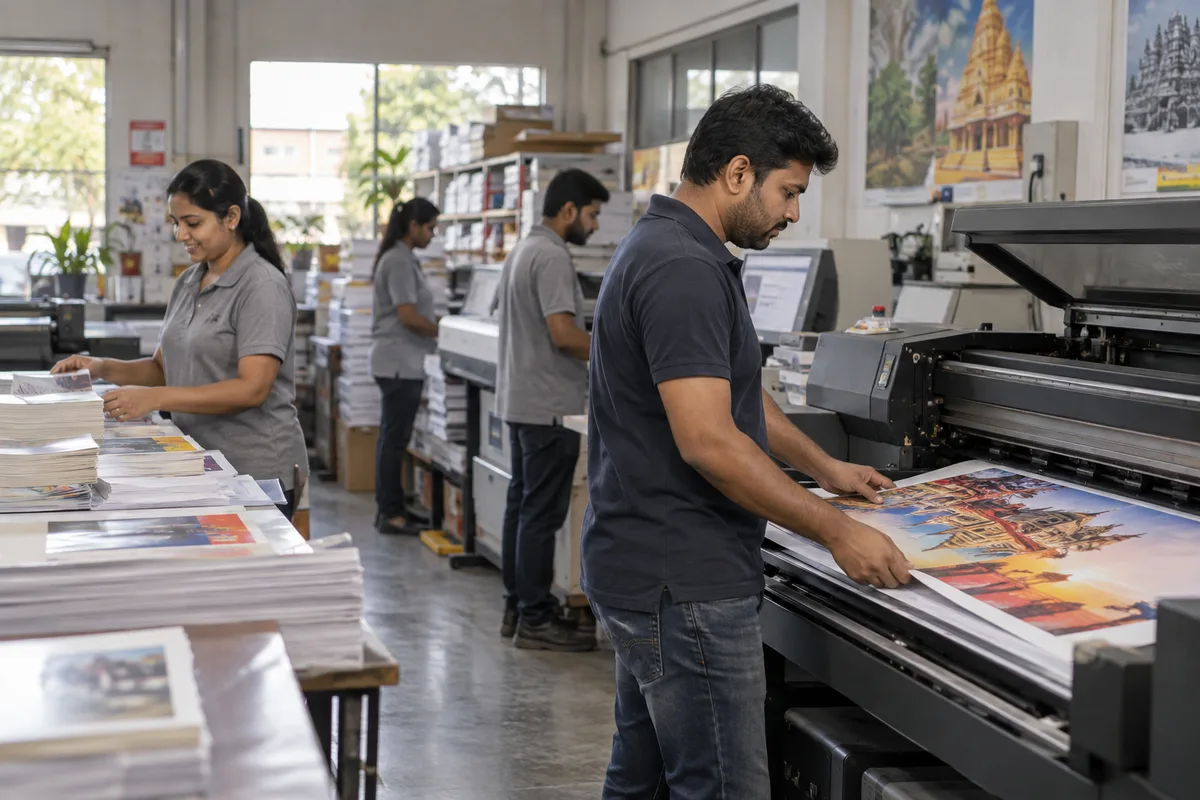
Branding is what a customer remembers about your business beyond the product, including your name, colours, tone of voice and what you are known for locally. GullySales sets or corrects this once and applies it consistently across your website, signage and adverts so the business looks like one company everywhere.
Also for printing businesses
- SEO for printing businesses
- PPC ads for printing businesses
- Lead generation for printing businesses
- Digital marketing for printing businesses
- Reputation management for printing businesses
- Local SEO for printing businesses
- Social media marketing for printing businesses
- Content marketing for printing businesses
Sales and marketing for printing businesses, the overview.
Last updated 5 Oct 2026.
For printing businesses
Where it usually goes wrong, and what we would do.
“Your own printed material is the sample”
A buyer judges a press by its visiting card and its quotation, and a card printed on the cheapest stock says more than any claim about quality.
“Being known for one thing wins the bigger jobs”
The press known for monocartons or for foiled invitations gets asked to quote on them, while the shop that does everything is asked only for rates.
“The sample folder is the brand”
What a buyer touches at the counter decides the order, so a torn plastic file of yellowed samples costs more work than it saves.
What we do
What we deliver for printing businesses.
Every deliverable, what it covers for you, and the result it is there to produce. Nothing here is an extra.
A decision on what the press is known for
One page fixing the job types you want more of, the buyers who pay for them, and what you stop chasing.
Result: Everyone in the shop is selling the same thing.
A name, mark and stationery of your own
A logo that reproduces on a small label and a large board, and your own cards, letterhead and job bags printed properly.
Result: Your own material shows the quality you sell.
A sample kit buyers can keep
A boxed or bound set of your best work by job type, with paper and finish named on each piece, made to be left behind.
Result: The buyer keeps your work on their desk.
A quotation format that looks like the shop
Quotations laid out with specifications, terms and your identity, sent as a proper document rather than a message.
Result: Your price arrives looking like a supplier, not a guess.
Shop front and counter guidance
Board, window display and counter arrangement set so a walk-in sees a press that handles the jobs you want.
Result: The shop sells the work before anyone speaks.
How the result is measured
- Recognition in customer feedback
- Consistency across channels
- Repeat enquiries by name
Recorded as a baseline before work starts, so every later report has an honest comparison.
Positioning in one sentence
The sentence a printing business can fill in so a buyer knows which jobs to bring to you.
We print [products] for [type of buyer] in [area], and unlike [the press two doors down] we [show a proof and a sample before the run].
- Who it is for
- A small business needing cards and bills, a company with regular stationery, a brand wanting labels or cartons, a family printing wedding cards. Pick the buyer whose repeat work you want.
- What you print
- Name the products and processes: offset brochures, digital short runs, flex and vinyl, labels, spot UV. A buyer searching for a product should find your word for it.
- What a buyer gets that the other press does not
- A proof before the run, a sample on the paper they will receive, a quote that lists size, paper and finish. Pick what you do on every job.
- The proof you can show
- A sample folder of real jobs, photographs of the machines, a customer who has reordered for years, and your colour-matching steps written plainly.
- Words buyers ignore
- 'Quality printing', 'quick service' and 'all types of printing' are on every board. Replace them with product names and what you check before the press runs.
- The name and tagline test
- A name ending in 'Printers' or 'Graphics' is shared by many. Add what you do best and the locality, and check how the name looks on a delivery challan and a visiting card.
Who it is for
This is written for these printing businesses.
- Commercial offset printing businesses
- Digital and quick-print shops
- Packaging and label printing businesses
- Large format and signage printers
- Wedding and event stationery printers
- Corporate stationery and print suppliers
- Textile and garment printing businesses
- Print-on-demand and personalised merchandise printers
Not for
It is not the right fit if.
- You have not settled which jobs the press wants to be known for, so a new mark would only repaint a shop with no direction.
- The shop has no samples worth showing yet, so a brand kit would present a promise the work cannot back.
How it works
How the branding work runs
The work itself, in order. How an engagement starts, from your brief to a written scope, is set out on our method page.
- 1
Interview customers and team
We talk to real buyers, won and lost, and to people inside the business who deal with customers daily.
- 2
Review the competitive field
We look at how the nearest competitors present themselves so the position is not accidentally identical.
- 3
Draft the position
A first version of the positioning statement and messaging pillars is written and checked against what customers actually said.
- 4
Test it against real conversations
The draft is tried out in a real sales call or two before it is finalised, since a position that does not survive a real conversation needs rework.
- 5
Hand over the rollout brief
The final position, pillars and not-for list are documented for your team and any agency to apply consistently.
Where this fits
Three pieces of sales work, in this order.
This work sits inside sales process design, at stage 1, prospecting and lead generation. The audit comes before it, and sales management keeps it running.
Step 1
Sales audit
Find where deals are being lost and what to fix first.
Start here if you cannot say where orders are lost.
Step 2 · you are here
Sales process design
One written way to sell, from first enquiry to repeat order.
Start here if every salesperson sells differently.
Step 3
Sales management
A target, a review routine and someone who owns the number.
Start here if the team has targets and no routine.
FAQ
Questions owners ask before they call.
Not here? More answers, or ask on WhatsApp.
Is branding worth spending on for a press?
Should we change our name after twenty years?
Should we print our name on the jobs we deliver?
What should the sample folder show?
How much does it cost?
How long is the contract?
How soon will we see results?
Who will actually do the work?
What do you need from us?
What if we are not happy with the work?
From the blog
Further reading for printing businesses.
 6 min read · 18 Aug 2026Why your business is growing but profit is notRevenue rising while profit stays flat usually means discounts, the wrong customers or an uncalculated acquisition cost, all visible in your own records.
 7 min read · 18 Aug 2026How to get printing orders that repeat every monthPrinting orders come from local searches, corporate and institutional buyers who reorder, and fast quotes. Pick the jobs you print best, show prices, and chase the reorder before the customer runs out.
 6 min read · 8 Apr 2025How to create a sales process for a small businessA sales process is the stages a real order already passes through, each with what must be true before a deal can leave it, reviewed weekly.
More for printing businesses
Everything else we would do for you.
Or start from the overview: sales and marketing for printing businesses.
Your next practical step
Tell us what you are trying to grow, and we will read it before we call.
Eight short steps, mostly taps. Skip anything you would rather answer on the call.