Plotted development companies · Digital marketing
Connect search, ads and your layout page so the click ends in a site visit.
Digital marketing for a plotted development company means using search, social advertising and your own pages together to bring land buyers to a visit. GullySales plans the channels around your approvals, your plot list and your sales team.
Scope, fee, reporting and term are agreed in writing after we have read your brief and spoken to you.
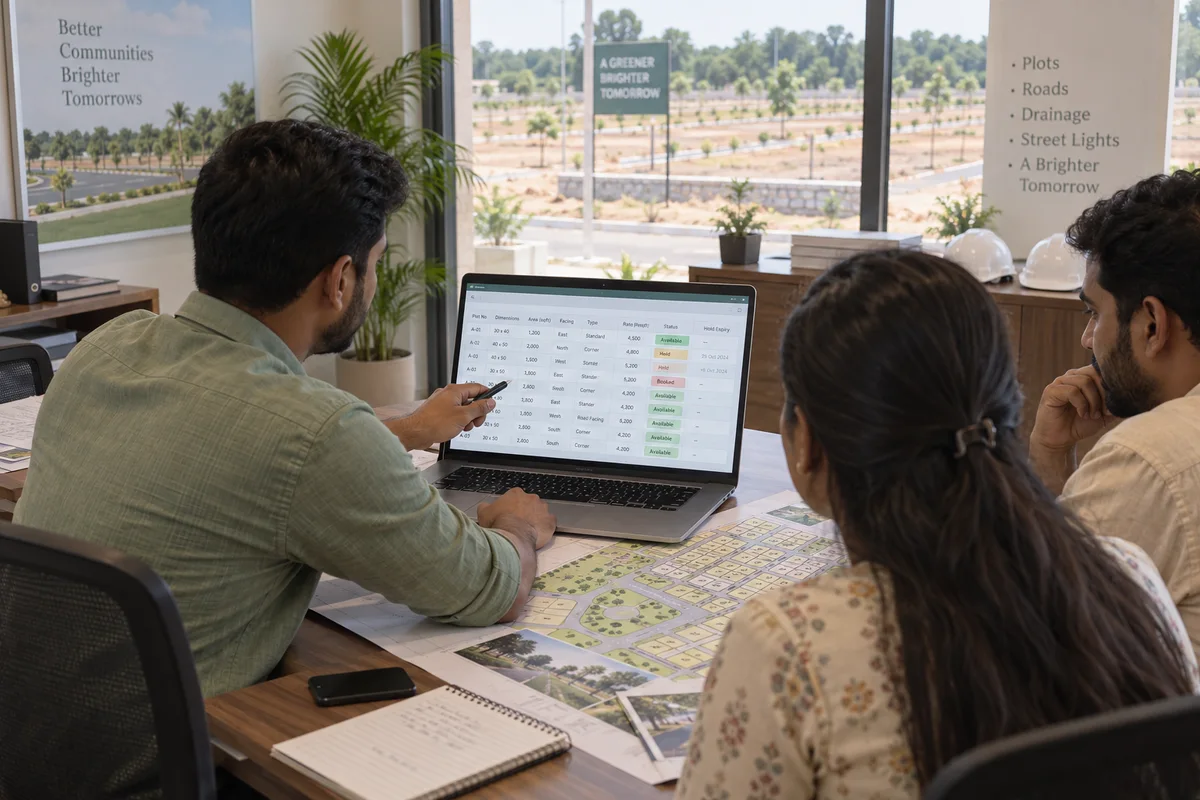
What digital marketing means
Digital marketing is the combined work of search, social media, advertising and website channels running together rather than as separate projects with separate people. GullySales runs these as one connected system so a change in one channel, such as a new offer, is reflected everywhere at once.
Also for plotted development companies
- Buyer personas for plotted development companies
- Lead generation for plotted development companies
- SEO for plotted development companies
- Local SEO for plotted development companies
- Social media marketing for plotted development companies
- Content marketing for plotted development companies
- CRM for plotted development companies
- Follow-up systems for plotted development companies
Sales and marketing for plotted development companies, the overview.
Last updated 14 Nov 2026.
For plotted development companies
Where it usually goes wrong, and what we would do.
“An advertisement that hides the approval wastes the click”
The buyer clicks, wonders about approvals, and cannot find them. An advertisement that states the approval and the plot sizes sends clicks from people who read the approval first.
“Sending ad traffic to a home page loses the locality”
A buyer who clicked an advertisement for a named town should land on the page for the layout in that town. A home page asks them to search again, and some do not.
“Digital sources are judged on calls, not on sale deeds”
A channel that fills the phone with callers who never visit looks successful in a report. Only a record that follows each enquiry to booking shows whether the channel is worth its spend.
“The sales team receives leads they were not told about”
If a campaign starts and the executives do not know the offer, the area or the plot sizes, calls go badly. Briefing the team before the advertisement runs is part of the campaign.
What we do
What we deliver for plotted development companies.
The work available for this need. We agree the deliverables and responsibilities for your engagement in writing.
Channel plan
A plan naming which channels to use for which layout, such as search for ready buyers and video for those still saving.
Result: Each channel has a stated job.
Advertisement set
Search and social advertisements written around approval, locality and plot size, each pointing to the layout page.
Result: Every advertisement leads to a page that repeats its claim.
Tracking set-up
Source tags on every link and call so that an enquiry can be traced to the advertisement that produced it.
Result: The enquiry list shows the source for each entry.
Sales team briefing
A short brief for executives and brokers before each campaign: the offer, the plots, the questions likely to come.
Result: Everyone answers the same way on day one.
Spend and result report
Spend, enquiries, visits and bookings by channel, against the baseline.
Result: You can see cost per booking, not just cost per click.
How the result is measured
- Enquiries across channels
- Cost per enquiry overall
- Channel mix by contribution
Recorded as a baseline before work starts, so every later report has an honest comparison.
Searches your buyers type
Where land buyers look online, and the page each click should end on.
- plots for sale in your locality
- The search ad lands on the layout page for that locality, with plot sizes and approval on the first screen and an enquiry form below.
- Buyers who watched a layout video
- A video view leads to the enquiry page with the site visit details. Keep the ad to what is built today and mark planned work as planned.
- People who opened the plot map and left
- Show them the plot sizes still unsold. Take the ad down as the sizes are booked.
- Families abroad searching for land in their home town
- A page in the buyer's language with the video of the plot and the name of the person to speak with about registration through a power of attorney.
- Investors comparing land near a highway
- A page on road frontage, the approval held and what the company does for the land after sale.
Who it is for
This is written for these plotted development companies.
- Authority-approved residential layouts on city outskirts
- Companies converting agricultural land into plotted layouts under local rules
- Gated plotted communities with roads, parks and a clubhouse
- Joint development partners who develop a landowner's land and share the plots
- Small layouts of ten to forty plots in towns
- Commercial and industrial plots near highways
- Plots sold with a construction option on the same land
- Companies selling plots in tier-two towns to families living abroad
Before you decide
When this may not be the right fit.
- You do not yet have an approval you can show on the landing page, and a paid click would only buy the buyer's doubt.
- You cannot take a call within the day an enquiry arrives, so paid clicks would turn cold before anyone replies.
- You are selling the last few plots in a layout, and paid reach would bring buyers for sizes that no longer exist.
Before you decide
Agree the work. Know how to judge it.
Digital marketing for plotted development companies: use these checks to prepare, choose the scope, and review what changes.
Bring the right evidence
Bring a recent won order and an enquiry that went nowhere. Trace how each buyer found you, what they asked, and who handled the next step. A channel list alone will not explain the difference.
Make the scope clear
Choose one offer and one buyer group first. Agree which part needs attention: being found, getting a useful enquiry, or turning an enquiry into an order. Separate recommendations from the work required to carry them out.
Check the work in use
A useful plan names the first change, its owner, the evidence behind it, and the number that will show whether it worked. Ask what has deliberately been left out and why.
Know when to change course
If your team cannot answer the enquiries it already receives, improve that handover before buying more traffic. If the offer itself is unclear, test it with buyers before adding channels.
These are discussion points, not a fixed package. GullySales confirms the deliverables, responsibilities, fee, and term in writing after reading your brief and speaking with you.
Before we start
What to have ready before the work starts.
The records, access and decisions this work needs from plotted development companies. Anything missing is noted in the written scope, with who will supply it.
- Your adviser's approved approval wording
- The exact lines on approvals and status that may appear in public. We do not judge them. Without them, advertisements carry no approval wording and ask the buyer to view documents. Your adviser may also want to see the final advertisement, not only the lines, because layout and wording together can change the message.
- The plot list for the chosen layout
- Current availability by size and facing. Without it, advertisements may promise sizes that are gone. If the list is stale, the first week of the work is spent correcting it, which delays the advertisements.
- A named person for ad enquiries
- Someone must answer calls from advertisements the same day. Without one, spending is wasted. Calls from advertisements that ring unanswered teach the buyer to try another layout, and the money spent on the click is lost.
- A ceiling on test spend
- Write the amount you are willing to spend on a first test, chosen by you. If undecided, we plan organic effort only.
- Access to site, pixel and number
- Give editor access to the site and the phone number used on ads. Without them, we cannot trace which source brought a call. Without the number tracking in place, calls from search, social and the site all look alike on the phone, and no source can be judged.
How it works
How the digital marketing work runs
The work itself, in order. How an engagement starts, from your brief to a written scope, is set out on our method page.
- 1
Choose the layout that needs buyers first
We ask the owner which layout has unsold plots that carry weight and which is nearly complete, and plan the first effort around the one you choose. You tell us the plot sizes and the approvals that can be stated. Spreading the effort across every layout comes later.
- 2
Check the approval wording before any ad
We write the lines about approval and layout status and send them to your adviser, who decides what may be said. We never publish a claim that has not been cleared. The cleared wording becomes the base for every advertisement and page. If the adviser asks for changes, the advertisements wait. We do not run a line because a competitor does, and we do not paraphrase an approval into something stronger.
- 3
Build the layout page the ad lands on
We prepare the page an advertisement opens, with the locality, plot sizes, approvals folder and a form that books a site visit. You read it against the layout file. A click that ends on a home page is not accepted. The form asks for the buyer's name, number and preferred day only, and we leave out questions that belong in the first call.
- 4
Draft the advertisement set
We write a few advertisements for search and social, each naming the locality, the plot sizes and the approval wording cleared. The sales head chooses which to run. The platform's current advertising rules for real estate are checked first. The sales head also decides which plots are shown in the advertisements, so they match the stock the desk is trying to sell now.
- 5
Brief the sales desk before the first click
We tell the executives which source each call will come from, what the form says and how to reply. A test enquiry is sent through each channel. You confirm it reaches a named person. We explain that a call from an advertisement is likely to be a first enquiry, and the executive should ask about the plot size and the day for a visit before talking about price.
- 6
Reconcile every source with visits and tokens
We match each channel's enquiries to visits booked and tokens recorded, using the sales record. The desk tells us which enquiries were genuine. Then we decide with you what to continue or stop, judging channels on visits, not on clicks. A source that brings numerous calls and no visits is questioned, and one that brings few calls and visits is looked at more closely.
Where this fits
Three pieces of sales work, in this order.
This work sits inside sales process design, at stage 0, foundation. The audit comes before it, and sales management keeps it running.
Step 1
Sales audit
Find where deals are being lost and what to fix first.
Start here if you cannot say where orders are lost.
Step 2 · you are here
Sales process design
One written way to sell, from first enquiry to repeat order.
Start here if every salesperson sells differently.
Step 3
Sales management
A target, a review routine and someone who owns the number.
Start here if the team has targets and no routine.
FAQ
Questions owners ask before they call.
Not here? More answers, or ask on WhatsApp.
What budget do we need?
Search or social for land?
Are there rules for real estate advertising?
Should the same ad run for the whole layout?
Can one advertisement serve every layout?
How soon do we know whether it works?
How long is the contract?
Who will actually do the work?
What do you need from us?
What if we are not happy with the work?
More for plotted development companies
Related work to consider.
Closest to this: strategy and research
Also for plotted development companies
Or start from the overview: sales and marketing for plotted development companies.
Your next practical step
Tell us what you are trying to grow, and we will read it before we call.
Eight short steps, mostly taps. Skip anything you would rather answer on the call.