Fabric shops and retailers · Content marketing
Answer how many metres she needs, and she buys them from you.
Content for a cloth shop is the practical answer a buyer searches before buying: metres for a kurta, cloth for a sofa, what a window needs. GullySales writes those guides and turns what your counter staff already know into pages buyers can use.
Scope, fee, reporting and term are agreed in writing after we have read your brief and spoken to you.
What content marketing means
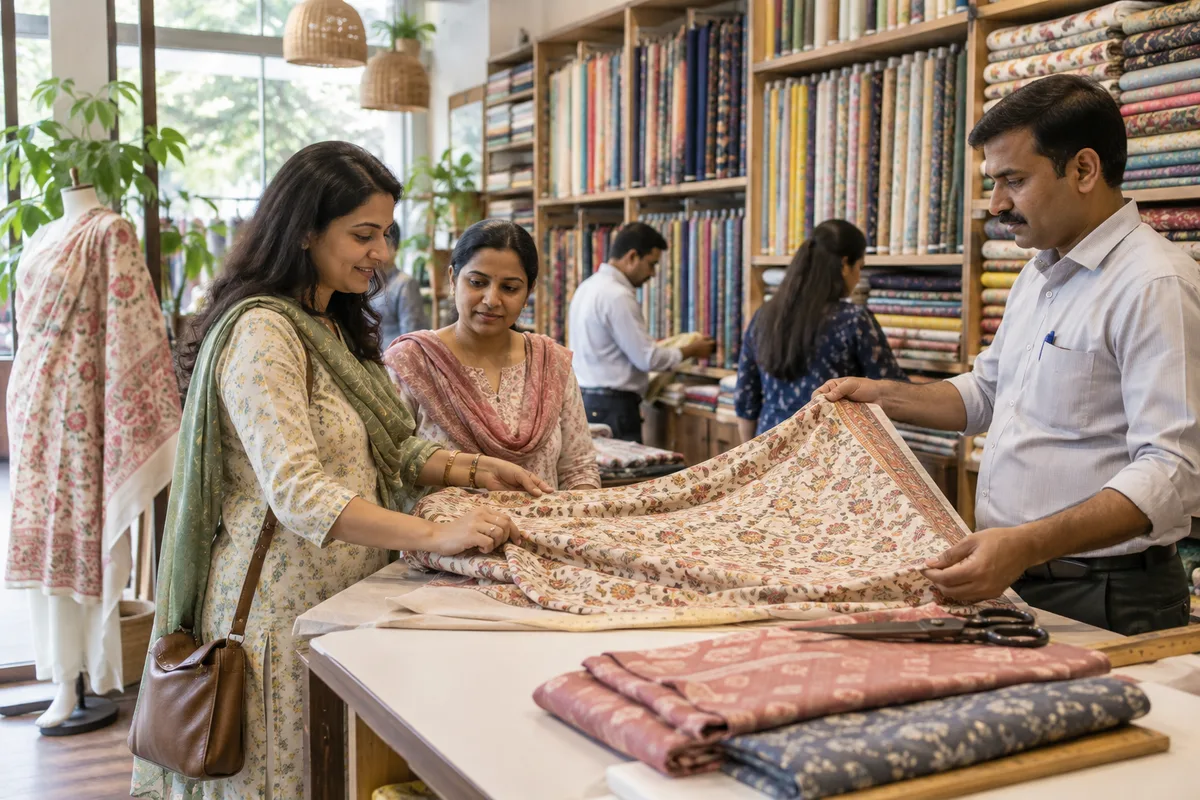
Content marketing is writing articles, guides and pages that answer the questions buyers search before they are ready to enquire. This makes your business visible and trusted before the first call. GullySales plans this content from the first conversation onward, choosing topics that match real search demand rather than guesses.
Also for fabric shops and retailers
- Social media for fabric shops and retailers
- SEO for fabric shops and retailers
- PPC ads for fabric shops and retailers
- Lead generation for fabric shops and retailers
- Digital marketing for fabric shops and retailers
- Reputation management for fabric shops and retailers
- Local SEO for fabric shops and retailers
- Branding and identity for fabric shops and retailers
Sales and marketing for fabric shops and retailers, the overview.
Last updated 5 Oct 2026.
For fabric shops and retailers
Where it usually goes wrong, and what we would do.
“How much cloth do I need is the search before the sale”
A buyer working out metres for a kurta, a sofa or a set of curtains has decided to buy, and the page that answers her chooses the shop.
“The care question comes after the sale and brings the next one”
Shrinkage, the first wash and whether a shade runs are asked at home, and the shop that answered honestly is the one she returns to.
“Your counter already explains this forty times a week”
The weave, the width, the difference between two qualities and what a fall is get explained aloud all day and written down nowhere.
What we do
What we deliver for fabric shops and retailers.
Every deliverable, what it covers for you, and the result it is there to produce. Nothing here is an extra.
Metre requirement guides per garment
How much cloth for a kurta, a saree blouse, a churidar, a shirt and a suit, by width, written the way your counter staff say it.
Result: A buyer arrives knowing what to ask for.
A curtain and upholstery measuring guide
Window measurements, pleat allowance, lining and how a three-seater sofa is calculated, with a worked example beside the metres.
Result: The measurement visit starts from an informed customer.
A care and shrinkage page per fabric
First wash, shrinkage, ironing and colour running, answered honestly for each quality you stock rather than in general terms.
Result: She comes back instead of blaming the shop.
A glossary of the words a tailor uses
Lining, fall, interlining, thaan, width, count and weave explained plainly, since a household buyer hears them at the counter and nods.
Result: Buyers can follow what the tailor asks for.
A new arrivals note each season
A short piece with the lot, the weave and the rate band each time a season's stock lands, written so it can be forwarded.
Result: Regular buyers hear before the showroom advertises.
Report of which guide brought a call
Enquiries and walk-ins traced to each guide, read against the baseline recorded before the writing started.
Result: You learn which guide is worth another.
How the result is measured
- Pages published
- Organic traffic
- Enquiries from content pages
Recorded as a baseline before work starts, so every later report has an honest comparison.
Questions buyers ask first
The questions a buyer asks before cutting cloth, and the guide that answers each one.
- How many metres do I need for a kurta?
- A table by garment and by cloth width, with a margin for pattern matching and for a fall or lining. Counter staff give this answer all day, so write it once.
- Will this shrink after the first wash?
- A care page by fabric: cotton, linen, silk, rayon. Say which should be pre-washed or dry cleaned and what to tell the tailor about allowance.
- How do I measure my window for curtains?
- A measuring guide: rod or track, fullness, drop and hem, with a sheet the customer fills in and sends on WhatsApp. It ends with how you quote the cloth and the stitching.
- What is the difference between cotton, linen and rayon?
- A plain explainer using pieces from your stock: which wrinkles, which is cool in summer, which is heavy. A buyer who understands the cloth picks the better piece.
- Can you show me this shade in daylight?
- A photographing note and a swatch offer: shoot in daylight beside a reference card, say that a phone screen can mislead, and send a cut swatch by courier for large orders.
- Do you give a trade rate for tailors and boutiques?
- A trade page: thaan rate terms, minimum purchase, credit, and how to open an account. Tailors who stopped coming need a reason and an easy way to return.
Who it is for
This is written for these fabric shops and retailers.
- Retail cloth shops selling suiting and shirting
- Saree and blouse-piece shops
- Dress material and unstitched wear shops
- Curtain, sofa and upholstery fabric houses
- Wholesale cloth merchants supplying tailors and boutiques
- Uniform cloth suppliers for schools, hotels and factories
- Handloom, khadi and silk outlets
- Online fabric sellers cutting to the metre and couriering
- Brand franchise counters for suiting and shirting
How it works
From your first message to the first report.
No open-ended retainer. Every step gives you something in writing.
First
Your brief
You tell us what you need in a few short steps: your business, what you want, where enquiries come from and how they are handled.
After the brief
A conversation and a written scope
We read it, then talk with whoever handles your enquiries. If you want our help, the scope, the fee and the reporting come in writing, and nothing starts before you have read them.
Before work starts
Baseline recorded
The numbers this work is meant to move, such as enquiries, quotations, orders, visits or renewals, written down so every later report has an honest comparison.
After the baseline
The first fix goes live
The fix we agreed to start with is put in place and measured against the baseline, whether that is a reply, a follow-up, a page, a listing or the handover between marketing and sales.
As agreed
Report against the baseline
What moved, what did not, and what changes next, in plain words. How often you get it is set in writing before work starts.
At renewal
Renew on the numbers
The term ends and you decide whether to continue from the results. The length is agreed in writing before anything starts.
How the content marketing work runs
- 1
Confirm the plan
Topics and formats for the coming month are confirmed against the content strategy.
- 2
Produce and review
Content is written or filmed, then reviewed by someone who knows your trade before it goes out.
- 3
Publish and distribute
Finished content is published to the site and pushed through the channels your buyers actually use.
- 4
Track enquiries
Enquiries are traced back to content where a direct line exists, and reported honestly where it does not.
- 5
Report and adjust
We report results and adjust the next topics based on what actually worked.
Why us
Why owners pick GullySales over an agency.
Marketing and sales, as one job
Most agencies stop at the enquiry. We also fix what happens after it: the reply, the follow-up, the quote and the CRM.
The person on the first call does the work
No account managers in between. You are never handed to someone you have not met.
A baseline before anything starts
Your numbers are written down on day one, so every later report compares against something honest.
The fee in writing, split three ways
Our time, your media spend and production on separate lines. You always see what goes to us.
No guarantees we cannot keep
The term is agreed in writing and never a default twelve months. We never promise a ranking or a lead count, because nobody controls those.
One office, and we say so
Nagarbhavi, Bengaluru. We work across India by call and WhatsApp and travel when a session needs to be in person.
#257, 3rd floor, Sri Nanjundeshwara Complex, Nagarbhavi 8th Block, Outer Ring Road. How we work.
Your brief
Tell us what you need, and we will read it before we call.
Eight short steps about your business, what you want and who decides. Most questions are a tap, and you can skip any you would rather answer on the call.
FAQ
Questions owners ask before they call.
Not here? More answers, or ask on WhatsApp.
Will explaining metres cost us sales?
Who writes this, us or you?
Can the guides be printed cards at the counter?
Should we write the guides in Hindi, Gujarati or Marathi?
How long is the contract?
How soon will we see results?
Who will actually do the work?
What do you need from us?
What if we are not happy with the work?
More for fabric shops and retailers
Everything else we would do for you.
Closest to this: content and social
Also for fabric shops and retailers
Or start from the overview: sales and marketing for fabric shops and retailers.
Your next practical step
Tell us what you are trying to grow, and we will read it before we call.
Eight short steps, mostly taps. Skip anything you would rather answer on the call.