TV and audio stores · Lead generation
Fill the demo room with households who are choosing a screen this season.
Lead generation for a TV and audio store means collecting the names of households who are close to buying a screen or a sound system, not the clicks of people comparing prices on an app. GullySales works on the invitations, the capture points and the record that turn a curious search into a booked demo.
Scope, fee, reporting and term are agreed in writing after we have read your brief and spoken to you.
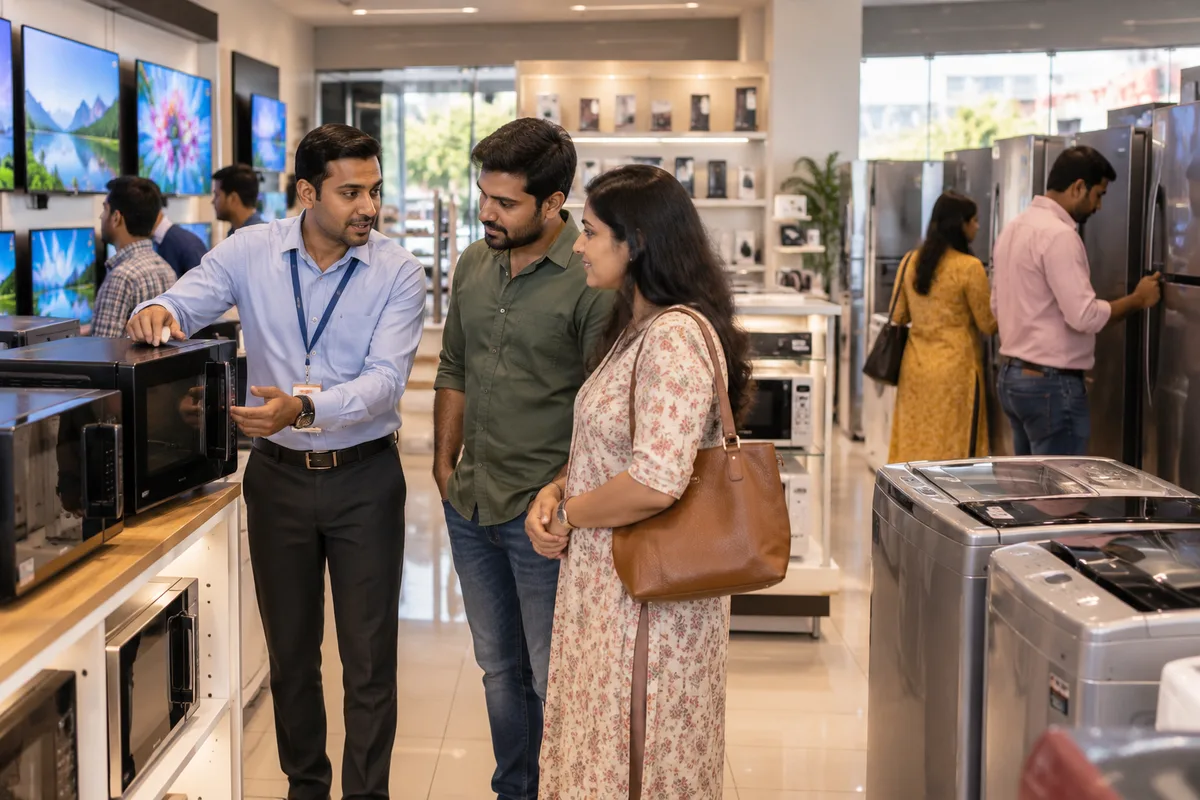
What lead generation means
Lead generation is the combined work of every channel that brings in a new enquiry, whether from search, adverts, referrals or a stall at an exhibition. GullySales runs these channels together and reports the number of enquiries each one produced, not the activity behind it.
Last updated 18 Oct 2026.
For TV and audio stores
Where it usually goes wrong, and what we would do.
“A lead here is a household with a wall and a date”
The useful enquiry names a room, a seating distance and an occasion such as a cricket series or a housewarming. A bare phone number from a banner has none of that, so the salesperson starts the call blind and the household hangs up.
“Footfall is not a lead until someone writes it down”
Match week fills the floor with people who look, listen and leave. Without a note of size, budget and shortlisted models taken at the counter, the busiest days of the year add nobody to the list you can call.
“Audio buyers and screen buyers arrive by different doors”
The screen buyer searches a size and a brand. The soundbar or hi-fi buyer searches for a demo with their own music. Treating both as one funnel sends the audio enthusiast a television offer and loses the higher-value conversation.
“Builders and designers hand over leads before the client has picked a shop”
An interior designer fitting out a flat names the screen wall months before the household walks in. That introduction is a lead source of its own, and it needs a pack the designer can forward without rewriting.
What we do
What we deliver for TV and audio stores.
Every deliverable, what it covers for you, and the result it is there to produce. Nothing here is an extra.
A demo room booking invitation
A WhatsApp and Instagram invitation with a choice of time slots, the screen sizes on show and a line about the sound corner, ending in a one-tap booking.
Result: Every invitation leads to a booking page or chat you can count.
A capture card at the counter
A short form on a tablet or card that records room size, budget, shortlisted models and the reason for buying now, filled while the household is still standing there.
Result: Each visitor leaves a record, bought or not.
Lead sources tagged at the start
Each enquiry is marked with where it came from: search, Instagram, match campaign, designer, walk-in or referral.
Result: You can see which source brought households who bought.
A designer and builder introduction pack
A short document with room-size guides, brands stocked, installation terms and a contact for site measurements.
Result: A designer can forward one file to a client.
Festival and match campaign landing pages
One page per campaign, built around a screen size and a sound setup, with the invitation as the single next step.
Result: Campaign enquiries are separate from everything else.
How the result is measured
- Enquiries generated
- Cost per enquiry
- Enquiries by source
Recorded as a baseline before work starts, so every later report has an honest comparison.
Who it is for
This is written for these TV and audio stores.
- Multi-brand television showrooms with a demo room
- Home theatre and hi-fi specialists
- Brand-exclusive television and audio stores
- Soundbar and speaker boutiques
- Stores supplying hotels, guest houses and offices
- Stores supplying interior designers and builders
- Electronics stores with a strong TV and audio floor
- Small-town TV dealers who deliver and install
How it works
From your first message to the first report.
No open-ended retainer. Every step gives you something in writing.
First
Your brief
You tell us what you need in a few short steps: your business, what you want, where enquiries come from and how they are handled.
After the brief
A conversation and a written scope
We read it, then talk with whoever handles your enquiries. If you want our help, the scope, the fee and the reporting come in writing, and nothing starts before you have read them.
Before work starts
Baseline recorded
The numbers this work is meant to move, such as enquiries, quotations, orders, visits or renewals, written down so every later report has an honest comparison.
After the baseline
The first fix goes live
The fix we agreed to start with is put in place and measured against the baseline, whether that is a reply, a follow-up, a page, a listing or the handover between marketing and sales.
As agreed
Report against the baseline
What moved, what did not, and what changes next, in plain words. How often you get it is set in writing before work starts.
At renewal
Renew on the numbers
The term ends and you decide whether to continue from the results. The length is agreed in writing before anything starts.
How the lead generation work runs
- 1
Understand your capacity
We agree how many enquiries your sales team can actually handle well, so the system is not built to overwhelm it.
- 2
Audit current sources
We check what already brings in enquiries today, even informally, before adding anything new.
- 3
Strategise the channel mix
Content, search and paid channels are chosen based on where your buyers already look.
- 4
Implement capture and follow-up
Pages, forms and a follow-up process are built and connected end to end.
- 5
Measure and optimise
We track enquiry volume and quality and adjust the channel mix to match.
Why us
Why owners pick GullySales over an agency.
Marketing and sales, as one job
Most agencies stop at the enquiry. We also fix what happens after it: the reply, the follow-up, the quote and the CRM.
The person on the first call does the work
No account managers in between. You are never handed to someone you have not met.
A baseline before anything starts
Your numbers are written down on day one, so every later report compares against something honest.
The fee in writing, split three ways
Our time, your media spend and production on separate lines. You always see what goes to us.
No guarantees we cannot keep
The term is agreed in writing and never a default twelve months. We never promise a ranking or a lead count, because nobody controls those.
One office, and we say so
Nagarbhavi, Bengaluru. We work across India by call and WhatsApp and travel when a session needs to be in person.
#257, 3rd floor, Sri Nanjundeshwara Complex, Nagarbhavi 8th Block, Outer Ring Road. How we work.
Your brief
Tell us what you need, and we will read it before we call.
Eight short steps about your business, what you want and who decides. Most questions are a tap, and you can skip any you would rather answer on the call.
FAQ
Questions owners ask before they call.
Not here? More answers, or ask on WhatsApp.
Should we buy leads from a portal?
How do we stop leads from going cold after match week?
How much does it cost?
How long is the contract?
How soon will we see results?
Who will actually do the work?
What do you need from us?
More for TV and audio stores
Everything else we would do for you.
Closest to this: leads and follow-up
Also for TV and audio stores
Or start from the overview: sales and marketing for TV and audio stores.
Your next practical step
Tell us what you are trying to grow, and we will read it before we call.
Eight short steps, mostly taps. Skip anything you would rather answer on the call.