Home appliance stores · Point-of-sale marketing
Put the right card beside the right fridge before the family reaches for a phone.
Point-of-sale marketing for an appliance store is the printed and physical material on the showroom floor that settles a choice between two boxes standing side by side. GullySales designs it to fit your floor, your brand tie-ups and your delivery promise, and checks that outdated offer cards come down.
Scope, fee, reporting and term are agreed in writing after we have read your brief and spoken to you.
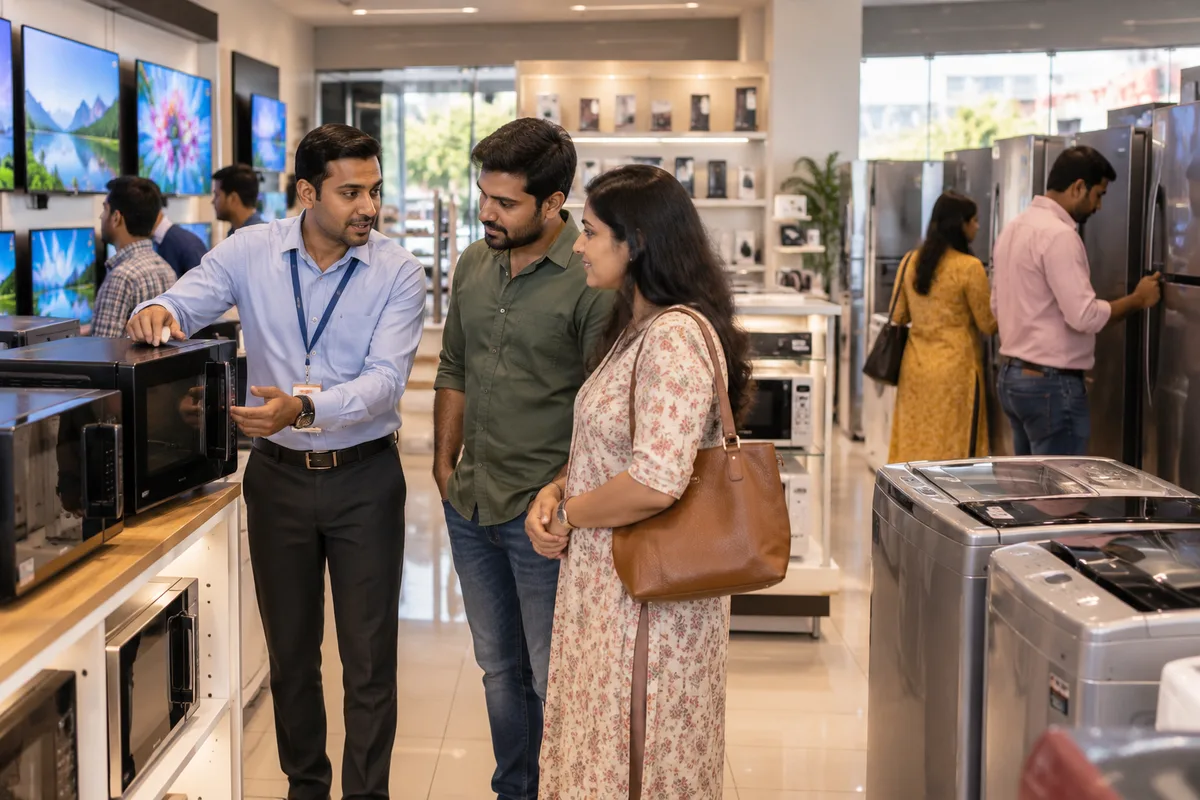
What point-of-sale marketing means
Point-of-sale marketing is the printed and physical material at the counter and shelf that decides the last choice between brands. GullySales designs it to fit real shop space, adds a QR code to your WhatsApp catalogue or warranty page, checks that it is put up, and gets outdated scheme material removed.
Also for home appliance stores
- Lead generation for home appliance stores
- SEO for home appliance stores
- Local SEO for home appliance stores
- Social media marketing for home appliance stores
- Content marketing for home appliance stores
- Buyer personas for home appliance stores
- CRM for home appliance stores
- Follow-up systems for home appliance stores
Sales and marketing for home appliance stores, the overview.
Last updated 18 Oct 2026.
For home appliance stores
Where it usually goes wrong, and what we would do.
“The price tag is read against a phone screen”
A household standing at a washing machine compares your tag with an online price on the spot. A tag that shows only the sticker figure invites that comparison. A card that lists exchange value, delivery, installation and stand supplied, in that order, answers it where the buyer is standing.
“Brand-supplied display material does not suit your floor”
Every brand sends its own standees, danglers and offer posters. Together they crowd a narrow market-street showroom and hide the very models you want a family to touch. Someone has to decide which pieces stay, which go to the godown and which are cut to a smaller size.
“Old offer cards outlive the offer”
A festival exchange card still hangs on the AC after the scheme has closed, and the buyer asks for it at billing. The counter staff either honour it at a loss or argue with a family at the till. Removal is part of the job, and it needs a named person.
“The demo unit is switched off or dusty”
A washing machine with a closed lid and no water point tells a family nothing. A demo that runs, with a card naming what the buyer is seeing, replaces a salesperson's explanation when the floor is busy and everyone is occupied.
What we do
What we deliver for home appliance stores.
The work available for this need. We agree the deliverables and responsibilities for your engagement in writing.
Floor plan and display brief
A sketch of your showroom with the position of each product, the card that belongs beside it and the pieces to leave out. Brand material that does not fit is listed for return, not forced in.
Result: A marked-up floor plan the shop manager can walk with.
Model cards in your own words
One card per model giving capacity, the features a family asks about, the delivery and installation terms and where to see the lender's own sheet. Prices and offers are copied from your written note and approved by you.
Result: A card whose every line matches the offer note on file.
Exchange and finance counter card
A card for the billing counter explaining the exchange process and the documents a finance scheme needs, pointing to the lender's own terms. No rate or approval is stated on it.
Result: Two counter staff explain the exchange steps in the same order.
QR code to warranty registration or WhatsApp
A code on the card that opens your WhatsApp catalogue or a warranty registration form under your own account. It is tested on a phone before print.
Result: Scanning the code on a handset opens the right page.
Offer withdrawal list
A dated list of every card tied to a scheme, with who removes it and when the floor is rechecked after the scheme closes.
Result: A floor with no expired offer card on it.
How the result is measured
- Outlets with each piece put up, separate from pieces dispatched
- Material in the right place and readable at the counter
- Outdated scheme material still showing after its end date
Recorded as a baseline before work starts, so every later report has an honest comparison.
Who it is for
This is written for these home appliance stores.
- Multi-brand white goods and appliance showrooms
- Single-brand exclusive stores run by dealers
- Air conditioner specialists with installation teams
- Washing machine and fridge dealers in market streets
- Water heater, geyser and water purifier stores
- Appliance retailers selling mainly on instalments
- Showrooms supplying builders, hostels and guest houses in bulk
- Open-box and ex-display appliance outlets
Before you decide
Agree the work. Know how to judge it.
Point-of-sale marketing for home appliance stores: use these checks to prepare, choose the scope, and review what changes.
Bring the right evidence
Map existing partners, their territories, and the customers they serve. Review active selling and repeat orders separately from the number of partners signed up.
Make the scope clear
Agree partner fit, territory rules, onboarding, and support responsibilities. Clarify how direct enquiries and partner enquiries are assigned before starting recruitment.
Check the work in use
Follow a partner enquiry through to an order and the next purchase. Check whether the partner has the product knowledge and material needed to sell without repeated intervention.
Know when to change course
If current partners cannot sell because supply or support is weak, resolve that before recruiting more. A bigger network can spread the same problem further.
These are discussion points, not a fixed package. GullySales confirms the deliverables, responsibilities, fee, and term in writing after reading your brief and speaking with you.
How it works
How the point-of-sale marketing work runs
The work itself, in order. How an engagement starts, from your brief to a written scope, is set out on our method page.
- 1
Outlet and product choice
You tell us the outlets you sell through and the products that need a push at the counter. We agree which pieces suit which outlet.
- 2
Space measurement
Your field team or a dealer sends photographs and measurements of counters and shelves. We fit sizes to them before any artwork begins.
- 3
Artwork and QR approval
You approve each proof, the offer wording and the QR destination. Anything that states a price or scheme is checked against your written scheme note.
- 4
Print and dispatch handoff
The approved files go to your printer or ours as agreed in writing, with quantities by dealer. Dispatch records which outlet got which piece.
- 5
Store-visit check
Photographs or visits confirm the material is up, readable and in the right place. Gaps go to the responsible dealer or field representative.
- 6
Scheme withdrawal
When a scheme ends, the withdrawal list is sent and a recheck confirms old material has come down.
Where this fits
Three pieces of sales work, in this order.
This work sits inside sales process design, at stage 0, foundation. The audit comes before it, and sales management keeps it running.
Step 1
Sales audit
Find where deals are being lost and what to fix first.
Start here if you cannot say where orders are lost.
Step 2 · you are here
Sales process design
One written way to sell, from first enquiry to repeat order.
Start here if every salesperson sells differently.
Step 3
Sales management
A target, a review routine and someone who owns the number.
Start here if the team has targets and no routine.
FAQ
Questions owners ask before they call.
Not here? More answers, or ask on WhatsApp.
Can we use the brand's posters and our own cards together?
Who writes the price on the card?
How long is the contract?
How soon will we see results?
Who will actually do the work?
What do you need from us?
What if we are not happy with the work?
More for home appliance stores
Related work to consider.
Or start from the overview: sales and marketing for home appliance stores.
Your next practical step
Tell us what you are trying to grow, and we will read it before we call.
Eight short steps, mostly taps. Skip anything you would rather answer on the call.