Plumbing and sanitaryware distributors · Lead generation
An enquiry here is a call to somebody's own number, and it goes when the salesman does.
Lead generation for a plumbing and sanitaryware distributor means finding the retailers, contractors and builders who are not yet buying from you, and catching the enquiries that already reach you by call, WhatsApp, IndiaMART and the brand. GullySales records every source in one place and sets who replies.
Scope, fee, reporting and term are agreed in writing after we have read your brief and spoken to you.

What lead generation means
Lead generation is the combined work of every channel that brings in a new enquiry, whether from search, adverts, referrals or a stall at an exhibition. GullySales runs these channels together and reports the number of enquiries each one produced, not the activity behind it.
Also for plumbing and sanitaryware distributors
- CRM for plumbing and sanitaryware distributors
- Follow-up systems for plumbing distributors
- SEO for plumbing and sanitaryware distributors
- Local SEO for plumbing and sanitaryware distributors
- WhatsApp marketing for plumbing and sanitaryware distributors
- Referral marketing for plumbing and sanitaryware distributors
- Email marketing for plumbing and sanitaryware distributors
- Sales management for plumbing and sanitaryware distributors
Sales and marketing for plumbing and sanitaryware distributors, the overview.
Last updated 6 Oct 2026.
For plumbing and sanitaryware distributors
Where it usually goes wrong, and what we would do.
“Enquiries from the brand land on whoever picked up”
The area officer gives your number to a family or a builder and the call goes to a salesman on route. Nobody else sees it, and the brand never hears what happened.
“IndiaMART enquiries go to four distributors at once”
The buyer sent the same quantity list to several. A reply that carries a rate and a delivery date stands out beside the others, and the rest are forgotten.
“The shop that said not now is not written down”
A salesman visits a new retailer, hears 'come after Diwali' and moves on. Without a note and a date, nobody comes back.
“New projects are visible before they buy”
Site boards and a builder's launch announcement show where bathrooms will be fitted next. The list of those sites is kept, if at all, in one man's memory.
What we do
What we deliver for plumbing and sanitaryware distributors.
Every deliverable, what it covers for you, and the result it is there to produce. Nothing here is an extra.
One enquiry sheet for every source
A sheet the order desk and salesmen both fill: source, name, product, quantity, area, who replied and when.
Result: Enquiries stop depending on one person's phone.
A list of shops in your area not yet buying
Hardware, plumbing and sanitary shops drawn from Maps, directories and route knowledge, marked against your sales register.
Result: The salesmen call on shops chosen from a list, not from habit.
A project watch list for builders and contractors
Sites in your supply area with the builder, the stage and the person who buys, kept and dated.
Result: You ring before the bathroom fittings are bought.
A reply routine for IndiaMART and directory enquiries
Who answers, the first message with rate and delivery, and a second call if there is no answer.
Result: Directory enquiries are answered by a person with a reply to give.
A first-order note for new retailers
Brands carried, the rate sheet, credit terms in writing, delivery arrangement and a contact name, sent after the first visit.
Result: A shop can say yes to a first order without ringing back for details.
Sources counted against the baseline
Enquiries by source, time to first reply and orders from each source, set against the baseline taken before work started.
Result: You know which source brings orders and which only brings calls.
How the result is measured
- Enquiries generated
- Cost per enquiry
- Enquiries by source
Recorded as a baseline before work starts, so every later report has an honest comparison.
Where enquiries come from
The ways an enquiry reaches a plumbing and sanitaryware distributor, and what to record for each.
- A retailer rings the order desk
- Write down the shop, the area and what was asked for, including what you could not supply. That list is who to call when the stock arrives.
- The brand passes on an enquiry
- Ask the brand's area officer which number the enquiries go to. Reply with the stock position and a visit date, record the source as the brand, and tell the officer what came of it.
- IndiaMART or JustDial enquiry
- Record the platform, the item and the quantity. Reply with rate, delivery and a named contact in the first message, and ring if there is no answer, because the buyer has asked others.
- A builder's quantity list
- Record the project, the tower or floor, the approved makes and the date the material is needed. Send a written quote and put a callback date against it.
- A walk-in at the counter or showroom
- Ask how they found the shop and take a name and number before the bill is made. A visitor who buys nothing today is the sheet's most useful entry.
- A route visit that ends in not now
- Note the shop, who was met, the reason given and the date to go back. The new retailer list improves only when the shops that said no are kept on it.
Who it is for
This is written for these plumbing and sanitaryware distributors.
- CPVC, UPVC and SWR pipe and fittings distributors
- Sanitaryware and CP fittings distributors
- Water tank and storage distributors
- Multi-brand plumbing wholesalers supplying sub-dealers
- Distributors with a bathroom showroom and a trade counter
- Project suppliers to builders and contractors
- Valve, pump and water heater stockists
- District sub-distributors and stockists
Not for
It is not the right fit if.
- Nobody is named to reply to a directory or brand enquiry, so a larger flow would only reach the next distributor first.
- Your supply area is small and covered, so more enquiries would come from towns you do not deliver to.
- The salesmen keep the retailer numbers on personal phones and will not share them, so a lead list would leave with them.
How it works
How the lead generation work runs
The work itself, in order. How an engagement starts, from your brief to a written scope, is set out on our method page.
- 1
Understand your capacity
We ask how many enquiries your team can answer well, who answers after hours, and what a good enquiry looks like. Without this, the system fills a funnel nobody is watching.
- 2
Audit current sources
We read your call log, WhatsApp chats, enquiry sheet and platform dashboards. The baseline is recorded: enquiries by source, reply time, conversion and cost per order.
- 3
Strategise the channel mix
Search and maps are chosen for people ready to buy, ads for people who are not yet looking, and content and referrals for trust.
- 4
Implement capture and follow-up
Pages, forms, tags, the lead record and the first-reply message are built and tested end to end. We submit test enquiries ourselves before any media money is spent.
- 5
Measure and optimise
Enquiries are traced to source and judged by what became orders, not by volume alone. Channels that fill the sheet with poor enquiries are cut back. How often you are reported to is agreed in writing.
Where this fits
Three pieces of sales work, in this order.
This work sits inside sales process design, at stage 1, prospecting and lead generation. The audit comes before it, and sales management keeps it running.
Step 1
Sales audit
Find where deals are being lost and what to fix first.
Start here if you cannot say where orders are lost.
Step 2 · you are here
Sales process design
One written way to sell, from first enquiry to repeat order.
Start here if every salesperson sells differently.
Step 3
Sales management
A target, a review routine and someone who owns the number.
Start here if the team has targets and no routine.
FAQ
Questions owners ask before they call.
Not here? More answers, or ask on WhatsApp.
Should we buy leads from a portal that sells distributor enquiries?
The same plumber appears from IndiaMART, a call and WhatsApp. How do we avoid counting the plumber three times?
What counts as a qualified enquiry for a distributor?
How do we count a retailer who says come back after Diwali?
How much does it cost?
How long is the contract?
How soon will we see results?
Who will actually do the work?
What do you need from us?
What if we are not happy with the work?
From the blog
Further reading for plumbing and sanitaryware distributors.
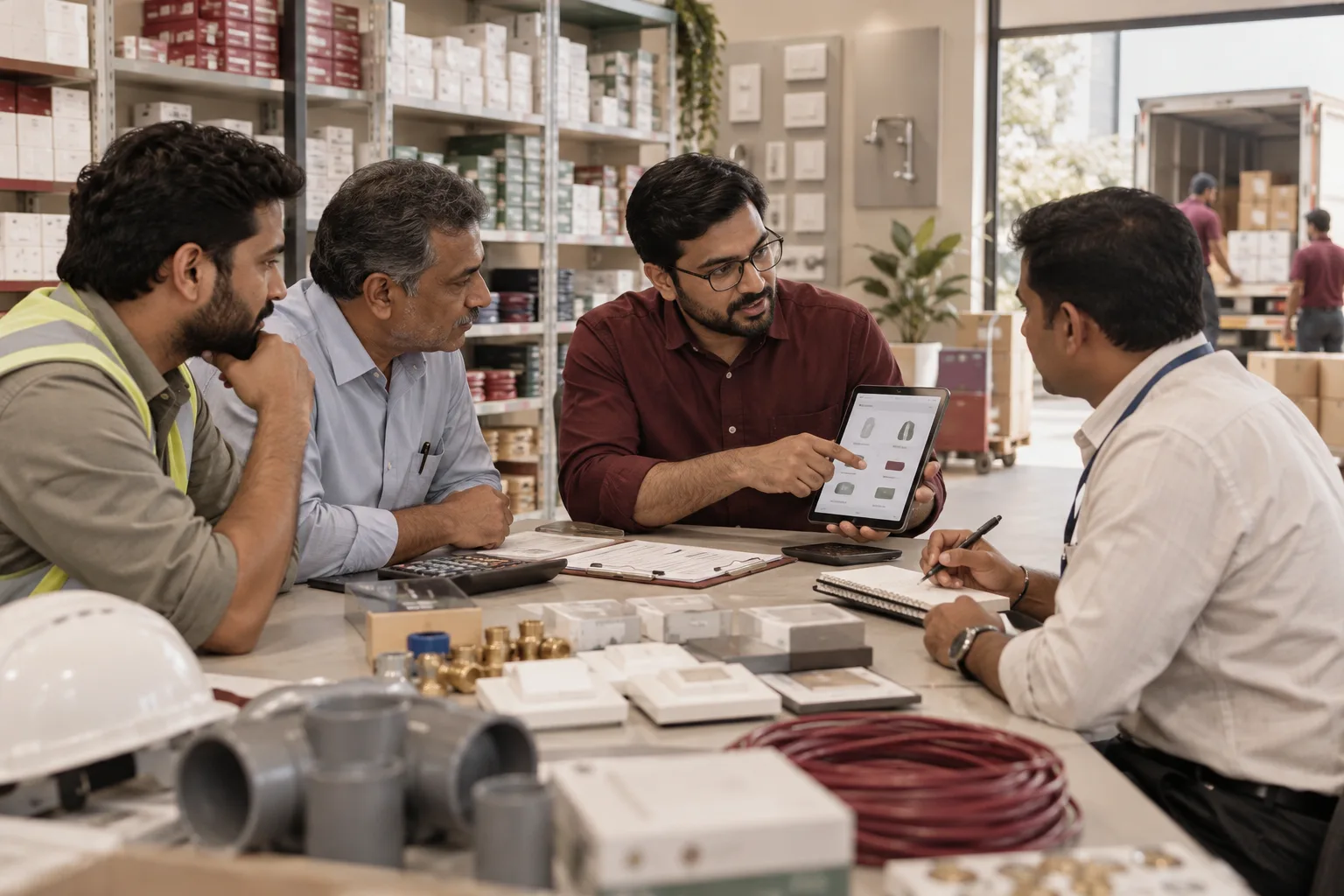 6 min read · 6 Oct 2026How trade buyers pick a dealer when the brands matchWhen every counter in town carries the same brands, trade buyers choose on stock, delivery, paperwork and returns. This post sets out how contractors, electricians, plumbers and purchase managers compare dealers.
 5 min read · 6 Oct 2026How plumbing distributors quote a builder's quantity listA builder's quantity list is quoted line by line against the approved makes, with what each rate includes, a dispatch plan, a credit position and a named person who calls back.
More for plumbing and sanitaryware distributors
Everything else we would do for you.
Closest to this: leads and follow-up
Also for plumbing and sanitaryware distributors
- SEO for plumbing and sanitaryware distributors
- Local SEO for plumbing and sanitaryware distributors
- WhatsApp marketing for plumbing and sanitaryware distributors
- Referral marketing for plumbing and sanitaryware distributors
- Email marketing for plumbing and sanitaryware distributors
- Sales management for plumbing and sanitaryware distributors
Or start from the overview: sales and marketing for plumbing and sanitaryware distributors.
Your next practical step
Tell us what you are trying to grow, and we will read it before we call.
Eight short steps, mostly taps. Skip anything you would rather answer on the call.