The sales process · Customer research
Every enquiry you lost stopped at a particular step, and you can name it.
A buyer journey is the sequence a person moves through from not knowing your business exists to signing, written as the steps they take rather than the steps you take. Mapping it shows where most of them stop, which is rarely the place the owner expects.
In one paragraph
A buyer journey is the sequence a person moves through from not knowing your business exists to signing, written as the steps they take rather than the steps you take. Mapping it shows where most of them stop, which is rarely the place the owner expects.
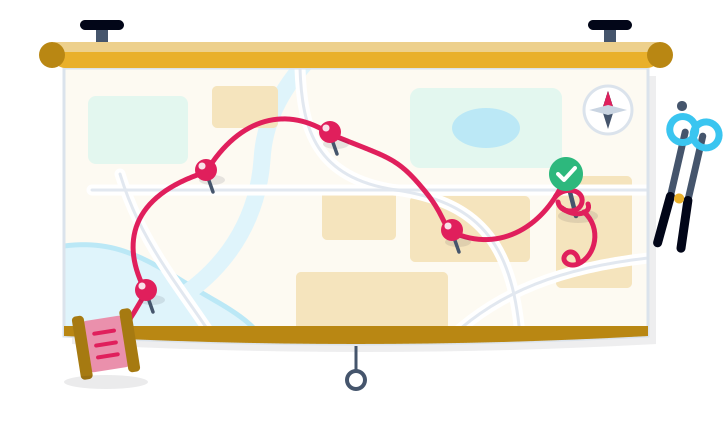
Draw it as a line with stops on it. Saw a board on the ring road, searched the name, opened the website, read two pages, left. Came back nine days later, sent a WhatsApp message at ten at night, got a reply the following afternoon, asked for a price, went quiet.
Written out like that, a journey is a list of moments where a person can walk away, and most businesses lose the same people at the same stop every month. For a job shop it might be the week between sending a sample and hearing anything back. For a diagnostic centre in Jayanagar it is the phone ringing out between one and two.
Take your last fifty enquiries and mark where each one stopped. That is the map. No software, no diagram tool, one spreadsheet and an afternoon with whoever answered those calls.
Customer behaviour explained what pushes a buyer. This arranges the pushes in order, and buyer context, which follows, explains why two people standing at the same stop behave nothing alike.
Where this sits
Stage 2 of 10, customer research. Who buys, why they buy, and what they are comparing you against while they decide.
- The stage before
- Strategic plan
- The stage after
- Prospecting
If you want this done for you
Find the exact step where buyers currently give up on you.
The work
What this step is actually like.
“Use the buyer's words for the stages, not the textbook ones”
Awareness, consideration and decision tell you nothing about where to act. Saw the hoarding, asked the family WhatsApp group, took three quotes to my father, asked for a site visit. Those you can do something about on Monday.
“The drop is usually at a handover”
Between the advertisement and the person who answers the number on it. Between the receptionist who took the message and the engineer who was meant to ring back. Journeys do not break in the middle of a stage, they break between two people who each assumed the other had it.
“Half of it happens before you exist to them”
Buyers ask a neighbour, read reviews, look at two competitors and form a shortlist without contacting anybody. You cannot measure that half, so map it from what customers tell you afterwards and accept the map is rougher on the left.
“Count them, do not estimate them”
Ask five people in the office where enquiries are lost and you get five confident and different answers. Fifty rows in a spreadsheet settles it in an afternoon, and the answer is frequently something nobody suggested.
What we do
What you end up with.
The artefacts this step produces, what each one is for, and how you know it is finished.
The stage line
Five to seven named stages on one sheet of paper, in the buyer's language, from the first time they hear of you to the order. Write the stages before you look at any data, then correct them once the data disagrees.
Result: Finished when two people in your office describe the stages the same way without looking at the sheet.
The drop-off count
One row per enquiry for the last fifty. Columns for source, date, last stage reached, hours until the first reply, number of follow-ups, and what the person said when they stopped.
Result: Finished when you can say which single stage loses the most people and roughly how many.
One fix per stage
Against each stage, a single action with a name and a date. Not a project. A different voicemail message, a price sent the same evening, a photograph of the last job attached to the quotation.
Result: Finished when every stage has exactly one action and none of them needs a budget approval to start.
The reply clock
A standing record of how long each enquiry waits for its first human answer, kept from now on. It is the one number on the map that moves within a week of anyone paying attention to it.
Result: Finished when the clock is recorded for every enquiry this month, including the ones that came on WhatsApp after hours.
Why us
Why owners pick GullySales over an agency.
Marketing and sales, as one job
Most agencies stop at the enquiry. We also fix what happens after it: the reply, the follow-up, the quote and the CRM.
The person on the first call does the work
No account managers in between. You are never handed to someone you have not met.
A baseline before anything starts
Your numbers are written down on day one, so every monthly report compares against something honest.
The fee in writing, split three ways
Our time, your media spend and production on separate lines. You always see what goes to us.
No lock-in, no guarantees we cannot keep
Three to six months at a time. We never promise a ranking or a lead count, because nobody controls those.
One office, and we say so
Nagarbhavi, Bengaluru. We work across India by call and WhatsApp and travel when a session needs to be in person.
#257, 3rd floor, Sri Nanjundeshwara Complex, Nagarbhavi 8th Block, Outer Ring Road. How we work.
The offer
Start with a free audit of how you sell.
It is useful on its own, whether or not you hire us.
What you receive
- A 90-minute call with the person who will do the work
- A written, scored report on the six places orders leak, within a few working days
- Every fix ranked by what it returns and what it costs
- The one thing to do first, and why
- An honest line on whether you need outside help at all
- If you do, the scope and the fee in writing
No invoice. No obligation. No sales script.
FAQ
Questions owners ask before they call.
Not here? More answers, or ask on WhatsApp.
How many enquiries do we need before the map means anything?
Is a buyer journey the same thing as a sales funnel?
Our buyers take six months to decide. How do we map that?
Who should draw this?
When is it worth buying this as a service rather than doing it?
How much does it cost?
How long is the contract?
How soon will we see results?
Who will actually do the work?
What do you need from us?
Where to go next
The work that carries this step further.
The rest of customer research
Or read the whole sales process in order.