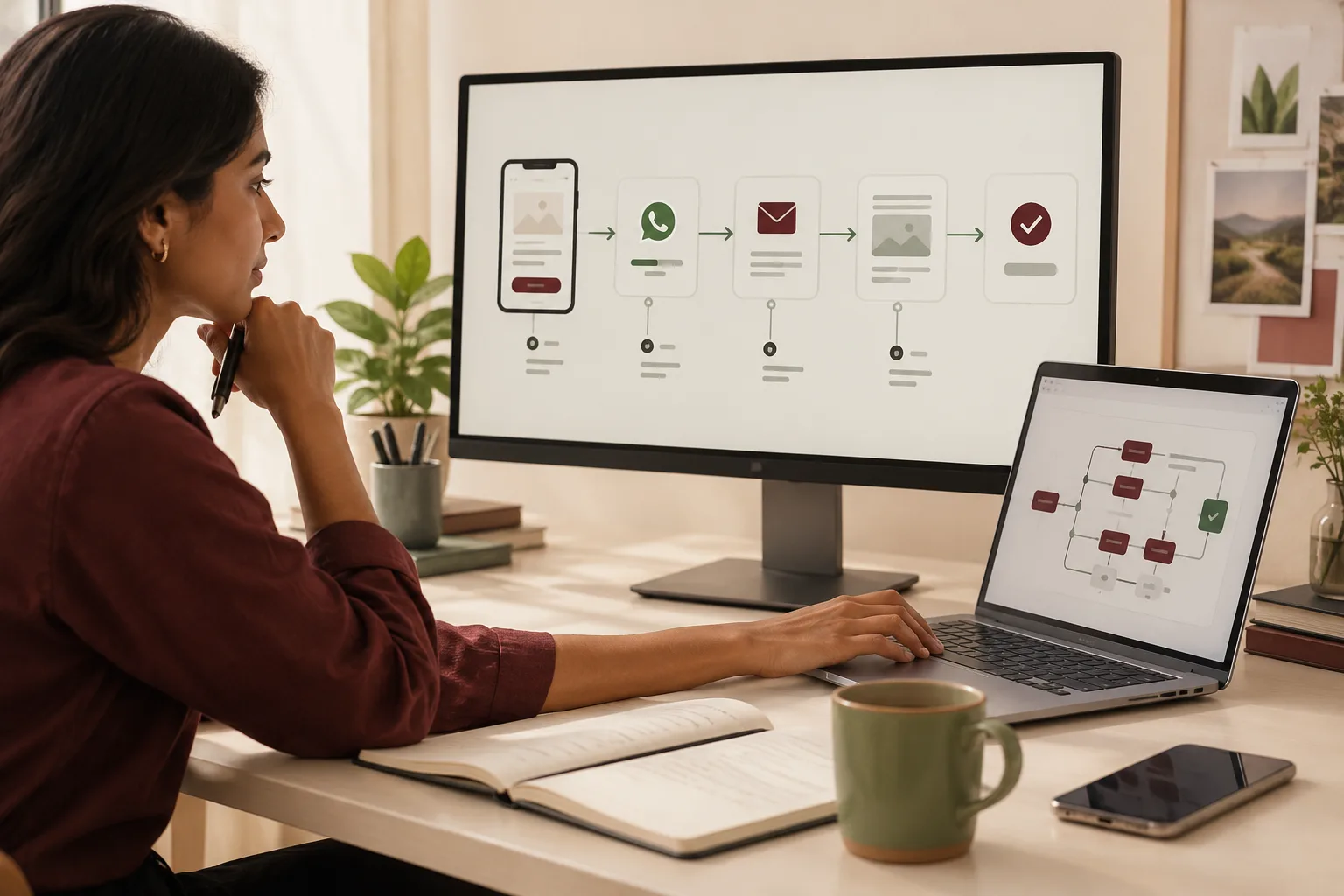
Your website, WhatsApp, email and sales calls work as one path, not four separate ones.
Gully Sales designs the digital path your customers follow from first search to first order: which page, message or reply they meet at each step, how each step hands over to the next, and how you will know where it leaks.
- Every stage gets a defined touchpoint, message and next step, on one map.
- Handoffs between ads, site, WhatsApp, email and sales are designed, owned and tracked.
- A build-ready specification your vendors and team can implement without guessing.
Gully Sales Private Limited works across marketing, sales and service for small and medium businesses in India, which is where a journey has to hold together.
In one paragraph
What is Digital customer journey design for Indian SMBs?
Digital customer-journey design from Gully Sales specifies the path a customer should follow across your website, ads, WhatsApp, email and sales team, from first search to repeat purchase. For each stage we define the touchpoint, the message, the handoff to the next stage and the measure, then sequence the changes into a roadmap your team and vendors can build. It suits businesses whose channels work, but not together.
The problem
Each touchpoint works on its own, and the customer still slips between them.
Most SMBs have built their digital presence one piece at a time. A website from one vendor, ads from another, a WhatsApp number the sales team runs from their own phones, an email tool somebody set up for one campaign. Each piece was judged on its own. Nobody designed how a prospect should move from one to the next, so nobody owns the gaps between the pieces. The customer meets all of them.
You will recognise it as
- Prospects who clicked an ad land on the home page and have to find the offer the ad promised.
- Enquiries arrive on WhatsApp, the form and the phone, and each is handled differently depending on who picks it up.
- Visitors read the site, then call to ask the questions the site was meant to answer.
- The first follow-up message repeats what the website said instead of moving the prospect to the next step.
- Customers who did buy say the process felt harder than it needed to be, and you cannot say which step they mean.
- Marketing reports traffic, sales reports closures, and nobody reports what happened in between.
What it costs the business
- Prospects you have already paid to attract drop out at handoffs nobody owns, and the loss is invisible because no report covers it.
- The sales team spends its first call rebuilding the confidence the website and the follow-up should have built.
- Every new channel or campaign adds another disconnected step instead of strengthening the path that exists.
- Improvement budgets go to the loudest touchpoint, usually the website, when the leak may be in a slow WhatsApp reply or a quote that took three days.
Why it persists. The journey belongs to nobody. The website vendor owns the website, the agency owns the ads, sales owns the calls, and the owner sees only the totals. Each part can report that it is doing its job while the whole underperforms. Designing the path across those boundaries means deciding what each vendor and team must do for the next one, which nobody inside the business has had the time or the method to do.
If it stays unresolved. Acquisition costs keep rising to replace the prospects lost in the gaps. A new website, new campaigns and new tools each promise a lift, and each delivers less than hoped, because they are applied to one step of a path that breaks somewhere else.
What changes
You get a designed path your customers can follow and your team can run.
In the first weeks
- A target-state journey map showing every stage, the touchpoint that serves it and the handoff to the next.
- A check of the current path that shows where it breaks today, with evidence, so the design starts from facts.
In how the work runs
- One agreed path for enquiries whichever channel they arrive through, with an owner and a response standard for every handoff.
- Website copy, WhatsApp replies, emails and sales scripts that answer the same questions in the same order.
- Page briefs, reply templates and routing rules your vendors and team can build from directly.
In sales and marketing
- More of the prospects you already attract reaching a quote, booking or order.
- A shorter gap between first contact and decision, because each stage prepares the next.
In what management can see
- Measurement at each stage, so you can see where the path leaks rather than only how many arrive and how many buy.
Over the longer term
- A journey your team maintains and extends as you add products, channels and markets, instead of rebuilding it each time.
We control the design of the path, the specifications, the roadmap and the measurement plan, and can design the changes themselves. Conversion, lead quality and cost per conversion depend on how the roadmap is built and on the traffic and follow-up behind it, which we can help you run.
Who it is for
This is for businesses that lose prospects between touchpoints, not on one page.
The businesses it suits
- Owners and marketing or sales heads of Indian SMBs whose enquiries arrive through several channels and are handled inconsistently.
- Businesses with a reasonable website and steady traffic where conversion has plateaued and nobody can say why.
- Clinics, institutes and service firms whose customers research online, enquire on WhatsApp and decide after a visit or a call.
- Manufacturers and distributors selling to dealers or industrial buyers, where a quote passes through several hands before it is sent.
- E-commerce and D2C brands whose customers browse on Instagram, check the website and buy on a marketplace.
- Businesses about to invest in a new website, a CRM or a campaign and wanting the path designed before the spend.
What usually prompts the call
- Traffic and ad spend have grown but enquiries, bookings or orders have not kept pace.
- Sales say the leads are poor, marketing say sales do not follow up, and both are partly right.
- A new channel, city or product line is about to add another set of touchpoints to a path that is already unclear.
- Customer feedback mentions confusion, waiting or repeating themselves, and you cannot pin it to a step.
- You are about to brief a website, app or CRM vendor and want the customer's path defined before the build.
What Gully Sales does
The work, component by component.
Journey stages and the question each must answer
We set out the stages your customer passes through, from realising they have a need to buying again, and fix the one question each stage's touchpoint must answer before the customer will move on.
- Why it matters:
- A touchpoint can only do its job if it answers the question the customer has at that moment. Most answer the question the business wants to talk about.
- You receive:
- A stage model with the governing question, the proof required and the next step for each stage.
- Business value:
- Every page, reply and call can be checked against a simple test: does it answer the question the customer has right now?
Touchpoint and handoff design
For each stage we decide which digital touchpoint serves it, what it says, what it collects, where it sends the customer next and who replies, then write the rules for each handoff: ad to page, form to reply, chat to quote, quote to follow-up.
- Why it matters:
- Drop-off happens most often at handoffs, and a handoff that nobody has designed is handled differently every time it occurs.
- You receive:
- A touchpoint specification per stage and a written handoff rule for every transition, with owners.
- Business value:
- The whole path fits on one page, and every gap between two teams or two vendors has a rule and a name against it.
Current-path check
Before designing, we check how the present path performs using analytics by stage, session recordings, response times per channel and samples of real enquiry threads and quotes, and record where it breaks.
- Why it matters:
- Designing without looking at the present path produces a tidy diagram that ignores the two or three places actually losing prospects.
- You receive:
- A short friction log with evidence, severity and the stage affected.
- Business value:
- The design concentrates on the breaks that cost you prospects, not on redrawing what already works.
Conversion and experience opportunities
We set each design change against its likely effect and effort, whether it is a rewritten section, a reply template, a routing rule, a removed step in the quote process or a brief for a vendor.
- Why it matters:
- A long list of changes is not a plan. Owners need to know which three matter most and which can wait.
- You receive:
- A ranked opportunity list separating quick fixes, structural changes and vendor work.
- Business value:
- Your team starts on changes that move enquiries this quarter while larger work is planned properly.
Build specification and roadmap
We turn the design into things people can build: page briefs, message frameworks, reply templates, enquiry routing and automation rules, and a tracking plan, sequenced into a roadmap with owners and dependencies.
- Why it matters:
- Journey work fails when it ends with a presentation. It succeeds when a vendor can open the brief and start, and each change has a metric attached.
- You receive:
- A specification pack and a sequenced roadmap, walked through with sales, marketing and vendors.
- Business value:
- The design becomes a plan of work your business can run, with or without us.
Measurement design
We define a metric for each stage, name where the number comes from, set up the tracking that is missing and record a baseline, so the journey can be watched as a whole rather than as separate reports.
- Why it matters:
- Without stage-level numbers the next leak will hide the way the current one did.
- You receive:
- A measurement plan with metric, source, baseline and review cadence per stage.
- Business value:
- You can tell within a review cycle whether a change worked, and where the next problem is forming.
What you will have at the end.
- A target-state digital journey map from first search to repeat purchase, as a working document and a one-page summary.
- A stage model naming the question, the proof and the next step each stage's touchpoint must deliver.
- A touchpoint specification for every stage: purpose, message, what it collects, where it sends the customer and who owns it.
- Written handoff rules for ad-to-page, form-to-reply, chat-to-quote and quote-to-follow-up, with response standards.
- A current-path friction log with evidence drawn from analytics, recordings, enquiry samples and staff conversations.
- A ranked opportunity list separating quick fixes, structural changes and items that need a vendor.
- Page briefs, a message framework per stage and reply templates ready for your website vendor, agency and sales team.
- Enquiry routing and automation rules describing which enquiry goes to whom, how fast, and what is recorded.
- A sequenced implementation roadmap with owners, dependencies and the metric each change is expected to move.
- A measurement plan naming the metric, source and baseline for every stage, with the tracking gaps to close.
- An anonymised sample journey map and touchpoint specification, shared before you commit, so you know what you will receive.
- A working session with your sales, marketing and service teams and vendors to walk the design and agree the first changes.
How it runs
The engagement, step by step.
- 1
Audit and scope
We start with a free audit of your current path: which channels bring prospects, where they enquire, who replies and how. Together we choose the journey to design first, usually the product line or segment with the most spend or the most complaints.
- You provide:
- Access to analytics, ad accounts and enquiry channels, and an hour with the owner and the person who handles enquiries.
- We produce:
- A written scope naming the journey, the touchpoints in and out, and the decisions the work will settle.
- Done when:
- You have agreed the scope and the people we will speak to.
- 2
Check the current path
We follow the present path ourselves and through data: analytics by stage, session recordings, ad-to-page matches, response times per channel and samples of real enquiry threads and quotes. If you already have a buyer journey map, we start from it.
- You provide:
- Exports or read access to analytics, chat histories, CRM or enquiry sheets and sample quotes, with personal details removed where needed.
- We produce:
- A friction log with evidence, and a list of the touchpoints and handoffs that exist today with their owners.
- Done when:
- We know the two or three places the present path loses prospects, and can show the evidence.
- 3
Define stages and questions
With your sales and service staff we fix the stages, the question a customer has at each one and the proof that answers it. We speak to a few recent customers to confirm the questions are theirs, not ours.
- You provide:
- Time with sales and service staff, and introductions to a handful of recent customers.
- We produce:
- The stage model, reviewed and corrected with your team.
- Done when:
- Your team recognises the stages as true and can name the question at each one.
- 4
Design touchpoints and handoffs
For each stage we decide the touchpoint, its message, what it collects, where it sends the customer and who replies, and write the rule for each handoff. This is the core of the work and where most of the review time is spent.
- You provide:
- Decisions on channels, response standards and who will own each handoff; honest input on what vendors can realistically change.
- We produce:
- The target-state journey map, the touchpoint specifications and the handoff rules.
- Done when:
- Every stage has a designed touchpoint and every transition has a rule and an owner.
- 5
Specify the changes
We turn the design into page briefs, a message framework, reply templates, routing and automation rules and a tracking plan, and rank each change by effect and effort.
- You provide:
- Review of the briefs and templates by the people who will use them.
- We produce:
- The specification pack and the ranked opportunity list.
- Done when:
- A vendor or team member can pick up any brief and start without a further meeting.
- 6
Roadmap and working session
We sequence the changes into a roadmap, record baselines for each stage metric, and walk sales, marketing, service and vendors through the design in a working session where the first changes are agreed.
- You provide:
- Attendance from the people who will own changes, and decisions on what starts first.
- We produce:
- The implementation roadmap, the measurement plan and the session notes.
- Done when:
- Each change has an owner, a start point and a way to know it worked.
- 7
Support the build and measure
Where you want us to, we design the pages and messages in full, brief and manage vendors, and review the stage metrics with you at each cycle, adjusting the roadmap as results come in.
- You provide:
- A regular review slot and access to the numbers.
- We produce:
- Finished designs, vendor coordination and a stage-by-stage report at each review.
- Done when:
- The first changes are live and measured, and the next set is scheduled.
Ways to work with us
Have the journey designed, built with you, or run month after month.
Journey design
One journey, one segment or product line, designed end to end with the current-path check, touchpoint specifications, handoff rules, specification pack and roadmap. Your own team and vendors implement. Suits a business with capable staff that wants the design and the plan.
Journey design and rollout
The design plus the changes themselves: finished page copy, reply templates, enquiry routing, quote process and vendor briefs, with us coordinating your website, ad and CRM vendors through delivery and measuring each stage as changes go live.
Ongoing journey management
A retained arrangement in which we hold the design, review stage metrics with you at each cycle, extend the journey as you add channels, products or cities, and keep every touchpoint saying the same thing.
Why Gully Sales
What you are actually choosing when you choose us.
We design across marketing, sales and service, not only the website.
Gully Sales works on the whole revenue system for Indian SMBs. A journey design therefore covers the ad, the page, the WhatsApp reply, the quote and the onboarding, because the customer does not care which team or vendor owns each one.
The design starts from evidence, not from a whiteboard.
Every change we propose is tied to a place where the present path is measurably losing prospects: a recording, a response time, a sample thread or a customer's own words. The argument about whose fault it is becomes unnecessary.
The output is written for a business without specialists.
Specifications are described as things a sales head, a marketing executive or a website vendor can build, with an owner and a metric. We do not hand over a strategy deck that needs a consultant to interpret.
We can carry the changes through.
If you want, the same team that designed the journey writes the pages, replies and processes, briefs your vendors and reviews the numbers with you. The design does not stop at the boundary of what we happen to sell.
We say plainly what we do not control.
We are responsible for the design, the specifications, the roadmap and the measurement plan. Conversion and cost per enquiry also depend on your traffic, your team's follow-up and your vendors, and we say so before you sign.
Where it applies
The same service, in different businesses.
Healthcare clinics and hospitals
- The situation:
- Patients search for a condition, read the site, message on WhatsApp, and then book by phone or walk in. Front-desk staff answer the same questions the website should have settled.
- How it applies:
- Design the patient path from search to first visit: condition pages that answer the first question, a WhatsApp reply standard, and a booking step that confirms rather than explains.
- Likely benefit:
- Fewer enquiries lost in the wait for a reply, and a front desk that confirms bookings instead of explaining services.
Industrial manufacturers and distributors
- The situation:
- A buyer finds the product page, sends a specification by email or WhatsApp, and waits while the enquiry passes from sales to engineering to accounts before a quote goes out.
- How it applies:
- Design the enquiry-to-quote path: what the product page and first reply must collect, who the enquiry goes to, and a quote handoff rule so it can be prepared in one pass.
- Likely benefit:
- Quotes go out sooner with fewer clarifying calls, and the buyer's impression of the company is formed by a prompt answer rather than a delay.
Education and training institutes
- The situation:
- Parents and students compare several institutes online, download a brochure, ask questions on WhatsApp and visit before enrolling. Counsellors repeat details that are on the site and lose track of who visited.
- How it applies:
- Design the enquiry-to-enrolment journey so brochure, chat and visit each answer a different question, and counsellors know what each family has already seen before the visit.
- Likely benefit:
- Counsellor time goes to the families closest to a decision, and fewer enquiries go cold between the chat and the visit.
D2C and e-commerce brands
- The situation:
- Customers discover the brand on Instagram, check reviews on the website, and buy on a marketplace or abandon the cart. Nobody can say which step loses them.
- How it applies:
- Design the discovery-to-purchase path across social, site and marketplace, so product pages, reviews and offers answer the question asked at each stage and the tracking shows where shoppers stop.
- Likely benefit:
- A clearer view of which step loses shoppers, and changes aimed at that step rather than at the whole store.
Home services and interiors
- The situation:
- A homeowner searches, browses a portfolio, requests a site visit through a form or a call, and receives an estimate days later after a survey. Many go quiet after the estimate.
- How it applies:
- Design the enquiry-to-estimate-to-acceptance path: what the portfolio and first call must establish, what the survey visit confirms, and a planned follow-up after the estimate.
- Likely benefit:
- Estimates reach homeowners who are already confident in the firm, and the silence after an estimate is replaced by a planned follow-up.
B2B services and software
- The situation:
- Prospects read a services page, book a demo or discovery call, and then receive a proposal. The demo repeats the website, and the proposal arrives with questions still unanswered.
- How it applies:
- Design the path from first visit to signed proposal, so the site, the demo agenda and the proposal each build on what the prospect has already seen instead of repeating it.
- Likely benefit:
- Shorter sales cycles, because each conversation moves the prospect forward instead of starting again.
Questions buyers ask
Before you enquire, the answers you will want.
How will journey insights translate into practical changes?
Every design decision becomes a specific item: a rewritten page section, a WhatsApp reply template, a rule for routing enquiries, a field added to the form, a step removed from the quote process or a brief for your vendor. Each item names an owner, the effort involved and the stage metric it should move. The roadmap sequences them so your team starts with the quick fixes while larger work is planned. If you want, we design and coordinate the changes as well.
How long does the engagement take?
It depends on the number of channels and touchpoints in the journey, how quickly we can reach staff and customers, and how much data already exists. A single journey with a few channels moves faster than one that spans social, marketplace, website and a field sales team. We agree the schedule at scoping and hold to it; we do not publish a fixed duration because a wrong promise would be worse than none.
What inputs are required from us?
Read access to analytics, ad accounts and enquiry channels; exports of chat, email or CRM records with personal details removed where needed; sample quotes and proposals; introductions to a handful of recent customers; and time with the people who answer the phone, reply on WhatsApp and send quotes. We also need owner-level decisions at the design stage on channels, response standards and who owns each handoff. Most clients spend a few hours a week during the design phase and less afterwards.
How is success measured?
Against the stage metrics we set at the start: qualified conversion rate, form completion, lead quality, response time, progression between stages, checkout or quote completion and cost per conversion. We record a baseline before any change, review the numbers at each cycle, and report which changes moved which metric. We measure what the design was built to affect, and we are clear that traffic volume and sales follow-up also shape the results.
What is excluded from scope?
Building or redesigning the website itself, running ad campaigns, writing large volumes of content, setting up or migrating a CRM, and staffing your sales or service desk. Journey design tells each of those what to do and in what order, through the specification pack; the doing is a separate service, some of which Gully Sales offers and some of which your existing vendors may carry. We say clearly at scoping which changes fall inside the engagement and which do not.
How is this different from buyer journey mapping, a website audit or conversion rate optimisation?
Buyer journey mapping describes how your customers buy today, from research. A website audit examines one touchpoint in depth. Conversion rate optimisation improves pages through testing. Digital customer-journey design decides what the path should be: the touchpoint, message, handoff and measure at each stage across website, ads, WhatsApp, email and sales, written up so it can be built. If you already have a buyer journey map, we start from it rather than repeat the research.
Do we need analytics or a CRM already in place?
No. Many SMBs we work with track enquiries in a spreadsheet or in the sales team's phones. We work with whatever exists, fill gaps with enquiry samples and staff conversations, and set up basic stage tracking as part of the measurement plan. If you are planning a CRM, journey design is useful before you choose one, because it tells you which stages, handoffs and fields the tool must support.
Will you work with our existing website vendor and ad agency?
Yes. The touchpoint specifications name every vendor and what they own, and each one receives a brief that says what their page or campaign must achieve for the next stage of the journey. We are not asking you to replace anyone. In practice most vendors welcome a brief that removes guesswork. Where a vendor cannot deliver a change, we say so and suggest alternatives.
3 more questions
Can the design include an offline step, such as a showroom visit or a site survey?
Yes, and for many Indian SMBs it must. The decision often happens in a clinic, a showroom, a factory visit or a home survey, and the digital touchpoints before and after must prepare for and follow up on that moment. We include the offline step in the stage model, speak to the staff who handle it, and design the digital touchpoints around it, while keeping the digital side as the focus of this service.
What if most of our customers come through WhatsApp and phone rather than the website?
Then the design will concentrate on those channels: reply templates, response standards, how a chat becomes a quote and how it is recorded. The website still matters because most prospects check it before or after messaging, so it is designed to support the conversation rather than replace it. We do not force a website-first plan onto a business whose customers do not behave that way.
What happens after the roadmap is delivered?
Your team begins the first changes with owners, briefs and metrics already assigned. You can implement on your own, ask us to write and coordinate the changes, or retain us to hold the design, review stage numbers at each cycle and extend the journey as you add products, channels or cities. Whichever you choose, the map, the specifications and the measurement plan stay yours and remain useful long after the engagement ends.
Talk to us
Book a free audit and we will show you where your journey loses people.
The review is free, takes one conversation and a look at your channels, and gives you an honest view of where prospects are dropping out, whether or not you go further with us.
- No obligation and no sales script
- A reply from someone who does the work
- Your details are never sold or shared