Point-of-purchase display design · Marketing
Your display sits at the shelf and nobody stops to read it.
A shopper reaches the shelf with a rough idea of what they want. A display decides, in a glance, whether your product is noticed, understood and picked up. It has no time to explain, so the artwork must say one thing and say it from a short distance.
Scope, fee, reporting and term are agreed in writing after we have read your brief and spoken to you.
In one paragraph
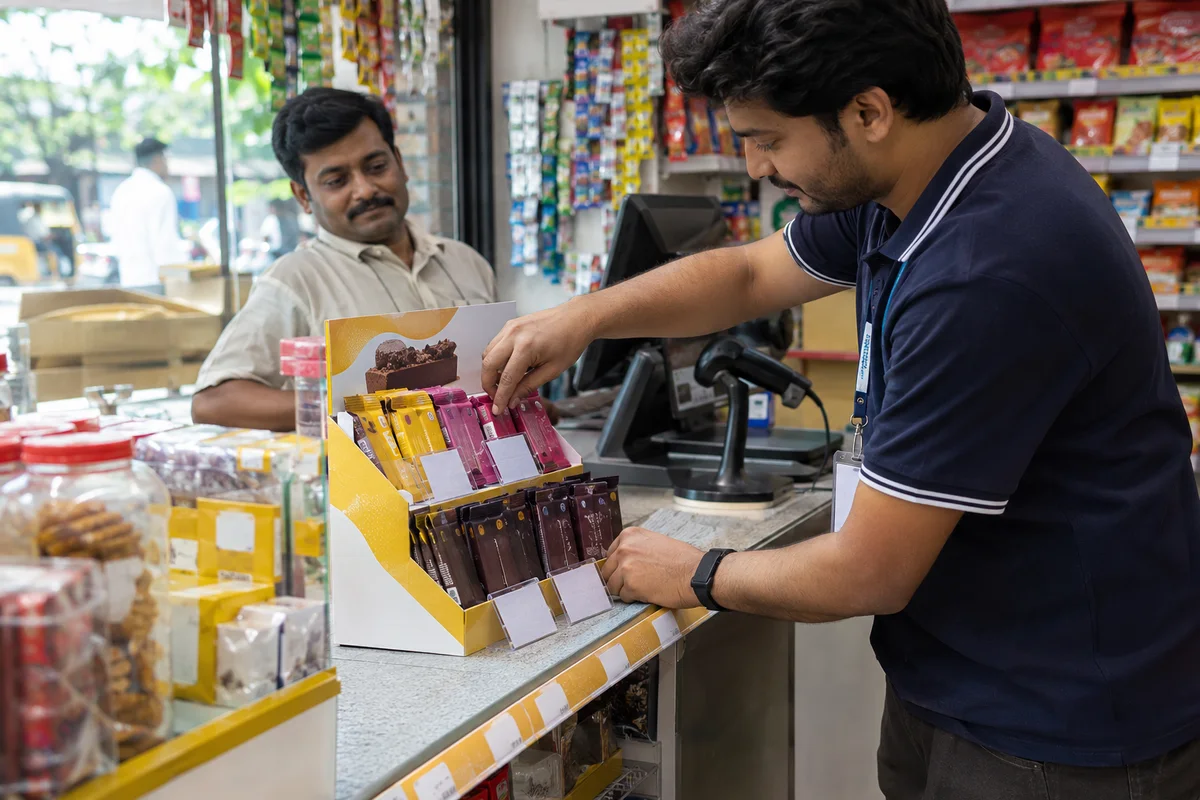
Point-of-purchase (POP) display design is the artwork and structural drawing for a unit that stands where the buyer chooses: a counter box, a shelf strip, a floor stand, a wobbler or a dump bin. GullySales designs the graphics and the build drawing, then hands over print-ready files and a specification sheet for the fabricator.
A display is also an object. It has a front panel, a header, a base, a pocket for stock and a way to stand up. A flat poster idea fails when it meets cardboard, a till counter or a shelf edge, so the drawing and the artwork are designed together.
This page covers the artwork and the structural drawing. The words on the unit, fabrication, printing, delivery and fitting are separate scopes, and the plan for where displays go sits with the neighbouring retail services named below.
Who it is for
This is written for you if these sound familiar.
- A manufacturer launching a product whose buyers choose at a dealer's counter or a supermarket shelf
- A pharmacy or optical shop that wants a counter unit for an accessory or a care product
- A cafe or bakery that sells packaged items beside the till and wants them noticed
- A personal care or beverage brand sending one display to several kinds of outlet
- A distributor who supplies dealers with a display and wants it to look like one family
- A shop owner whose own range of gifts, spectacle frames or pet items needs a fixture of its own
Before you decide
When this may not be the right fit.
- You need the placement of displays across outlets checked and the execution tracked. Retail execution and merchandising does that, and this page supplies the unit it would check.
- You want a programme of material for dealers, covering schemes and refills. Point-of-sale marketing runs that programme; this page designs one display inside it.
- You want a sign for the shop front or the aisle. Retail signage design draws that, and the two can be scoped together.
The problem
Does this sound like your business?
Common situations this work addresses.
“The display looks fine flat and wrong when built”
The artwork was approved as a picture. Folded, the logo disappears into a crease, the header leans and the product pocket hides the price. Nobody drew the build, so nobody caught it.
“Shoppers walk past without a glance”
The unit carries a logo, a slogan and four product claims. From arm's length none of it is readable. The eye needs one clear idea, a plain product view and a reason to stop.
“The unit does not fit the shop”
A floor stand arrives at a narrow aisle. A counter box is deeper than the counter. Dealers push it into a corner or leave it in the carton, and the design never meets a customer.
“Every campaign needs a new display from scratch”
Last season's unit cannot take a new offer panel, so the whole fixture is redrawn and reprinted. A design built with a changeable header and insert would have lasted several campaigns.
Choose the right scope
Start with the work your business needs.
One display for one product
A single unit, such as a counter box or shelf strip, designed with its drawing and print files. Bought when a product is launching and needs something at the till or on the shelf.
A family of displays for several outlets
A counter unit, a shelf strip and a floor stand drawn as one set, so a dealer, a pharmacy and a supermarket each receive a version that fits and looks related.
A refresh of an existing display
New artwork on a structure that already works, with changeable inserts added. Bought when the fixture stands well but its message is old and reprinting the whole unit is wasteful.
A version for a second buyer
The same display redrawn for another shopper, such as a parent instead of a gift buyer, or a trade customer instead of a household. Bought when one unit is asked to serve two kinds of outlet.
What we do
The work we can include.
Each deliverable and the purpose it serves. Your written scope confirms what is included, who is responsible, and what it costs.
Display concept and format recommendation
A short set of sketches comparing the display formats that suit your product and outlets, with a reason for the one we recommend. You approve the format before any artwork or drawing is detailed.
Structural drawing and dieline
A flat drawing showing every fold, cut, tab and panel of the unit, drawn to the fabricator's method. It shows how the display stands, how stock is held and where the weight sits.
Front, header and side artwork
The designed faces of the unit: header, product panel, side panels and base. Each follows one message, one product view and one clear next step, placed where a shopper's eye lands first.
Product and offer insert artwork
Artwork for the changeable parts: a price card, an offer panel or a feature strip. When the offer changes, only the insert is reprinted and the main unit stays in use.
Placement mock-ups
Your display drawn into pictures of a counter, a shelf and an aisle, so you judge size and visibility before production. Mock-ups show intent and are not a promise of how a shop will place it.
Fabricator specification sheet
A written sheet for the printer or fabricator: materials to quote, finishes, colour references, fold directions, and stock load. They quote and build against this sheet and not against a guess.
Print-ready files and editable sources
Final artwork prepared to the printer's specification, with the working files, fonts listed with their licence notes, and a handover list, so a later change is made on the original and not rebuilt.
How the result is measured
- Outlets that put the display up where the brief asked
- Displays built correctly from the first print proof
- Shopper enquiries that mention the display
- Units still standing at the next visit
- Campaigns that reused the same unit with a new insert
- Questions from fabricators about the drawing
Recorded as a baseline before work starts, so every later report has an honest comparison.
Marketing and sales together
The person who visits the outlet knows whether the display is working.
A field representative, a dealer visit team or a shop manager notes whether the display is up, where it stands, whether stock is loaded and what shoppers ask about it. Those notes go into the outlet record, and the next design and the fabricator's brief are corrected from what the visit found.
Decisions to make before the work starts
What is not included
The words, fabrication, printing, delivery, fitting, placement across outlets, media buying and the checking of outlet compliance are separate scopes. A packaging or signage design is also separate. Where partner pages exist, they can be scoped together with this one.
What stays your decision
Offers, prices, product claims, mandatory statements, trade marks and any shop's permission to display are yours to settle. We design the space and the structure, and leave each statement to you. A claim your own records cannot support does not go on the unit.
Where a retailer, regulator or fabricator sets the rules
A retailer may set its own fixture sizes and rules, a regulator may set wording for food, medicines and health products, and a fabricator sets what its machines can cut and fold. Each rule is theirs, and we draw to the one you give us.
This or a nearby service
Which piece of work fits your situation.
These services sit close to each other. The line between them, in plain words.
- Point-of-sale marketing
- Choose point-of-sale marketing when you want a whole programme of material for dealers, with schemes, upkeep and checks that it is put up. Choose this service when the need is the design of one display unit, its drawing and its files.
- Retail execution and merchandising
- Choose retail execution and merchandising when stock, shelf position and pricing in outlets need checking and correcting. Choose this service when those standards exist and the missing piece is the display unit that stands in the outlet.
- Retail store signage design
- Choose retail signage design when the need is wayfinding, fascia or aisle signs for a shop you control. Choose this service when the piece is a product-holding unit that stands in someone's outlet and must carry stock.
A sample of the output
A fabricator specification sheet says how each part of the display is built.
This is part of a sheet for an illustrative counter box that holds a skin-care accessory. Each row is one part of the unit. Read across for the part's job, how it is built and what the fabricator must check.
| Part | Job it does | Build note | Check at proof |
|---|---|---|---|
| Header card | Names the product and carries the one message | Folds back from the front panel, glued at the tabs | Logo clear of the fold |
| Front panel | Shows the product and the price card slot | Printed on the outside, open pocket behind | Price slot lines up with the insert |
| Side panels | Carry a short feature line and the brand mark | Tab-locked into the base without glue | Panels sit square when loaded |
| Base tray | Holds the stock and keeps the unit steady | Double wall where stock rests | Stock sits level when full |
| Offer insert | Carries the current offer, swapped by the dealer | Slides into a slot, printed on its own sheet | Insert changes without tools |
Before we start
What we need from you.
The work depends on these. Each says why it is needed and what happens when it is missing.
- Photographs of the outlets
- Pictures of the counters, shelves and aisles where the display will stand, with rough measurements. They show what space exists and what clutter surrounds it. Without them the unit is drawn for an imagined shop and may not fit a real one.
- The product and its packaging
- A sample of the product and its pack, or accurate drawings. The display must hold it, show it and sit beside it. Without them we cannot check weight, pocket size or whether the colours of unit and pack clash.
- One person who approves the design
- Display design stalls when several people each ask for a different header. One named person decides, collects comments and signs off the drawing. If nobody does, the structure is changed after artwork is complete.
- A fabricator or printer to draw against
- Name the supplier, or share the specification you were given, before the drawing starts. Methods differ, and a drawing for the wrong method will be corrected later. Without a supplier we draw to a stated general method and flag it.
- The offer and claims for the first run
- Settle what the unit says at launch: the product line, any offer and any required statement. If these are still changing, we draw placeholders and keep the insert separate, which delays final artwork.
How it works
How the work runs
The work itself, in order. How an engagement starts, from your brief to a written scope, is set out on our method page.
- 1
Read the brief and the outlets
We read your brief, the product, the packs and photographs of the outlets where the display will stand. We note shelf depth, counter clutter and who handles the unit, because the shop sets the limits.
- 2
Agree the one job of the display
With you we settle what the unit must do: introduce a product, support an offer, show a range or prompt a refill. A display with two jobs is split or cut before design begins.
- 3
Choose the format and sketch the structure
We compare formats such as counter box, shelf strip, floor stand and wobbler, and draw the chosen one in rough. Weight, stability and how stock is loaded are checked at this point.
- 4
Design the artwork on the drawing
We design directly on the structural drawing, so every fold and cut is visible while the artwork is made. Header, panels and base are set against your brand rules and the product's own packaging.
- 5
Mock up and test in context
We place the design in pictures of real counters and shelves, and look at it from a shopper's distance and angle. We change what cannot be read, then show you the version for approval.
- 6
Prepare files and brief the fabricator
We prepare the print files and the specification sheet, and answer the fabricator's questions on the drawing. Where a proof arrives wrong against the drawing, the written scope says how it is handled.
Before you hire anyone
Do this first yourself.
Look at where your product is chosen and what stands there now.
- Visit three outlets that stock your product and photograph the counter, shelf or aisle position it gets.
- Stand at arm's length from your current display and write down what a shopper can read from there.
- Measure the space an outlet could give a unit and list what already crowds it.
- Write the one thing a shopper should do or understand when they see the display.
- Ask the person who sets up displays in outlets what makes them leave one in the carton.
Judge any provider
What to ask any provider of this service.
Useful whoever you choose, including us.
- Will you draw the structure and the artwork together, and can I see a flat drawing from an earlier piece of work?
- How do you check that the logo and price card are clear of folds and slots once the unit is built?
- What do you hand to the fabricator, and who answers their questions about the drawing?
- How is a changeable insert designed so that a new offer does not mean a new unit?
- What does the written scope say about files, licences and changes after the proof arrives?
Where this fits
Three pieces of sales work, in this order.
This work sits inside sales process design, at stage 1, prospecting and lead generation. The audit comes before it, and sales management keeps it running.
Step 1
Sales audit
Find where deals are being lost and what to fix first.
Start here if you cannot say where orders are lost.
Step 2 · you are here
Sales process design
One written way to sell, from first enquiry to repeat order.
Start here if every salesperson sells differently.
Step 3
Sales management
A target, a review routine and someone who owns the number.
Start here if the team has targets and no routine.
FAQ
Questions owners ask before they call.
Not here? More answers, or ask on WhatsApp.
Who owns the finished artwork and the files?
Do you also write the words on the display?
Do you make or print the display?
How are changes handled after you show the design?
Will a display design raise sales?
Who approves claims on a display?
By industry
Point-of-purchase display design, written for your industry.
Related services
Often bought with this, or instead of it.
Your next practical step
Tell us what you are trying to grow, and we will read it before we call.
Eight short steps, mostly taps. Skip anything you would rather answer on the call.