Skip to content
GullySales

Every enquiry is captured in one place and carried to a decision.

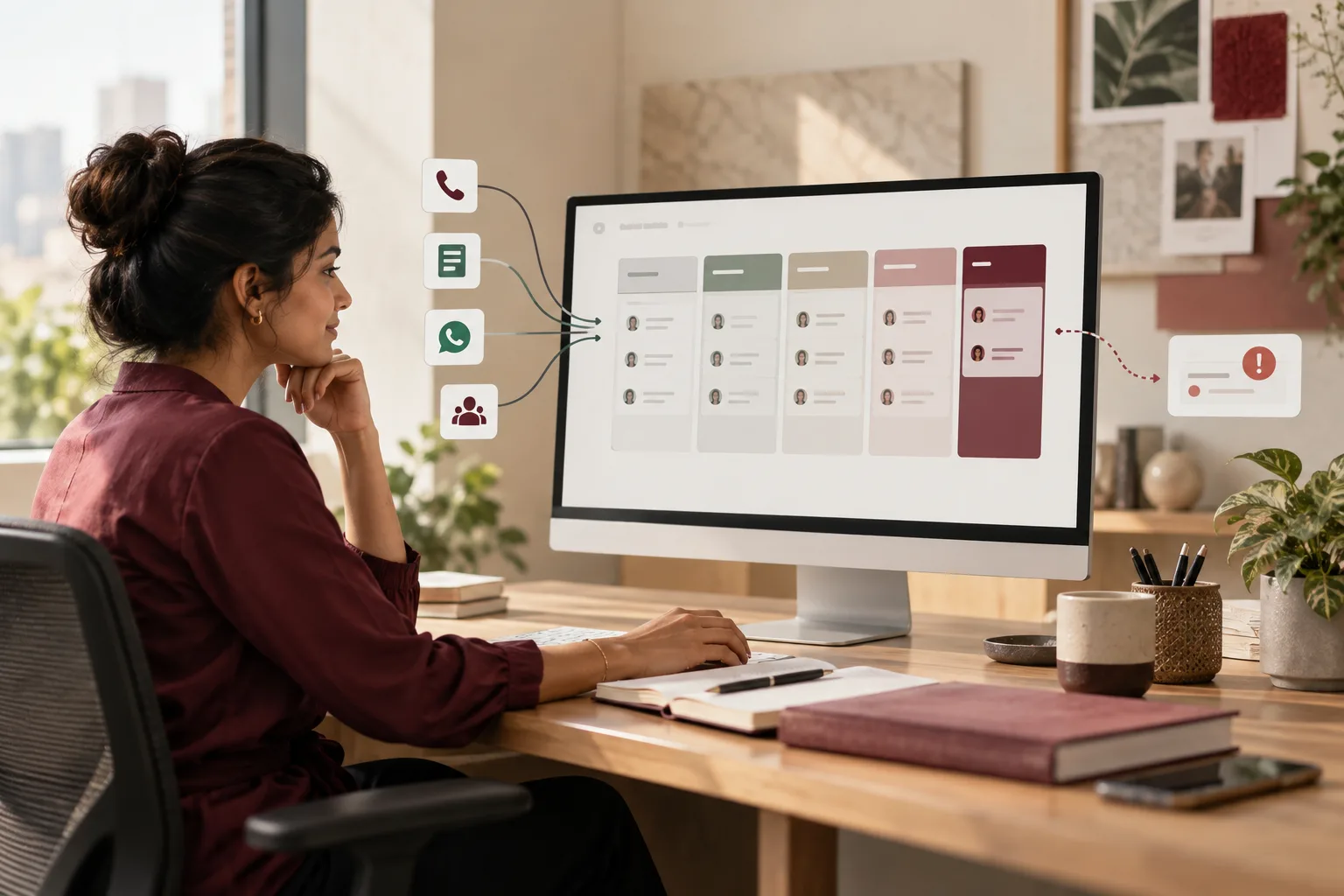
Gully Sales brings every enquiry from forms, calls, WhatsApp, marketplaces and walk-ins into one record, then gives each stage of a lead's life a definition, an owner and a next step until it converts or is closed with a reason.

  • One capture point for forms, calls, WhatsApp, marketplaces and walk-in enquiries
  • Lifecycle stages with written definitions, entry rules and a named owner
  • Every lead moves, waits with a return date, or closes with a recorded reason

Gully Sales Private Limited works with small and medium businesses across India, and builds this on the channels and tools you already use.

In one paragraph

What is Lead Capture and Lifecycle Management for SMBs?

Lead capture and lifecycle management is the work of collecting every enquiry from every channel into one record and defining the stages that lead travels through afterwards. Gully Sales fixes your capture points, sets the fields each enquiry must carry, writes stage definitions and owners, and adds nurture and closure rules so no enquiry is left in limbo.

The problem

Enquiries arrive from everywhere, and only some survive the first week.

This is the cost of becoming easy to contact. Enquiries now arrive on a website form, a WhatsApp number printed on a vehicle, a marketplace portal, a missed call, a visiting card from an exhibition and a phone that only one person answers. Each of those was added because it brought business. What nobody had time to design was the single place they all land in, and the sequence a lead follows once it does. So each channel keeps its own memory, and the ones that are quietest are the ones nobody notices going quiet.

You will recognise it as

  • An enquiry that came on WhatsApp exists only in one person's phone, and nobody else can see it or continue it.
  • Two people call the same buyer in one week, because the portal enquiry and the form enquiry were never recognised as one person.
  • Nobody can say how many enquiries came last month without opening four places and counting by hand.
  • A lead who said 'call me after Diwali' is remembered by nobody, because there was no way to park it with a date.
  • Half your records have no source, no requirement and no city, so the follow-up call starts from zero every time.
  • Leads that did not buy simply stop appearing, with no status saying whether they were lost, unreachable or only early.

What it costs the business

  • Money spent on ads, listings and exhibitions cannot be judged, because the enquiries they produced were never recorded against them.
  • Buyers who were genuinely interested go to a competitor who called first, and that loss never appears in any report.
  • The same enquiry is worked twice by two people, which wastes their time and tells the buyer your business is disorganised.
  • Follow-up quality depends on who happened to take the call, so results swing with individuals rather than with demand.
  • Any later attempt to build reporting, a CRM or automation inherits incomplete records, and begins by cleaning up years of gaps.

Why it persists. It persists because capture is added channel by channel, in response to whatever worked, and each addition is small enough to handle informally. One person can hold a WhatsApp thread in their head. Two can. Past that, the informal system fails quietly rather than loudly, and the failure shows up as a slightly weaker month rather than an incident anyone investigates. There is also nobody whose actual job is the space between an enquiry arriving and a salesperson deciding it is worth pursuing.

If it stays unresolved. Left alone, your enquiry count keeps growing while the share reaching a real conversation keeps falling, and you respond by spending more to generate demand you already had. The business also becomes fragile: when the person holding the threads is on leave or resigns, their pipeline leaves with them, and there is no record to hand to a replacement.

What changes

What changes once every enquiry is captured and carried.

In the first weeks

  • Every channel writes into one list, so the day's enquiries can be seen in a single view.
  • Each enquiry arrives with the fields your follow-up needs, not whatever the caller happened to mention.
  • Duplicate enquiries from the same buyer are recognised and joined rather than worked twice.

In how the work runs

  • Every lead sits at a stage with a written definition, a named owner and a next action with a date.
  • Leads that are not ready are parked in nurture with a return date instead of being lost or chased daily.
  • Closure requires a reason, so a lost lead becomes information rather than silence.
  • New team members follow the same sequence from day one, because it is written rather than learned by watching.

In sales and marketing

  • More of the enquiries you already pay for reach a genuine first conversation.
  • Spend can be compared channel by channel on enquiries that converted, not enquiries that merely arrived.
  • Buyers who were early rather than uninterested come back into contact on a planned date.

In what management can see

  • A weekly count of enquiries by source, stage and owner that nobody has to assemble by hand.
  • Stage-by-stage conversion, so you can see where leads stop instead of guessing.

Over the longer term

  • A clean lead history that any future CRM, scoring model or report can be built on.
  • Demand planning based on what your channels actually produced, month after month.

Gully Sales controls the design and the discipline: capture points, fields, stage definitions, owners, nurture rules and reporting. Whether more of those leads convert also depends on your offer, pricing and how quickly your team calls. We describe what we deliver, and measure the rest honestly.

Who it is for

This suits businesses that are easy to contact.

The businesses it suits

  • Businesses taking enquiries on more than two channels, with no single place where all of them land.
  • Owners who suspect enquiries are being missed but cannot prove it from any record.
  • Teams about to buy or rebuild a CRM, who want the lead process defined before software is configured.
  • Companies spending on ads, listings or exhibitions without knowing which produced customers.
  • Sales heads who inherit a follow-up routine living in individual phones and notebooks.
  • Businesses adding sellers or a second location, where informal follow-up has stopped scaling.

What usually prompts the call

  • A buyer tells you they enquired weeks ago and never heard back from anyone.
  • Two people from your company call the same prospect in the same week.
  • Your marketplace or portal enquiries are handled entirely inside that portal, by one person.
  • You are asked which channel produced last quarter's customers, and cannot answer from records.
  • A salesperson resigns and their follow-ups cannot be handed over to anybody.

What Gully Sales does

The work, component by component.

Capture point audit and repair

We list every way an enquiry can reach you, including website forms, landing pages, phone lines, WhatsApp, marketplace portals, email inboxes, walk-ins, exhibitions and referrals, and check what each one actually records. Broken forms, unmonitored inboxes and numbers that ring nowhere are found here. Each capture point is then fixed, connected to your system, or retired.

Why it matters:
An enquiry that is never recorded cannot be followed up, reported on, or counted against the money you spent to create it.
You receive:
A capture point inventory naming the fault, the fix and the owner for each one.
Business value:
You stop paying for demand that leaks away before anybody in your team sees it.

One lead record and its required fields

We agree the fields every enquiry must carry regardless of where it came from: who, business, city, requirement, source, campaign and preferred contact channel. Mandatory fields are kept few enough that busy people actually fill them. Duplicate rules decide when two enquiries are the same buyer, so one history follows the person rather than the channel.

Why it matters:
Follow-up quality depends on what the next person can see. A record holding a name and nothing else forces every call to start again from the beginning.
You receive:
A field definition sheet, a mandatory field list and duplicate matching rules.
Business value:
Anyone in your team can pick up any enquiry and continue the conversation instead of restarting it.

The lifecycle stage model

We define the stages a lead travels through before it becomes an opportunity, named in your own language rather than software vocabulary: new, contacted, engaged, qualified, nurture, recycled, disqualified and converted. Each stage gets a written entry rule, an exit rule, an owner, and a maximum time it may sit before somebody acts. This is the audience state map your team works from.

Why it matters:
When stages are undefined, two people looking at the same lead disagree about what has already happened and what should happen next.
You receive:
A stage map with entry and exit criteria, owners and a maximum dwell time per stage.
Business value:
Every lead carries a status that means the same thing to everyone, and a clear next step.

Triggers, message sequence and channel mix

For each stage we set the trigger that moves a lead forward and the contact sequence that follows it: what is said on the first call, what is sent afterwards, on which channel, and how many attempts are made before the lead is parked. Sequences are written for phone, WhatsApp and email in the mix your buyers actually reply on.

Why it matters:
Most enquiries are lost between the second and fourth attempt rather than the first, because nobody ever agreed what those later attempts should be.
You receive:
A stage-by-stage contact sequence with timing, channel and message outlines.
Business value:
Follow-up stops depending on who took the call and how busy that person was on the day.

Nurture, recycling and closure rules

Leads that are real but early are parked in nurture with a return date and a light contact plan, rather than chased daily or forgotten entirely. Leads that go quiet are recycled back with a reason. Closure requires a reason code chosen from a short agreed list, so a lost lead still tells you something. Wrong-fit enquiries are disqualified quickly and politely.

Why it matters:
Buyers rarely say no; they go quiet. Without rules for quiet, your list fills with leads nobody is working and nobody has closed.
You receive:
A nurture cadence, recycle triggers and a closed-lost reason code list.
Business value:
Your working list stays honest, and early buyers come back at the date they themselves asked for.

Handoff and lifecycle reporting

We define the point at which a lead leaves the lifecycle and becomes a sales opportunity, what must be true for that handoff to be accepted, and what happens when it is rejected. Reporting is then built on the same stage model: enquiries by source, movement between stages, ageing leads and response time, produced from the system rather than by hand.

Why it matters:
A handoff without acceptance criteria is where marketing and sales begin disagreeing about lead quality, and where leads sit longest.
You receive:
Written handoff criteria, a rejection route, and a one-page weekly lifecycle report.
Business value:
You can see where leads stop, and settle quality arguments with the record instead of opinion.

What you will have at the end.

  • A capture point inventory covering every form, number, inbox, portal and offline source, with the fix and owner for each.
  • A lead record definition: required fields, picklists and duplicate matching rules.
  • A lifecycle stage map with entry rules, exit rules, owners and maximum dwell time.
  • A written qualification checklist your team can apply on a first call.
  • Stage-by-stage contact sequences with timing, channel and message outlines for phone, WhatsApp and email.
  • A nurture cadence with return dates, recycle triggers and a closed-lost reason code list.
  • Handoff criteria between lead and opportunity, plus the route for a rejected handoff.
  • Configuration of these stages, fields and rules in your existing CRM or structured lead sheet.
  • A weekly lifecycle report showing enquiries by source, stage movement, ageing and response time.
  • An anonymised sample record and report extract, so you see the format before it goes live.
  • A short written playbook and a working session so your team can run it without us.

How it runs

The engagement, step by step.

  1. 1

    Trace how enquiries reach you today

    We follow real enquiries backwards from your team's phones, inboxes, portals and forms to see how each one arrived, what was recorded, who acted and how long it took. Nothing is redesigned in this step. We are establishing what actually happens, including the parts that exist only in somebody's phone.

    You provide:
    Access to your enquiry channels, recent enquiry examples, and time with the people who handle them.
    We produce:
    A written picture of your current capture and follow-up, with the leaks named and located.
    Done when:
    You recognise your own process in the description, including its gaps.
  2. 2

    Agree the record and the stages

    We define the fields every enquiry must carry and the stages a lead travels through, in your language rather than software vocabulary. Entry and exit rules are written for each stage, along with the owner and how long a lead may sit there. Disagreements about what qualified means are settled here, in a room, before anything is configured.

    You provide:
    A decision-maker for sales, and one person who knows how your buyers actually behave.
    We produce:
    A field definition sheet and a stage map with rules, owners and dwell times.
    Done when:
    Sales and marketing describe the same stage the same way without being prompted.
  3. 3

    Repair and connect the capture points

    Forms, landing pages, phone lines, WhatsApp, marketplace portals and offline sources are fixed and connected so each writes into the one record with its source attached. Where a channel cannot be connected automatically, we design a simple manual routine and name the person responsible for running it.

    You provide:
    Administrative access to your website, forms, phone or WhatsApp business tools and portals.
    We produce:
    Working capture from every live channel, with source and campaign recorded on arrival.
    Done when:
    A test enquiry from each channel appears complete in the one list.
  4. 4

    Write the sequences and the rules

    We write what happens after capture: first contact timing, the contact sequence across phone, WhatsApp and email, the qualification checklist, the nurture cadence with return dates, recycle triggers and the closed-lost reason list. Message outlines are drafted so your team is not inventing wording under pressure.

    You provide:
    Your current follow-up scripts if any, and the objections your team hears most often.
    We produce:
    A follow-up playbook with sequences, checklist, nurture plan and reason codes.
    Done when:
    A new joiner could run the follow-up from the document alone.
  5. 5

    Configure and pilot

    The fields, stages and rules are set up in your existing CRM or, where there is none yet, in a structured sheet a CRM can inherit later. We then run the process live with one team or one channel for a few weeks, watching carefully for the places where people work around it rather than with it.

    You provide:
    One team or channel to pilot with, and permission to change their daily routine.
    We produce:
    A configured system and a pilot log of what worked and what was quietly ignored.
    Done when:
    The pilot team is using the stages without being reminded to.
  6. 6

    Train the team and hand over

    We run working sessions with the people who take enquiries, using their own live leads rather than invented examples. The playbook is finalised with whatever the pilot changed, and the reporting is handed to whoever will read it every week.

    You provide:
    Time with everyone who handles enquiries, including field and part-time staff.
    We produce:
    A final playbook, the live weekly reports, and a team trained on their own records.
    Done when:
    Your team runs a full week without asking us what to do next.
  7. 7

    Review and tighten

    After the first full cycle we read the numbers together: where leads stopped, which stages hold leads too long, which sources produce enquiries that never convert, and which rules people quietly ignore. Rules that do not survive contact with real work are rewritten rather than repeated louder.

    You provide:
    An hour a month with the sales owner, and honesty about what is not being followed.
    We produce:
    A review note with the changes made and the reason for each of them.
    Done when:
    The process has changed at least once because the data said it should.

Ways to work with us

Fix the capture points, or the whole lifecycle.

Lead capture and lifecycle assessment

A short review of your capture points, your records and your follow-up, ending in a written picture of where enquiries leak and what to fix first. Suitable when you suspect losses but want evidence before committing to a rebuild.

Capture and lifecycle build

We design the record, the stages, the sequences and the rules, repair and connect your capture points, configure your existing system and train the team, through to a live pilot and a documented handover.

Design with your team implementing

We produce the stage map, sequences and rules, then coach your internal owner while your own team does the configuration and rollout, with review sessions at agreed points.

Ongoing lifecycle review

A recurring monthly or quarterly review of stage conversion, ageing leads, response time and source quality, with changes made to the rules where the numbers say they are needed.

Why Gully Sales

What you are actually choosing when you choose us.

We design for the channels Indian buyers actually use

Your enquiries arrive on WhatsApp, missed calls, marketplace portals and walk-ins as much as on web forms. The lifecycle we design assumes that mix, rather than an imported model built for buyers who only ever send email.

The process is written before the software is chosen

Stages, fields and rules are settled on paper with your team first. Whatever system you use afterwards is configured to a decision you have already taken, rather than the other way round.

We work with the team you already have

Sequences are built for the number of people who genuinely handle enquiries, including those doing it alongside another job. A process that needs staff you do not have is not a process.

Sales and marketing sit in the same room

Gully Sales works across marketing and sales, so the definition of a qualified lead is agreed by both sides at one table, instead of being negotiated later through complaints about quality.

It is measured from a recorded baseline

We record response time, data completeness and stage conversion before anything changes, so improvement is a comparison you can check rather than an impression somebody reports.

Where it applies

The same service, in different businesses.

Industrial equipment manufacturing

The situation:
Enquiries arrive from a marketplace portal, the website and exhibitions, and each is handled by whoever happened to see it first.
How it applies:
One record with source recorded, a stage map from new to qualified, and a written first-call checklist for capturing technical requirements.
Likely benefit:
Requirement details are captured once, and quotation follow-up stops depending on who took the call.

Hospitals and clinics

The situation:
Patient enquiries come by phone, WhatsApp and web form, and the front desk cannot remember who was called back and who was not.
How it applies:
A single enquiry list with appointment stages, return dates for people still deciding, and a daily list of enquiries not yet contacted.
Likely benefit:
People who were still deciding are contacted on the date they asked for, rather than forgotten.

Interior design and home services

The situation:
Leads are collected at exhibitions and through social media, then worked from personal phones and one shared sheet.
How it applies:
Offline capture at events routed into the same record, plus nurture stages for buyers whose project begins months later.
Likely benefit:
Long-cycle enquiries stay in contact until the project actually starts, instead of going cold in three weeks.

Building materials and hardware distribution

The situation:
Dealer enquiries and end-customer enquiries mix in one inbox, and the team cannot separate the two before calling.
How it applies:
Capture fields that identify enquiry type, separate lifecycle routes for dealer and retail leads, and closure reasons per route.
Likely benefit:
Dealer enquiries are treated as relationships and retail ones as orders, without either being dropped.

Professional and consulting services

The situation:
Referrals and website enquiries are handled by the founder, and follow-up stops whenever the founder is delivering client work.
How it applies:
A stage model with parking and return-date rules, and sequences an assistant can run without making judgement calls.
Likely benefit:
Enquiries keep moving during delivery weeks, and the founder joins only where a decision is genuinely needed.

Education and training institutes

The situation:
Admission enquiries peak in a short season and arrive faster than the counselling team can call them back.
How it applies:
One capture list with response-time ageing, a qualification checklist, and nurture for candidates asking about the next batch.
Likely benefit:
The oldest untouched enquiry is visible every morning, so a season's leads are worked in order rather than at random.

Proof

Work we can point to.

Premier Marketing

The problem:
Reach, the handling of incoming leads, and the speed of sales all needed to improve across domestic and industrial segments.
What we did:
Gully Sales worked on complete website development for the business, enabling wider reach, more streamlined lead handling and faster sales.
Over:
The result:
The case study describes enhanced reach, streamlined lead handling and accelerated sales across domestic and industrial sectors.
Read the case study

ViRo Enterprises

The problem:
Demand had to be expanded while the sales pipeline and outreach were run without much structure behind them.
What we did:
Gully Sales supported the business on renewable energy demand, sales pipeline optimisation and outreach.
Over:
The result:
The case study reports expanded renewable energy demand, optimised sales pipelines and improved outreach.
Read the case study

Questions buyers ask

Before you enquire, the answers you will want.

What behaviour should move a contact to the next stage?

Movement should follow evidence, not optimism. A lead becomes contacted when somebody actually spoke or messaged and recorded it. It becomes engaged when the buyer replies or asks something. It becomes qualified only when the checklist is met: a real requirement, a decision-maker involved, and a stated timeframe. We write these rules with your team so a stage change is a fact anyone can check, not a judgement one seller makes alone.

How long does lifecycle work take to stand up?

It depends on how many channels you capture from and whether a CRM already exists. Tracing your current enquiries and agreeing the record and stages is the first phase. Repairing capture points, writing sequences and configuring the system follows, and then a live pilot runs before handover. We commit to a schedule in writing once we have seen your channels, rather than quoting a length before we know what we are connecting.

What do you need from us to map the channels?

Access to your capture channels, meaning website forms, phone or WhatsApp business tools, marketplace portals and inboxes, plus recent enquiry examples. Time with the people who actually take enquiries, including field and part-time staff. One decision-maker who can settle what qualified means. And permission to change a daily routine, because a stage model nobody follows is only a document.

How will we know fewer enquiries are being lost?

Against a baseline we record before changing anything: enquiries captured per channel, data completeness, hours to first contact, leads sitting with no next action, and conversion from enquiry to qualified where history allows. Those same measures are read weekly and monthly afterwards. Operating measures move first. Conversion needs a full buying cycle before the comparison carries weight, and we say so rather than claiming an early win.

What is not included in lifecycle work?

We do not generate demand under this engagement; it manages the enquiries you already receive. Building a weighted scoring model, designing routing and assignment rules, and negotiating a formal marketing-to-sales service agreement are separate pieces of work, though we design the lifecycle so each can be added later. We also do not rewrite your website or run your sales calls for you.

Can we do this without a CRM in place?

No. The stage model, fields and rules are agreed on paper first, and can run in a structured shared sheet if you have no system yet. That is often the sensible order, because a CRM configured around an undefined process usually inherits the confusion. When you do buy one, the definitions transfer directly, and the sheet becomes the migration source rather than a wasted step.

How do we capture WhatsApp and phone enquiries properly?

By treating them as business channels rather than personal conversations. That means a business number with a shared inbox, a call log that records source and requirement, and a short routine for whoever answers. Where a tool can write these into your system automatically we connect it. Where it cannot, we design a manual step small enough that a busy person will still do it.

Will this create more admin work for the sales team?

It should reduce it, though it changes what the work is. We keep mandatory fields few, put them where the call already happens, and let the system raise reminders instead of the seller keeping a private list. The effort moves from remembering to recording. If a rule turns out to cost more time than it returns, we remove it at the first review rather than defend it.

4 more questions

What happens to leads that are interested but not ready to buy?

They are parked in nurture with a return date and a light contact plan, not chased weekly and not lost. The reason for parking is recorded, so the return conversation starts where the last one ended. A recycle trigger brings them back if they act in the meantime. For many Indian businesses this is the largest recoverable group, because early buyers are usually treated as failures.

How do you handle enquiries from marketplace and listing portals?

They enter the same record with the portal named as the source, so their conversion can be compared with your other channels. Portal enquiries often arrive in volume and go cold quickly, so they usually get their own first-response rule and a shorter attempt sequence. Where the portal cannot connect automatically, one person owns a daily export or manual entry routine at a fixed time.

Who should own the lead lifecycle inside our business?

One named person, usually the sales head in a smaller company, or a marketing or operations lead where enquiry volume is higher. The owner is not expected to work every lead. They own the definitions, read the weekly report, and decide when a rule changes. Where nobody can hold that role, we say so before starting, because the design will drift back within a quarter.

What does the weekly lifecycle report actually show?

Enquiries received by source, how many were contacted within the agreed response time, movement between stages during the week, leads ageing past their dwell time with no next action, and closures by reason. It is one page, produced by the system, and readable in a few minutes. Its purpose is to prompt two or three decisions a week, not to be a dashboard nobody opens.

Talk to us

Let us count the enquiry channels you are running.

A first conversation is a conversation, not a pitch. We look at how enquiries reach you today and tell you plainly whether this is worth doing, and what to fix first if it is.

  • No obligation and no sales script
  • A reply from someone who does the work
  • Your details are never sold or shared

Your details are used only to reply to this enquiry. We do not sell or share them, and we will not add you to a mailing list without your agreement. Write to hello@gullysales.com or call +91 80958 58589.

Protected by reCAPTCHA — Google’s privacy policy and terms apply.

Get a free audit of how you sell, and a scored report of where the work is.

Book a free audit