Notes for owners · Industry playbooks
A buyer's checklist for comparing two rubber moulders, written for the moulder
The checklist a purchase or development engineer runs when two rubber moulders quote the same part, so a moulder can score the offer first and close the gaps that lose orders.
The GullySales team · Updated 17 Oct 2026 · 5 min read
On this page
The development engineer has your offer and another moulder's open side by side, and the piece rates are close. Risk decides it. Does each moulder control its compound? Who makes and keeps the mould? Has it moulded a part like this before? Will it say when something changes? Score your own offer against the checklist below before it goes. Every box you cannot tick is a question the engineer answers alone, and answers against you.
How the engineer compares two moulders
The engineer fills a comparison sheet for a manager and has to write down why one moulder was chosen. On a new part, a rejected first lot costs the line far more than a small difference in piece rate, so the engineer reads for risk. A visit to the shortlisted plant comes later. Before that, all there is to go on is what your offer says.
Anything missing from your offer gets scored as missing. The engineer may not ring to ask whether you test each compound batch, and may assume you do not. How a unit gets onto the RFQ list in the first place is covered in how industrial buyers decide which unit gets the RFQ. This checklist starts once your offer is on the engineer's desk.
The checklist, in the order an engineer reads it
Compound
- Where the compound is mixed: on your own mill or kneader, or bought from a named mixing house.
- Polymer and hardness for this part, with the hardness tolerance you hold.
- Tests on each compound batch, and what happens to a batch that fails.
Mould
- Toolmaker: your own tool room or a named outside shop.
- Cavities, mould steel and expected life, and the sample date the toolmaker can keep.
- Ownership once the buyer pays for the mould, where it is stored, and how it is taken back if the part moves.
Moulding and finishing
- Process, compression, transfer or injection, with one line on why it suits this part.
- Post-cure, if the compound needs it.
- Deflashing method, and the flash limit you inspect to.
Inspection and papers
- Instruments you check the part with, named.
- Batch test certificate with each lot, and the cure date on every packet.
- A written promise to notify any change of compound, source, mould or process before it ships.
Proof
- One similar part you mould now, the industry it goes to, and a photograph or a sample.
- Free press capacity, by tonnage, for the buyer's yearly volume.
The commercial page
- Tool cost and piece rate on separate lines, with the basis on which the rate follows raw material prices.
Score your offer before the engineer does
Mark each box 2 if it is stated with evidence: a report, a photograph, a name. Mark it 1 if it is stated without evidence, and 0 if it is missing.
Then apply one rule. Any 0 under compound or mould is fixed before the offer goes, even if that costs a day. Those two sections carry the risk the engineer is reading for. Ones under proof are cheaper to lift: a photograph of a similar part, or a sample in the courier with the offer.
Do not tick a box with a claim you cannot show at the visit. If hardness is your only in-house test, say that, and name the outside lab for the rest. A small lab is easier to forgive than finding that the lab named in your offer does not exist.
Ask what decided it
A full score does not win every order. When you lose, put one question to the engineer a few days later: "Which line on your comparison sheet went against us?" Some will tell you if you ask plainly and do not argue.
Note each answer against the checklist section it falls in. Over several losses a pattern appears, and it may not be the one you guessed. Win-loss analysis is this habit, kept up and read across every quote.
Imagine: a Bawal moulder and a boot and grommet order
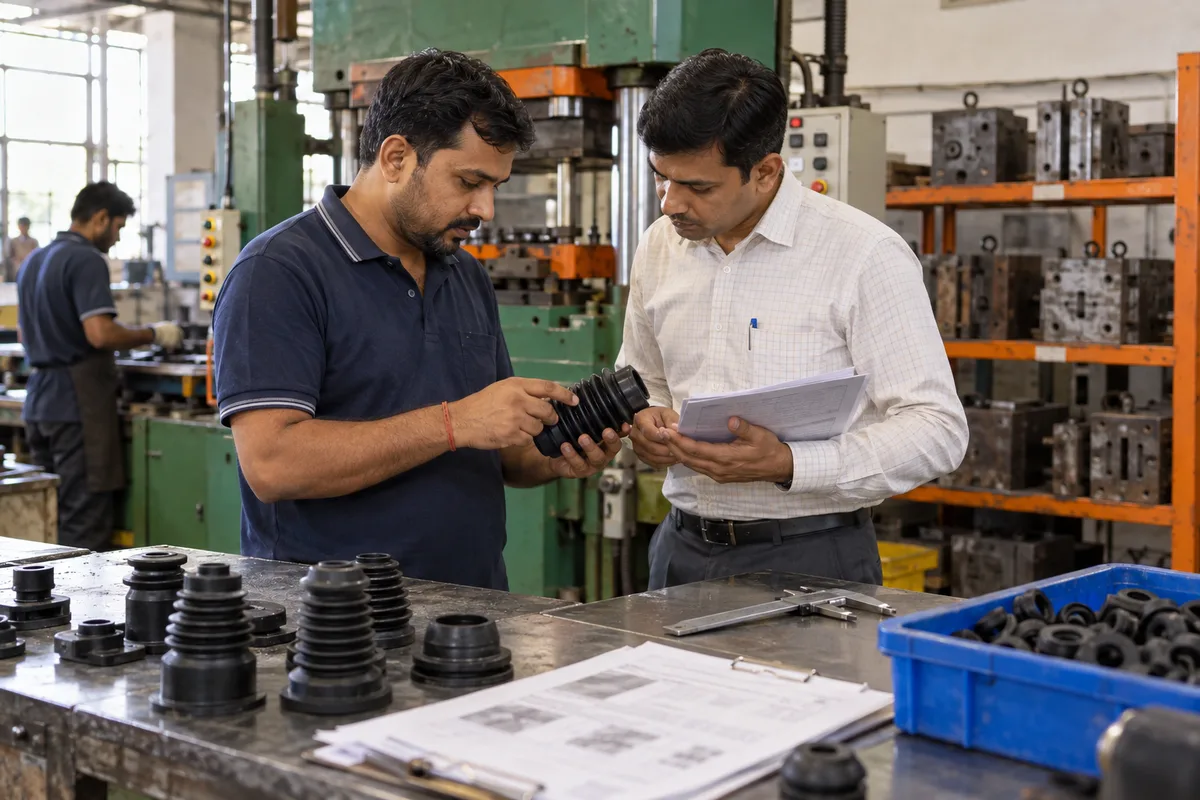
Imagine a rubber moulder in Bawal, Haryana, quoting bellows boots and grommets for a two-wheeler maker's new model. The details are illustrative.
Its offer was a single page: tool cost, piece rate, delivery. The piece rate was lower than the rival's, and it still lost. The owner asked the development engineer why. The answer was short. "We could not tell where your compound comes from. The other moulder sent hardness and ageing reports for a similar boot."
The Bawal moulder did buy compound from a mixing house and did check the hardness of every batch. It had simply never written either down. The owner built a two-page capability sheet with the mixing house named, a sample batch report, and photographs of the boot moulds with the toolmaker named. It also carried the change-notice promise and two similar parts with their industries. When the same maker sent an RFQ for a different part, the offer reached the sample stage. A capability presentation built from that sheet now goes with every new RFQ.
When the checklist will not win it
Some buyers require a quality system certification before any order. If you do not hold it, no checklist replaces it, so ask before you spend a week quoting. Some RFQs are rate checks, with the incumbent holding the mould and no intention of moving the part. Ask the engineer whether the part is moving or being re-priced. And if the volume suits injection moulding while you run compression presses, say so and propose what you can do well.
Read your last offer the way the engineer did
Take the last offer you lost and score it against the checklist, honestly. The zeros are your next capability sheet. The rest of the moulder's selling job is on the rubber products page. If you want help with the sheet through sales collateral development, tell us what you need.