Notes for owners · Branding and communication
A capability deck for a manufacturer: what goes on which slide
A slide-by-slide plan for a twelve-slide capability deck: machines, tolerances, certificates held, customers served and the work you decline, so a purchase and quality team can shortlist you from it.
The GullySales team · Updated 17 Oct 2026 · 6 min read
On this page
Your deck needs to let a purchase engineer and a quality head decide, without ringing you, whether to ask for a quotation. That takes twelve slides in a fixed order. Who you are, what you make and hold in tolerance, the machines behind it, the paper you carry, who you supply, and what you turn down. The founder's journey and the drone shot of the factory are optional.
Who reads it, and what each of them hunts for
Your deck may not stop with the person you sent it to. The purchase manager forwards it to the quality head and sometimes to a design engineer. The first wants to know if you are in the right range. The second looks for tolerances, inspection tools and certificates. The third wants to see a part like the ones they design.
So build the deck as a lookup, not a story. Each slide should answer one question that someone in that chain will ask, and the slide title should say what it answers.
The twelve slides
| Slide | What goes on it | The mistake to avoid |
|---|---|---|
| 1. Cover | Company name, town, what you make in one line, one phone number | Three taglines and a stock photo of a handshake |
| 2. What we make | The parts or products, with a photograph of each on a plain background | Listing "all engineering needs" |
| 3. Size and tolerance range | Smallest and largest part, materials, the tightest tolerance you hold in regular production | A tolerance you reached once on a sample |
| 4. Machines | A table: machine, count, what it holds, the largest part it takes | Brand names with no figures |
| 5. Inspection | The gauges, CMM or projector you own, and who signs the report | Saying "100 per cent inspection" with no instrument named |
| 6. Materials and processes | Grades you buy, where heat treatment or plating is done and whether in-house | Hiding that a process is outsourced |
| 7. Certificates held | Only those you hold today, with the body that issued them and the valid-to date | Showing an expired or applied-for certificate |
| 8. Customers served | Named customers you may show, the part, the years supplied | Logos with no part or year beside them |
| 9. One worked case | A drawing, the problem, what you changed, what the buyer got | A case with no part and no numbers from the shop floor |
| 10. How an order runs | Enquiry to first article to regular supply, with who handles each step | A flowchart with ten arrows and no names |
| 11. What we do not take | Sizes, materials, volumes and trades you decline | Leaving it out because it feels negative |
| 12. Contact | The person who takes enquiries, a phone, an email, the address of the works | A general mail box nobody opens |
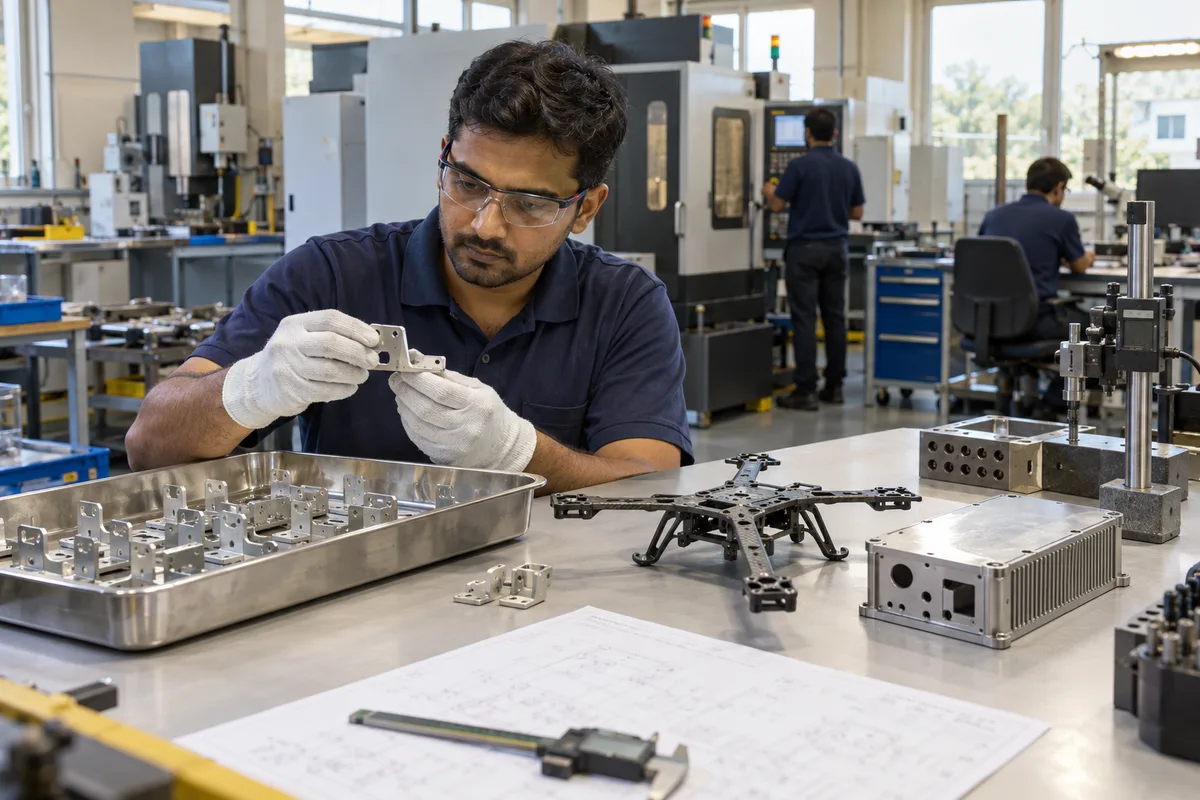
Use pictures of your own floor and parts, taken in daylight, on slides 2, 4 and 9.
Slide 4 does most of the work
Most decks list machines as "VMC x 6, lathes x 4". A quality head reads that and learns nothing. Write the machine table so each row says what the machine can do and hold:
| Machine | Count | Largest part it takes | Tolerance we hold on it |
|---|---|---|---|
| Vertical machining centre | 6 | 600 x 400 x 400 mm | as per your drawing, down to the figure on slide 3 |
| CNC lathe | 4 | 250 mm diameter | as above |
| Surface grinder | 1 | 300 x 150 mm | as above |
Replace the figures with your own, from your own records. If a machine is old, say what job it still does well.
Slide 11: say what you decline
A buyer who knows what you turn down has more reason to trust the rest of the deck. Write the plain version: "We do not take parts above 600 mm. We do not take single pieces. We do not work in titanium." It saves both sides a quotation round.
An invented case: a gear and sprocket maker in Kolhapur
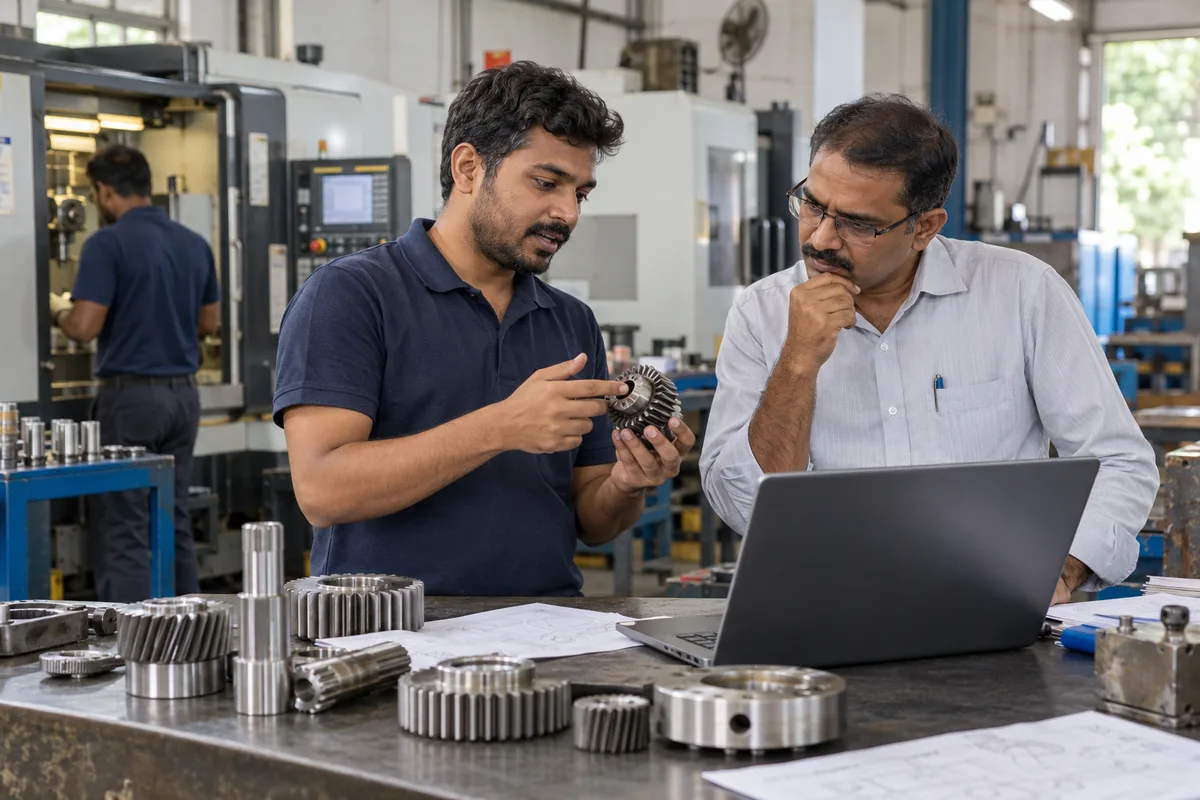
Take an invented unit in Kolhapur making spur gears, sprockets and splined shafts for sugar mill and conveyor makers. Its deck ran to thirty slides, opened with the founder's story, and listed "hobbing, shaping, grinding, heat treatment" on one slide with no numbers. A conveyor maker's purchase manager forwarded it to the design head, who replied asking only for the module range and the hardness the unit could deliver. The enquiry went cold while the owner hunted for the figures.
The rebuild followed the table above. Slide 3 stated the module range, the face width and the grades of steel the unit bought. Slide 4 gave each hobbing machine's largest gear diameter. Slide 11 said it did not cut gears above its largest hob size and did not take one-off breakdown jobs. The founder's story moved to a single line on the cover. The next forward to a design head came back with a drawing and a request for a quotation. It was for one gear, not the sugar mill's full set, and the unit lost two other enquiries that wanted sizes above its hob. The deck did its job by telling the wrong buyers early.
Send it as a light PDF
A purchase manager may open the deck on a phone between plant visits. Export a PDF small enough for an ordinary mail account, and check that slides 3 and 4 read at phone width. If the machine table needs a magnifying glass, make it two slides.
Check the deck before it leaves
Hand it to someone who does not work for you, such as a friend in another trade, and ask what you make and what you do not take. If they cannot say, the slides describe a company rather than a capability.
Then check three things only you can. Every certificate named is current. Every customer named has agreed to be shown. Every tolerance is one you hold in regular production. Rules and standards differ by industry and body and change, so state only what your own certificates say and check the wording with your certifying body.
Rebuild it with the table beside you
Open your current deck next to the slide table and mark which slides are missing. Start with slides 3, 4 and 11, which are the easiest to leave out. The one-page version is in what a capability statement needs. If you would like the deck built with you, capability presentations is the service, the manufacturing hub has more for factories, and you can tell us what you need.