Notes for owners · Industry playbooks
A first sample casting: what to include so the buyer's inspection goes your way
What a foundry should send with first sample castings: production-route pieces, the heat's test results, weights, a sectioned or machined piece and an honest deviation note, and when to pour again instead.
The GullySales team · Updated 17 Oct 2026 · 5 min read
On this page
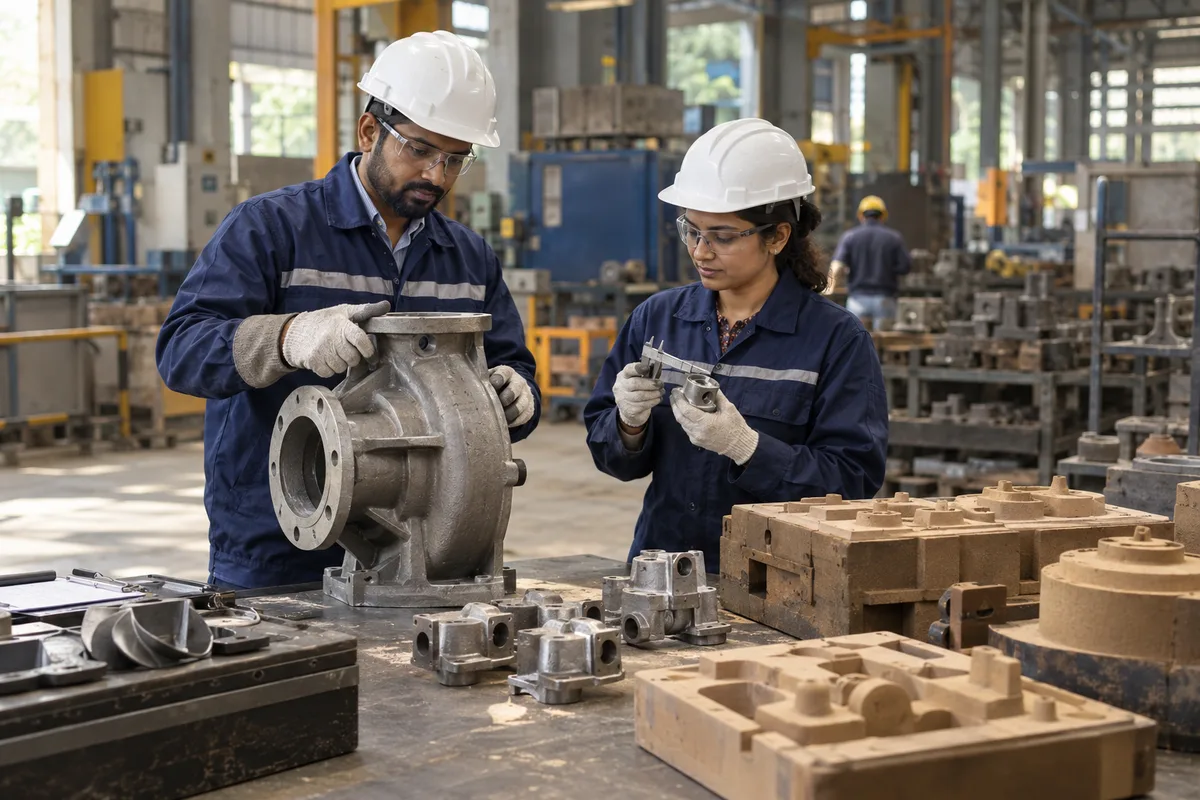
The first five castings are fettled, painted and look better than anything your floor has shipped. Before they go, take off whatever production will not repeat. Send castings made on the production pattern and route. Include the heat's chemistry and test results, the weight of each piece, and a plain note of anything out of tolerance or close to a limit. Say what you are changing. An inspector who is told where to look has a reason to trust the foundry. One who finds a ground-over defect unaided has a reason to doubt every report you send.
What the buyer's inspection is really for
The inspector checks the dimensions and the grade. Behind those checks sits another question: will the next five hundred castings look like these five? The samples alone cannot answer that. How they were made, and how honestly you describe them, can.
The hardest test comes after the inspection, in the buyer's machine shop. Porosity under a machined face, a hard edge that breaks a tool, an allowance that does not clean up: these surface only when the casting is cut. A sample that measures well and machines badly is rejected anyway, and late. The layout of a first-article report is covered in first-article approval. What follows is what only a foundry has to add.
Make the samples the way the batch will be made
Pour the samples from the production pattern and core boxes, on the moulding route the order will use, with your normal melt practice. If anything differs, a temporary pattern or hand moulding while the line pattern is made, say so in the note. Samples from a different route prove only that the different route works.
Fettle to the agreed delivery condition and stop there. Extra grinding, filler or a coat of paint that production will not apply makes the sample a showpiece. The first production lot then looks worse than the sample, and the buyer asks what changed. Paint deserves a special warning: inspectors know it can hide surface defects, and some will strip it.
Number each casting, mark the heat number on it, and keep a matching set at your foundry with the same numbers.
What goes in the box
- The numbered castings, packed so the inspector can match each to its report column.
- The heat report: chemistry, tensile and elongation from the test bar, hardness taken on the casting itself, and for SG iron, the microstructure and nodularity.
- A dimensional report in the buyer's own format, if there is one.
- The weight of each casting, beside the estimate in your quotation.
- One casting cut through its thickest section, or a radiograph of that area if radiography was agreed, to show the inside is sound.
- A machined piece if you can machine one. If not, ask the buyer's machine shop to report on the first casting they cut, and name the person you will call.
- The deviation note, on top of everything else.
Send now, or pour again
The deviation note forces a decision on every finding. Make it by this rule.
Pour again when a finding touches function: a crack, a leak path, a wall below its minimum thickness. No note makes that sample acceptable, and sending it costs you the trust you need for the second submission.
Send with a note when a dimension is out but the cause is in the pattern and the metal is sound. The buyer can still test machining and fit while you correct the pattern.
Send and mention marks that fall within the buyer's visual standard but may be noticed. A mark that was mentioned first is a small matter. Found unmentioned, it becomes a question about everything else in the box.
Write each finding in one line, with the casting number:
Casting 3: boss B is 1.2 mm over height. Pattern corrected; the next pour will show it.
Castings 1 to 5: sand mark under the flange, removed in fettling. Within your visual standard?
Imagine: a Gummidipoondi steel foundry and a pump casing
Imagine a steel foundry in the SIPCOT estate at Gummidipoondi, north of Chennai, sending first samples of a stainless steel pump casing to a process pump maker in Vadodara. The details are illustrative.
One casting showed shrinkage at a flange boss. The foundry weld-repaired it, ground the area smooth and painted all five. The note said nothing. The pump maker's machine shop faced the boss, found the repair zone and a fine crack beside it, and rejected the set. The quality engineer's email asked one thing. Were weld repairs on other castings also undeclared?
The foundry answered that question before pouring again, at the cost of a lost fortnight on the schedule. It enlarged the feeder on the boss and sent five fresh castings, unpainted. One was cut through the boss. The note listed every finding, including a small repair on one casting, with its location and method, and asked the buyer's permission. Whether a weld repair is acceptable is the buyer's decision, and the specification may set conditions. The buyer approved with one: every repair on future lots is reported on the dispatch note.
When a lighter sample is right
A buyer checking fit on a prototype assembly may want two castings and a weight, nothing more; ask before building a full box. A pattern change on a part you already supply needs the affected dimensions only. And if your own layout inspection of the first casting shows a problem, do not send samples to find out whether the buyer notices. Correct the pattern and pour again first.
Hold back the paint on your next sample
On the next new casting, write the deviation note before you pack the box, and send the castings as production will. The rest of the foundry's selling job is on the casting and foundry page. If your samples keep coming back with questions and you want a sales collateral pack that answers them first, tell us what you need.
Related services