Notes for owners · Websites and conversion
Material grade questions your rubber enquiry form should ask
The four questions that decide a rubber compound, how to put them on a website form a buyer will finish on a phone, and what the answers tell your estimator before the call back.
The GullySales team · Updated 17 Oct 2026 · 6 min read
On this page
The form on your website brings "need rubber gasket, 100 nos, send rate" and nothing else. Your estimator rings back, the buyer is in a meeting, and by the third WhatsApp the order has gone elsewhere. Ask instead for the four things that decide the compound. What does the part touch? How hot and cold does it get? Is there pressure? Does it move? Add where the part is used, what the buyer can send you, and the quantity. Offer "not sure" on every grade question, and your first reply can recommend a compound instead of asking.
Why the grade cannot wait for the call back
A rubber part fails by what surrounds it. Nitrile that is fine in hydraulic oil hardens in steam. EPDM that lasts years in hot water swells in mineral oil. Silicone handles heat well and tears in a seal that slides. Price the wrong compound and you lose either way: too cheap and the part fails with your name on it, too dear and the order goes to the trader.
Many buyers do not know the grade. They name the polymer they have heard of, or say "black rubber, good quality". What they do know is the job: the machine, the fluid, roughly how hot it runs. The form's task is to collect that job in taps, so your technical person can choose.
Our general note on what an enquiry form should collect argues for five or six fields. Rubber is an exception worth making, because a rubber part cannot be priced from a name and a phone number.
The form, as the buyer sees it
Ticks and short boxes, in this order. Starred fields are compulsory.
1.* Where is the part used?
    (one line: e.g. door seal on a steam steriliser, rod seal in a tipper cylinder)
2.  What does it touch?           [ ] water   [ ] hot water or steam   [ ] mineral or hydraulic oil
                                  [ ] diesel or petrol   [ ] acid or chemical (name it)
                                  [ ] food or drink   [ ] outdoor sun and rain   [ ] not sure
3.  Temperature at the part       lowest ___ °C   highest ___ °C   [ ] not sure
4.  Pressure                      ___ bar   [ ] none, it only keeps out dust or water   [ ] not sure
5.  Does it move?                 [ ] fixed   [ ] slides   [ ] rotates   [ ] flexes, like a diaphragm   [ ] not sure
6.  What can you send?            [ ] drawing (upload)   [ ] photo (upload)   [ ] old part by courier   [ ] sizes only
7.  Hardness or material, if known  ______________
8.* Quantity                      this order ____   in a year, if it works ____
9.  Papers needed                 [ ] none   [ ] test certificate   [ ] an approval (name it)
10.* Name, company, mobile or WhatsApp, city
Five rules that keep it short enough to finish
Put the job first. Field 1 is the one buyers answer best and your estimator reads first. "Rod seal in a tipper cylinder" tells the estimator more than any grade name.
Never make a grade question compulsory. A buyer stuck on "pressure in bar" closes the page. With a "not sure" tick the buyer moves on, and you ask on the call.
Let the phone camera do the typing. The upload must accept a photograph straight from the camera. Many buyers have only the old part, and a photo beside a steel rule settles the size.
Ask the yearly quantity next to this order's. A hundred pieces once is a cut gasket. A hundred a month may justify a mould, and that changes the whole quotation.
State on the form what happens next. Say who reads it and how the buyer will hear back, and promise only a reply time your desk truly keeps.
What the answers tell your estimator
Write your technical person's choices down as a card the desk can use. A common starting card looks like this, and the technical person will refine it from your own compounds:
- Oil or hydraulic fluid, moderate heat: start from nitrile.
- Hot water, steam or outdoor weather, with no oil: start from EPDM.
- High heat with oil or fuel: FKM, at a higher price the buyer should see explained.
- Wide temperature range and little rubbing: silicone.
- Any named acid, solvent or chemical: check the compound supplier's resistance data before quoting.
Whether a compound may touch food, drinking water or medicine is a separate question. The rules differ by product and by body and they change, so quote only what your compound supplier certifies in writing, and check with your own adviser or the regulator.
Imagine: a Kalamassery unit and a steriliser door
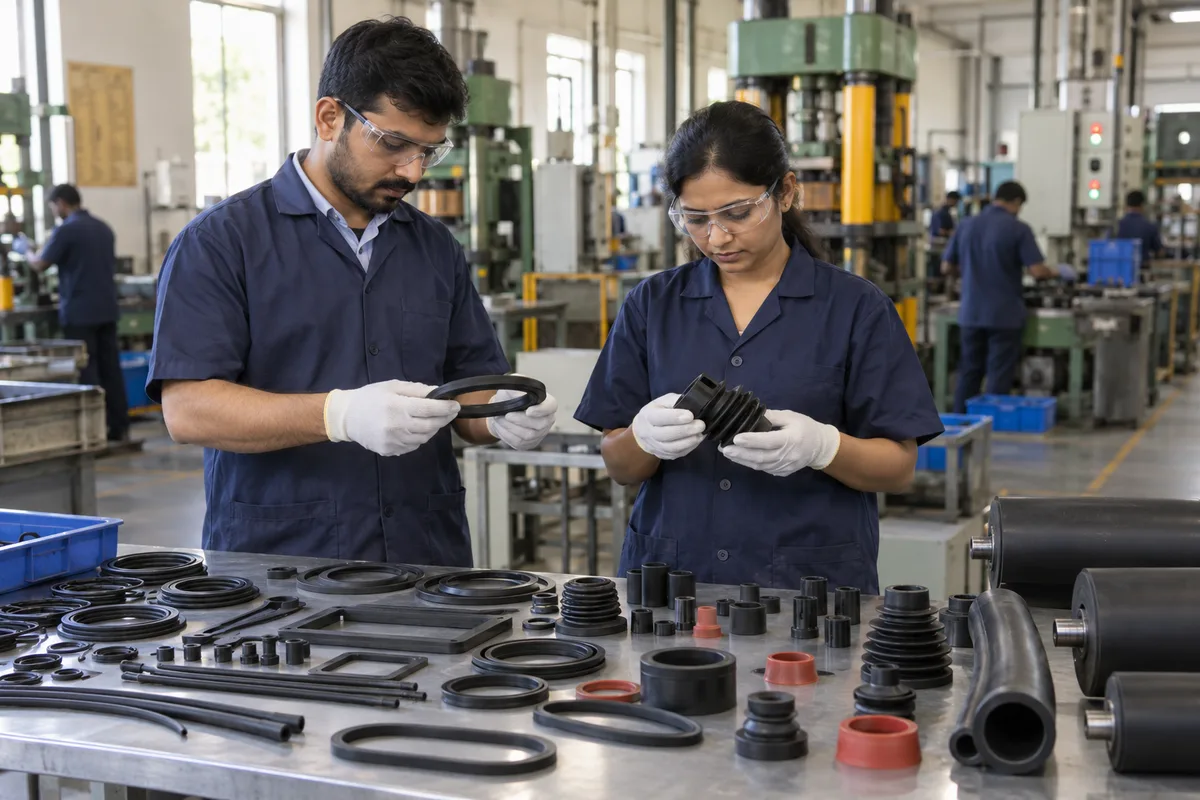
Imagine a rubber moulding and extrusion unit in the Kalamassery industrial area near Kochi, serving pump makers, boatyards and seafood processors. The details are illustrative. Its old form asked for a name, an email and a message.
A processor in Aroor sent "door gasket, 50 nos, urgent" with a photograph. The estimator matched the profile and quoted nitrile from stock, the cheapest compound on the shelf. The door belonged to a steam retort. The gaskets hardened and cracked within weeks, and the processor stopped taking calls.
The owner went to Aroor in person, saw the retort, and replaced the gaskets in EPDM from a compound the supplier certifies for food contact, absorbing the cost of the second set. Back at the unit, the owner rebuilt the form above. The next retort enquiry, from another processor, ticked steam, food and fixed, with the highest temperature filled in. The first reply named two compounds with a reason for each and asked which documents the buyer's QA needed.
When the form is the wrong door
A repeat buyer with an approved part number needs a box for the number and the quantity, nothing more. A distributor ordering standard O-rings wants a size list order sheet, not a questionnaire. If most enquiries arrive by phone or IndiaMART, put the same questions in a saved WhatsApp reply and a call sheet. The form is only one door. Turning those answers into a call order for the desk is lead qualification work.
Rebuild the form around the four questions
Open your form on your own phone and try to describe a steam door gasket with it. If you cannot, the buyer cannot either. The rest of the rubber shop's selling job is on the rubber products page, and the form itself is form and enquiry funnel optimisation. When you want a form your estimator can quote from, tell us what you need.