Notes for owners · Sales management
Time-zone overlap: how to run sales calls with a US prospect from India
How to fix call windows when your prospect is nine and a half to thirteen and a half hours behind you: who takes the late call, what gets written down, and how follow-up carries the deal between calls.
The GullySales team · Updated 17 Oct 2026 · 5 min read

On this page
The overlap between an Indian working day and a US one is thin and falls in your evening. For an East Coast buyer, their morning is your evening; for the West Coast, it is late night. The way through is to stop depending on live time. Fix two or three call windows and write down what each call decides. Let a follow-up message carry the deal between calls.
Where do the working hours actually meet?
India does not change its clocks. The US does, on dates set by US rules, so the gap moves by an hour twice a year. Check a time converter for the actual date before you confirm a slot; do not carry the gap in your head.
This table shows the usual shape of the gap. Times are the buyer's morning, converted to Indian time, and are approximate.
| Buyer's location | Their 9 am to 12 noon is, in IST (US standard time) | In IST (US daylight time) |
|---|---|---|
| Eastern | 7:30 pm to 10:30 pm | 6:30 pm to 9:30 pm |
| Central | 8:30 pm to 11:30 pm | 7:30 pm to 10:30 pm |
| Pacific | 10:30 pm to 1:30 am | 9:30 pm to 12:30 am |
Two things follow. An East Coast buyer is workable for most teams, since the call lands before bedtime. A West Coast buyer pushes you past 10 pm, so use their late afternoon instead, which falls in your early morning. At 5 pm Pacific standard time it is 6:30 am the next day in India.
Which calls need to be live?
Many do not. Sort the deal into steps and decide which ones need two people on a line at the same moment.
- First discovery call. Live, 30 minutes, and worth the late hour. The buyer decides whether you sound like a person they can work with.
- Sending the proposal. In writing, with a short voice note or video walkthrough they can watch at their own time.
- Questions on the proposal. Written first. Escalate to a call only if three emails have not settled it.
- Negotiation and sign-off. Live, with the decision-maker, because tone matters.
- Everything else. Email, with a date-stamped recap.
The awkward hours go to the two or three moments that earn them.
How to offer windows without sounding rigid
Do not write "let me know your availability". It hands the buyer a job. Offer slots in their time zone, with the day of the week, and say how long it will take.
A message that works:
"Hi Sarah, I would like 30 minutes to go through your drawing set. I can do Tuesday at 10 am Eastern, or Wednesday at 4 pm Eastern. If neither suits, name a window on Thursday. I will send the agenda the day before and a written recap after we finish."
Notice what it does. It names two slots in their zone, a fallback, an agenda and a recap. Do not add a deadline for the recap unless you are sure you will meet it.
If you run appointment booking through a calendar link, set the link's display zone to the visitor's own and show only the windows you will honour. Past a handful of buyers a month, a person doing this routing is easier than a link. Appointment setting is the service for that.
What to write down after each call
Because the next live conversation may be a week off, the written record is the deal's memory. Send it the same day, to the buyer, in five lines:
- What we agreed (one line per decision).
- What I will send you, and by when.
- What you will send me, and by when.
- The one question still open.
- The next call, in your time zone, or "no call needed until the proposal".
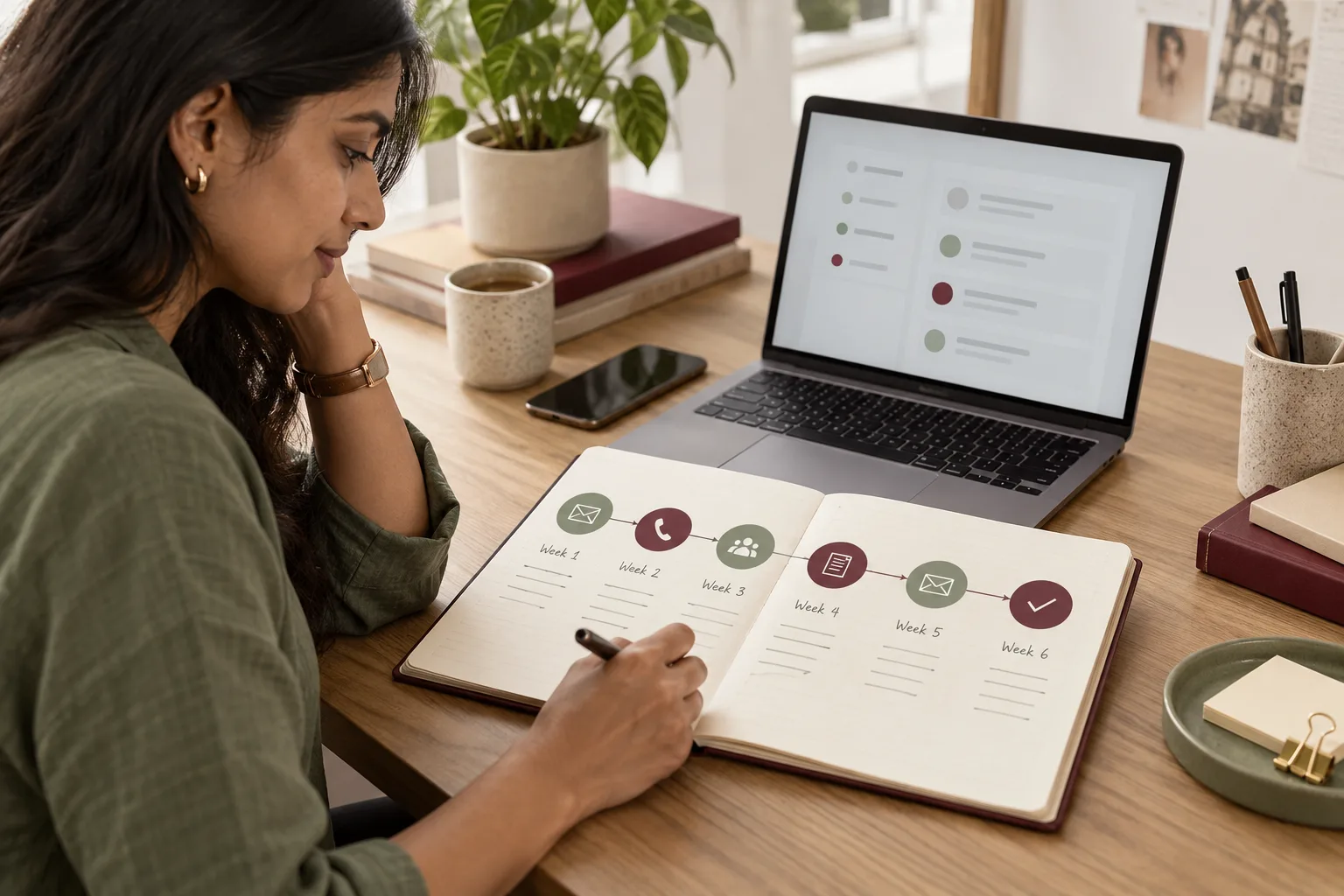
Keep a copy in your own notes with the buyer's reaction in your words. This is also your defence against two common leaks: a buyer who forgot what was promised, and a colleague who picks up the deal cold. For the messages between calls, designing a B2B follow-up sequence goes into what each one should say.
An invented example: a Noida visualisation studio
This studio is made up. It produces 3D walkthroughs and gets an enquiry from a Chicago architecture firm. The partner there answers emails at 8 am Central, which is 7:30 pm in Noida. The studio's director, who also manages production, takes the first call at 9 pm after a full day on the floor.
By then the director is tired and misses that the firm wants the walkthrough in two stages. The firm hears hesitation, and the proposal arrives two days later with the wrong scope.
The change is small. The studio asks for 8:30 am Central, now 8 pm in Noida, sends the agenda a day before, and writes the five-line recap the same evening. The proposal follows from the recap, not from memory.
It is not free. The director now gives up two evenings in that week, and the daily production review slips to the next morning. The firm still disputes the second stage, but the dispute now sits in writing and gets settled on the next call instead of in a rework.
This depends on one person owning the relationship. If you have no one who can take evening calls reliably, say so up front and offer an early-morning slot for the buyer's late afternoon instead.
Pick one deal and run it this way
Take the live US prospect you are least sure of. Write down the two calls that must be live, convert both into their zone, and send the recap after the next one.
If every deal depends on one person staying up, see sales process design and implementation. The United States hub has more on selling across the gap. To have the routine laid out for your team, tell us what you need.