Pharmacies · Branding
Half of what goes on a chemist's board is decided for you.
A pharmacy's board has to carry what the licence requires, and anything you add can turn a shop sign into an advertisement. GullySales settles what the board, the bill and the delivery bag may say, then makes those three agree, since a monthly customer sees nothing else.
Scope, fee, reporting and term are agreed in writing after we have read your brief and spoken to you.

What branding means
Branding is what a customer remembers about your business beyond the product, including your name, colours, tone of voice and what you are known for locally. GullySales sets or corrects this once and applies it consistently across your website, signage and adverts so the business looks like one company everywhere.
Last updated 17 Oct 2026. Rules for this trade differ by state and professional body, and they change. We describe restrictions in general terms, so check the current position with your own council or adviser before you publish anything.
For pharmacies
Where it usually goes wrong, and what we would do.
“The required display comes before the design”
Licence details and the pharmacist's particulars have to be shown. The design works around them, rather than over the top of them.
“A claim on the board changes what the board is”
Add a line about curing something, or a discount on medicines, and a shop sign becomes an advertisement subject to restrictions your licence carries.
“Your monthly customer never sees the shop”
The customer stopped walking in two years ago. The bag, the bill and the delivery boy are the whole of the brand they experience.
“A family surname tells a new customer nothing”
Shop names built on a surname give no clue that you deliver, stay open late or stock surgical supplies. The description has to carry all of that.
What we do
What we deliver for pharmacies.
Every deliverable, what it covers for you, and the result it is there to produce. Nothing here is an extra.
A board built around the required display
Licence and pharmacist particulars placed properly, with the service words, the hours and the phone number given whatever space is left.
Result: The board does its legal job and its selling job.
Delivery bag, bill and messaging profile matched
The same name, number, hours and delivery details on the bag, on the printed bill and on the profile a customer saves in their phone.
Result: The customer who never walks in still knows you.
Every public word checked against the restrictions
Board, counter cards, website and messages read against the limits on advertising medicines and making claims, with your pharmacist confirming each.
Result: No slogan puts the licence at risk.
One description used in every place
A short line naming delivery, late hours and the non-prescription ranges, used identically on Maps, JustDial, the board and the chat profile.
Result: Nothing about the shop says two things.
The pharmacist shown as the reason to come in
The registered pharmacist named and pictured, with what the pharmacist will help with, on the profile and at the counter, because no app can copy that.
Result: The one advantage you have becomes visible.
A yearly check that nothing has drifted
A pass over the board, the bag, the bill and every listing, because wording changes quietly whenever somebody reprints something.
Result: Drift is caught before an inspector notices it.
How the result is measured
- Recognition in customer feedback
- Consistency across channels
- Repeat enquiries by name
Recorded as a baseline before work starts, so every later report has an honest comparison.
Positioning in one sentence
The sentence a pharmacy can fill in, in service words only, before the board or the bill is redesigned.
We are the pharmacy for [families, patients of a clinic or a neighbourhood] on [road or area], and unlike [an app] we offer [a pharmacist who knows the family and a delivery from the same road].
- Who it is for
- A household with regular medicines, a family caring for an elderly parent, a clinic's patients, or a new mother buying baby care. Choose the group your shop serves best and write for them.
- What you do
- Say dispensing against a prescription, home delivery, and the other lines you stock, such as baby care or surgicals. Never describe prescription medicines in promotional terms.
- What a family gets that an app does not
- A pharmacist who knows the family's medicines, a call when a refill is due, a delivery from the same road. Pick what you do and say it without mentioning discounts or drug names.
- The proof you can show
- Licence details as required, the pharmacist's name and registration, a photograph of the shop, and customer words that talk about service, not medicines.
- Words customers ignore
- 'Trusted', 'genuine medicines' and 'lowest price' are on every board. Say the service: 'Home delivery on this road', or 'Open late' only if it is accurate.
- The name and tagline test
- A name pairing 'Medicals' with the owner's family name is common. Check it against nearby shops, and make sure the board, the bill and the delivery bag carry exactly the same name as the licence.
Who it is for
This is written for these pharmacies.
- Independent neighbourhood chemists
- Pharmacies attached to a clinic or nursing home
- Hospital pharmacies serving outpatients
- Pradhan Mantri Bhartiya Janaushadhi Kendras and generic medicine stores
- Multi-outlet local pharmacy chains
- Franchise outlets of national pharmacy brands
- Surgical and medical equipment stores
- Pharmacies stocking Ayurvedic and homoeopathic medicines
- Twenty-four hour and late-night pharmacies
Not for
It is not the right fit if.
- The licence name and the board name differ and you have not checked what the council rules allow on a chemist's board.
- You want a bold campaign look when the bill, the bag and the board still carry three different shop names.
- The owner plans to change premises soon, so spending on signage now would be wasted.
How it works
How the branding work runs
The work itself, in order. How an engagement starts, from your brief to a written scope, is set out on our method page.
- 1
Interview customers and team
We talk to real buyers, won and lost, and to people inside the business who deal with customers daily.
- 2
Review the competitive field
We look at how the nearest competitors present themselves so the position is not accidentally identical.
- 3
Draft the position
A first version of the positioning statement and messaging pillars is written and checked against what customers actually said.
- 4
Test it against real conversations
The draft is tried out in a real sales call or two before it is finalised, since a position that does not survive a real conversation needs rework.
- 5
Hand over the rollout brief
The final position, pillars and not-for list are documented for your team and any agency to apply consistently.
Where this fits
Three pieces of sales work, in this order.
This work sits inside sales process design, at stage 1, prospecting and lead generation. The audit comes before it, and sales management keeps it running.
Step 1
Sales audit
Find where deals are being lost and what to fix first.
Start here if you cannot say where orders are lost.
Step 2 · you are here
Sales process design
One written way to sell, from first enquiry to repeat order.
Start here if every salesperson sells differently.
Step 3
Sales management
A target, a review routine and someone who owns the number.
Start here if the team has targets and no routine.
FAQ
Questions owners ask before they call.
Not here? More answers, or ask on WhatsApp.
Can we put offers on our shop board?
Do we need a logo?
Can our name or board say 'wellness', '24 hours' or 'generic'?
Can the delivery bag and bill carry our name and number?
How much does it cost?
How long is the contract?
How soon will we see results?
Who will actually do the work?
What do you need from us?
What if we are not happy with the work?
From the blog
Further reading for pharmacies.
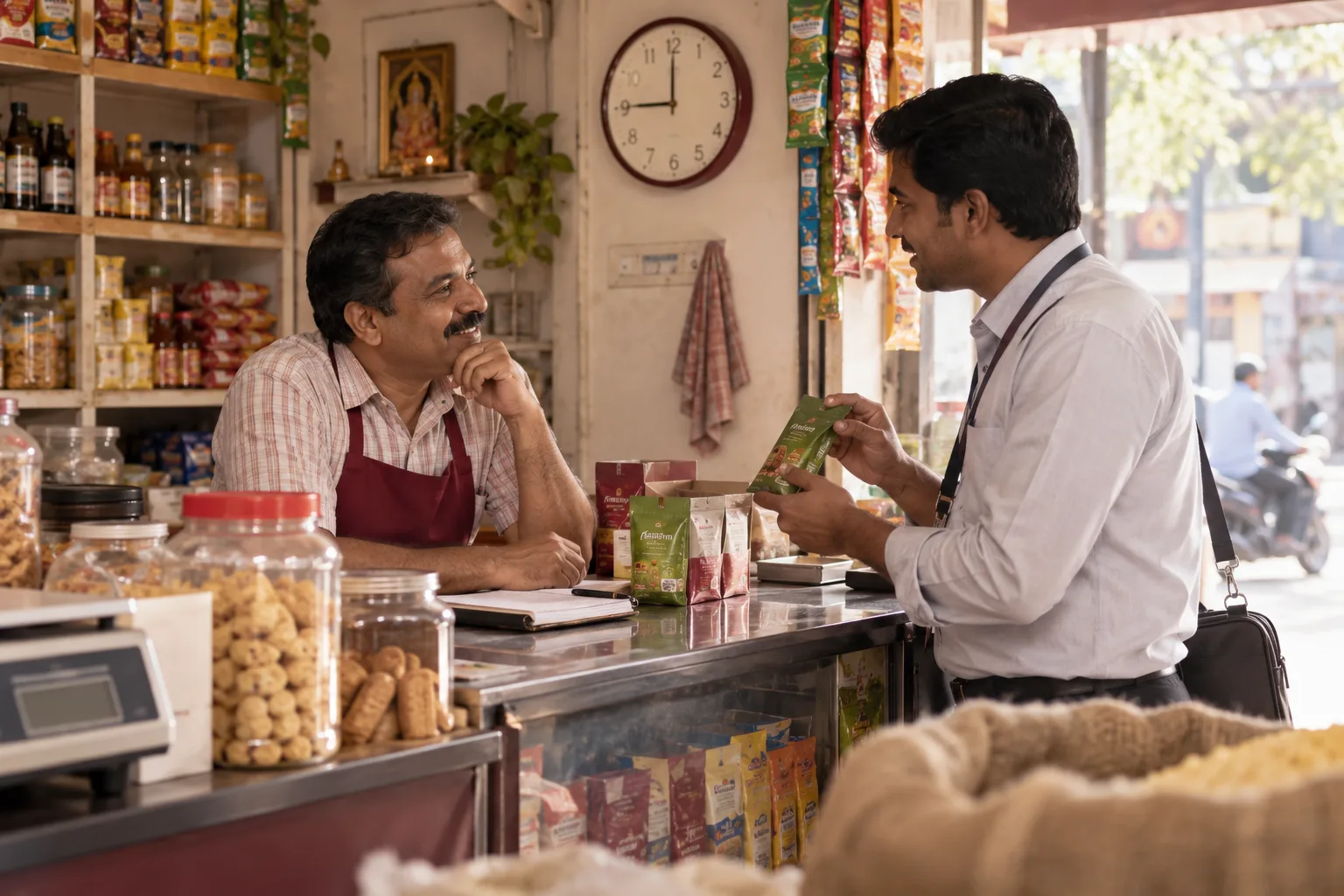 8 min read · 21 Sept 2026How to advertise to retail business ownersA shop owner is behind the counter from ten to nine and cannot leave it. That single fact rules out most media, and it makes the lean afternoon hour and the distributor's salesman worth more than any campaign.
 7 min read · 18 Feb 2025Best advertising channels for diagnostic centresMost tests are decided by a prescribing doctor, so advertising has a ceiling. The channels that pay are Maps, the referral round, home collection and a small number of honest packages.
More for pharmacies
Everything else we would do for you.
Or start from the overview: sales and marketing for pharmacies.
Your next practical step
Tell us what you are trying to grow, and we will read it before we call.
Eight short steps, mostly taps. Skip anything you would rather answer on the call.