Pharmacies · CRM
Your billing software holds the regulars; a CRM shows which of them is drifting away.
A CRM for a pharmacy is the customer record kept beside the bill: who the household is, what they buy regularly, when a refill falls due and what was last said to them. GullySales works on turning billing data and WhatsApp conversations into one private register the counter can use.
Scope, fee, reporting and term are agreed in writing after we have read your brief and spoken to you.

What CRM means
A CRM is the record where every enquiry, call and quote is kept against a customer, replacing separate notebooks, spreadsheets and memory. GullySales sets up or cleans an existing CRM and reports from it by enquiry outcome rather than by activity logged.
Last updated 17 Oct 2026. Rules for this trade differ by state and professional body, and they change. We describe restrictions in general terms, so check the current position with your own council or adviser before you publish anything.
For pharmacies
Where it usually goes wrong, and what we would do.
“The bill remembers but nobody reads it”
Billing software stores every purchase and answers one question, what to charge. Which household is due, who bought last quarter but not this one, who switched from a brand to a generic: those answers sit in the data and nobody at the counter sees them.
“Prescription data is not marketing data”
A customer's medicines reveal their health. The register has to keep what was dispensed apart from what is used to send messages, and record consent for each person. The record that drives reminders needs a name, a contact and a due date, not a list of drugs.
“The number on the bill may not belong to the patient”
It may be the son's, the helper's or the shop's own. A reminder sent to the wrong person annoys a household or exposes a private matter. The record needs a line saying who to contact, and about what.
“A notebook works until the second counter”
One pharmacist can carry the regulars in a notebook and in memory. With two shifts, a delivery boy and a second outlet, the notes drift apart and the customer repeats the story. A shared record, even a simple sheet, keeps the household's history across staff.
What we do
What we deliver for pharmacies.
Every deliverable, what it covers for you, and the result it is there to produce. Nothing here is an extra.
A regular customer register built from billing
Households that buy on a repeating pattern, pulled from your billing export into one sheet or CRM, with duplicates merged.
Result: The regulars are listed in one place, not scattered across the bill book.
Contact and consent fields
For each household, who to contact, on which channel, and a record of when and how they agreed to be reminded.
Result: Every message you send has a recorded permission behind it.
A due-for-refill list the counter can read
A simple view of households whose supply is likely to be ending, sorted so the pharmacist can act at the start of a shift.
Result: Staff see who to call before the customer calls an app.
A drifting regular flag
A marker for households whose purchases have stopped or shrunk against their own earlier pattern.
Result: You find out about a lost regular while a conversation can still bring them back.
Conversation notes linked to the household
The last thing promised, a substitute agreed or a complaint made, noted against the family so any staff member can pick up.
Result: The customer does not have to repeat themselves to a new face.
Staff access rules
A short list of who can see the register, who can edit it and what leaves the premises, set for the size of your shop.
Result: Customer details stay with the people who need them.
How the result is measured
- Enquiries logged in the CRM
- Data completeness
- Reports generated from CRM data
Recorded as a baseline before work starts, so every later report has an honest comparison.
Fields worth keeping
What a chemist's customer register holds, and what stays in the billing system.
- Household name and the number that pays
- Filled by the counter at the first bill. It separates the person who collects from the person who is cared for, which the bill alone cannot show.
- Consent to message, and the channel
- A yes or no with a date, filled when the number is taken. It is checked before any reminder or catalogue is sent.
- Delivery address and the person who receives
- Filled at the first delivery order. It spares the rider a call and lets the shop see which streets it serves.
- Last regular visit
- Read from billing, not typed. Lets the owner see which regular households have gone quiet.
- Language and time to call
- The preference the customer states. A retired patient who wants a call in Kannada before noon is not served by a text in English.
Who it is for
This is written for these pharmacies.
- Independent neighbourhood chemists
- Pharmacies attached to a clinic or nursing home
- Hospital pharmacies serving outpatients
- Pradhan Mantri Bhartiya Janaushadhi Kendras and generic medicine stores
- Multi-outlet local pharmacy chains
- Franchise outlets of national pharmacy brands
- Surgical and medical equipment stores
- Pharmacies stocking Ayurvedic and homoeopathic medicines
- Twenty-four hour and late-night pharmacies
Not for
It is not the right fit if.
- Billing software already holds everything you need and nobody reads its reports, so a new tool would be one more unread screen.
- You want to store the medicines each customer buys in the register; that belongs in the billing and dispensing record, not a marketing tool.
- One person at the shop does everything and a notebook ruled with a few columns would do the job.
How it works
How the CRM work runs
The work itself, in order. How an engagement starts, from your brief to a written scope, is set out on our method page.
- 1
Map the sales process
We sit with the people who sell and write down how a deal moves from enquiry to payment, including where it stalls.
- 2
Agree stages, fields and owners
Each stage gets a name your team already uses and a proof that the deal has left it. We agree which fields are required at which stage, and who may change what.
- 3
Build on a copy
Pipeline, fields and views are built on a trial copy where the CRM offers one, or in a separate pipeline where the plan allows. Live work stays untouched.
- 4
Connect channels, then switch on automations
Channels are connected first. Each automation is then switched on separately, so a misfiring rule is easy to find.
- 5
Test with real deals
The people who will use the CRM run open deals through it. Gaps are fixed before the whole team switches over.
- 6
Switch over and trim
Once real use shows which fields stay empty and which stages nobody uses, those are cut and the handover record is updated.
Where this fits
Three pieces of sales work, in this order.
This work sits inside sales management. A target, a review routine and someone who owns the number.
Step 1
Sales audit
Find where deals are being lost and what to fix first.
Start here if you cannot say where orders are lost.
Step 2
Sales process design
One written way to sell, from first enquiry to repeat order.
Start here if every salesperson sells differently.
Step 3 · you are here
Sales management
A target, a review routine and someone who owns the number.
Start here if the team has targets and no routine.
FAQ
Questions owners ask before they call.
Not here? More answers, or ask on WhatsApp.
Do we need special software, or will a spreadsheet do?
Can we store what medicines a customer buys?
Can a pharmacy CRM store prescriptions?
Who should be allowed to edit the register?
How much does it cost?
How long is the contract?
How soon will we see results?
Who will actually do the work?
What do you need from us?
What if we are not happy with the work?
From the blog
Further reading for pharmacies.
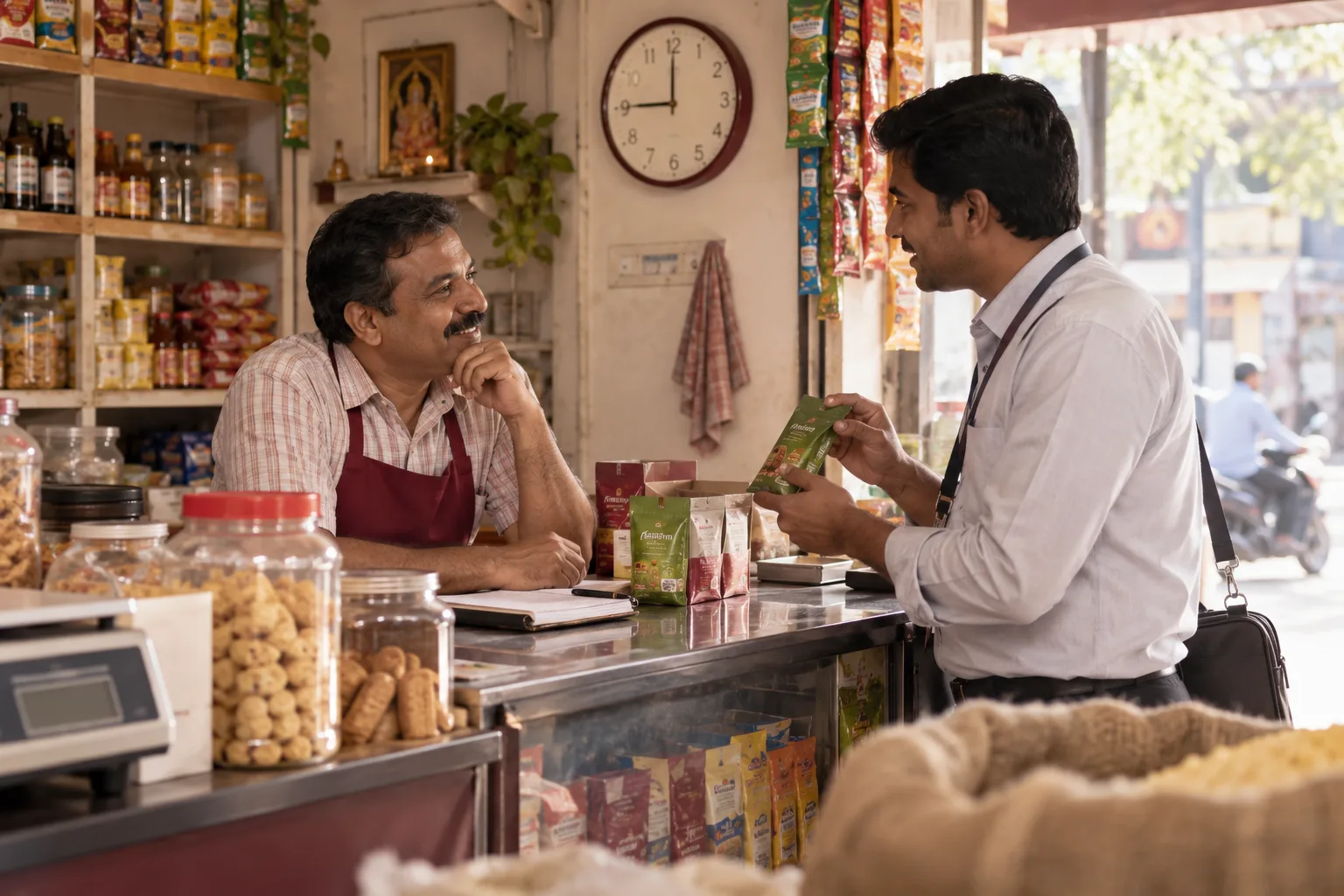 8 min read · 21 Sept 2026How to advertise to retail business ownersA shop owner is behind the counter from ten to nine and cannot leave it. That single fact rules out most media, and it makes the lean afternoon hour and the distributor's salesman worth more than any campaign.
 7 min read · 18 Feb 2025Best advertising channels for diagnostic centresMost tests are decided by a prescribing doctor, so advertising has a ceiling. The channels that pay are Maps, the referral round, home collection and a small number of honest packages.
More for pharmacies
Everything else we would do for you.
Closest to this: leads and follow-up
Also for pharmacies
Or start from the overview: sales and marketing for pharmacies.
Your next practical step
Tell us what you are trying to grow, and we will read it before we call.
Eight short steps, mostly taps. Skip anything you would rather answer on the call.