Locksmiths · Buyer journey
Know the difference between an 11pm emergency and a planned upgrade.
Buyer journey mapping for a locksmith separates the emergency call, decided in minutes, from planned work like a digital lock upgrade, decided over days.
Scope, fee, reporting and term are agreed in writing after we have read your brief and spoken to you.
What buyer journey means
The buyer journey is the sequence of steps a customer actually takes, from first hearing about you to deciding to buy, which is rarely a single visit or call. GullySales maps this sequence for your business and checks that something useful happens at each step instead of only at the final call.
Last updated 5 Oct 2026.
For locksmiths
Where it usually goes wrong, and what we would do.
“The emergency journey has almost no comparison step”
A locked-out customer calls the first credible result, so ranking and a fast answer matter more than persuasion.
“Planned work goes through a proper comparison”
A digital lock customer checks reviews and past installation photos over several days before booking.
“The follow-up after an emergency opens a second journey”
A customer relieved after a lockout is a good prospect for a security upgrade discussed a few days later.
What we do
What we deliver for locksmiths.
Every deliverable, what it covers for you, and the result it is there to produce. Nothing here is an extra.
A written map of the emergency call path
The exact steps from a locked-out search to an answered call and a confirmed arrival time, written down so nothing depends on memory.
Result: Every emergency call follows the same fast path, whoever answers.
A separate map for planned upgrade decisions
The steps a digital lock or CCTV customer takes, from comparing reviews and photos to booking, mapped separately from the emergency path.
Result: Planned enquiries get the proof they are actually looking for.
A follow-up trigger after every emergency job
A defined point, right after a lockout is fixed, when a security upgrade is mentioned, tied to the end of the emergency journey.
Result: A relieved customer gets asked about the next step at the right moment.
A journey-based content checklist
A checklist matching each journey stage, emergency or planned, to the page or message that should exist for it.
Result: Nothing in either journey is left without the content it needs.
How the result is measured
- Drop-off rate by step
- Time from first contact to sale
- Steps with no content
Recorded as a baseline before work starts, so every later report has an honest comparison.
Stages of the customer's journey
What happens between a locked door and a paid job, for an emergency call and for a planned upgrade.
- Locked out and searching
- The person is outside a door, often at night, searching on a phone. Keep the Maps listing's hours, service area and call button correct, since they pick whoever answers and is nearby.
- The call and the price question
- The first thing asked is the cost and when you can arrive. Give a call-out range and an arrival time in the first minute, and note the landmark, the type of lock and the door.
- Arrival and proof of identity
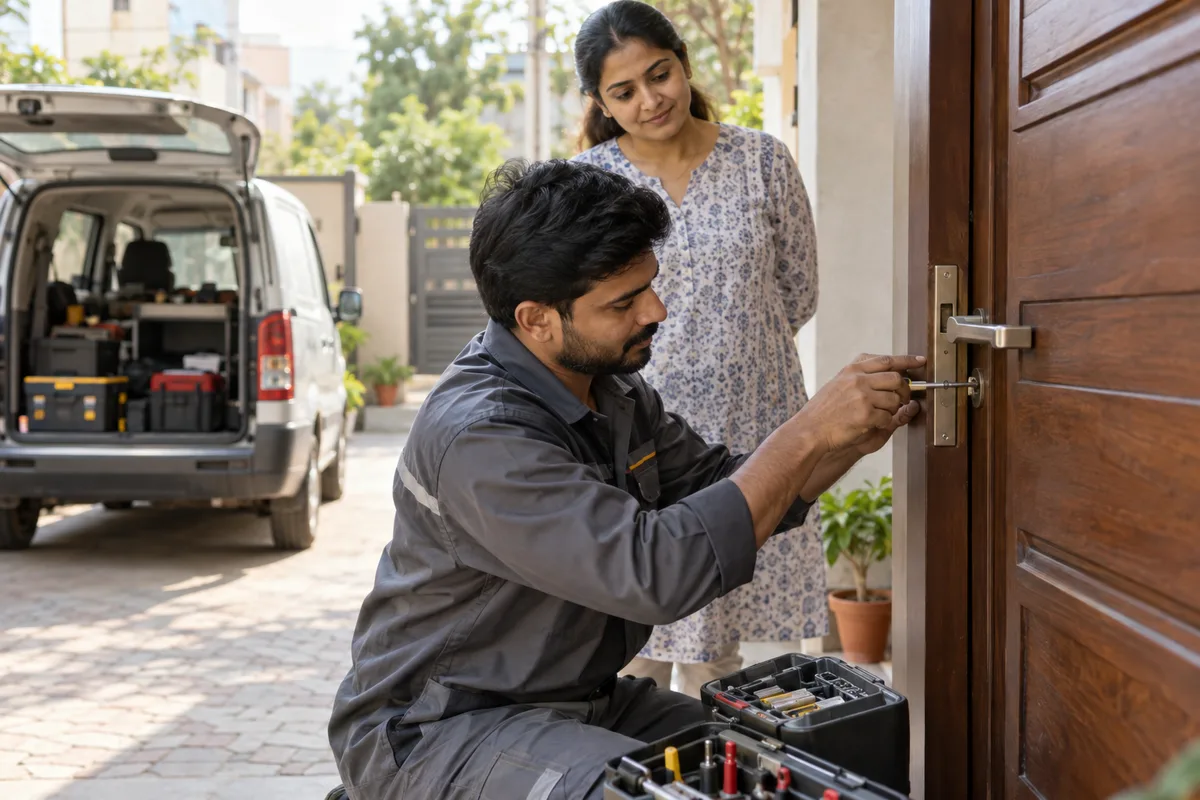
- A stranger arriving at a door has to look trustworthy. Have the technician show an ID card and a printed job slip with the quoted price before touching the lock.
- After the door opens
- The customer is relieved and the lock may be old or weak. Mention a replacement or upgrade once, in writing, leave the decision to them, and save the number for the next call.
- Planned work, such as a digital lock
- This buyer compares reviews, photos of fitted doors and brands over several days, often with a spouse. Keep a gallery of fitted doors and a page per brand with warranty terms.
- Site visit and booking
- For planned work, a visit measures the door and checks the frame. Send the quote in writing with the model, fitting and warranty terms, and ask for a date to follow up.
Who it is for
This is written for these locksmiths.
- Emergency and 24-hour locksmiths
- Automotive locksmiths and key programming specialists
- Residential lock and security installers
- Commercial and office locksmith services
- Safe installation and repair specialists
- Smart lock and digital security installers
- Society and RWA-contracted locksmiths
How it works
From your first message to the first report.
No open-ended retainer. Every step gives you something in writing.
First
Your brief
You tell us what you need in a few short steps: your business, what you want, where enquiries come from and how they are handled.
After the brief
A conversation and a written scope
We read it, then talk with whoever handles your enquiries. If you want our help, the scope, the fee and the reporting come in writing, and nothing starts before you have read them.
Before work starts
Baseline recorded
The numbers this work is meant to move, such as enquiries, quotations, orders, visits or renewals, written down so every later report has an honest comparison.
After the baseline
The first fix goes live
The fix we agreed to start with is put in place and measured against the baseline, whether that is a reply, a follow-up, a page, a listing or the handover between marketing and sales.
As agreed
Report against the baseline
What moved, what did not, and what changes next, in plain words. How often you get it is set in writing before work starts.
At renewal
Renew on the numbers
The term ends and you decide whether to continue from the results. The length is agreed in writing before anything starts.
How the buyer journey work runs
- 1
Understand the sales process
We walk through how a sale actually happens today, from the person who first answers an enquiry to the one who closes it.
- 2
Audit the data
Website analytics, call logs and CRM records are pulled together to see where people actually drop out, not where they are assumed to.
- 3
Interview buyers and staff
A handful of recent customers and the team who speak to them fill in the reasons behind the numbers.
- 4
Build the map
Stages, touchpoints and drop-off points are set out in one document everyone can read the same way.
- 5
Fix and measure
Each fix is implemented against the stage it addresses, and the drop-off rate at that stage is checked afterwards.
Why us
Why owners pick GullySales over an agency.
Marketing and sales, as one job
Most agencies stop at the enquiry. We also fix what happens after it: the reply, the follow-up, the quote and the CRM.
The person on the first call does the work
No account managers in between. You are never handed to someone you have not met.
A baseline before anything starts
Your numbers are written down on day one, so every later report compares against something honest.
The fee in writing, split three ways
Our time, your media spend and production on separate lines. You always see what goes to us.
No guarantees we cannot keep
The term is agreed in writing and never a default twelve months. We never promise a ranking or a lead count, because nobody controls those.
One office, and we say so
Nagarbhavi, Bengaluru. We work across India by call and WhatsApp and travel when a session needs to be in person.
#257, 3rd floor, Sri Nanjundeshwara Complex, Nagarbhavi 8th Block, Outer Ring Road. How we work.
Your brief
Tell us what you need, and we will read it before we call.
Eight short steps about your business, what you want and who decides. Most questions are a tap, and you can skip any you would rather answer on the call.
FAQ
Questions owners ask before they call.
Not here? More answers, or ask on WhatsApp.
Why map this separately from other trades?
Does a small locksmith need this mapped formally?
Who else has a say when a family or a society chooses a new lock?
A customer asked for a digital lock quote and never replied. What should we do?
How much does it cost?
How soon will we see results?
Who will actually do the work?
What do you need from us?
What if we are not happy with the work?

More for locksmiths
Everything else we would do for you.
Closest to this: strategy and research
Also for locksmiths
Or start from the overview: sales and marketing for locksmiths.
Your next practical step
Tell us what you are trying to grow, and we will read it before we call.
Eight short steps, mostly taps. Skip anything you would rather answer on the call.