Pest control companies · Branding
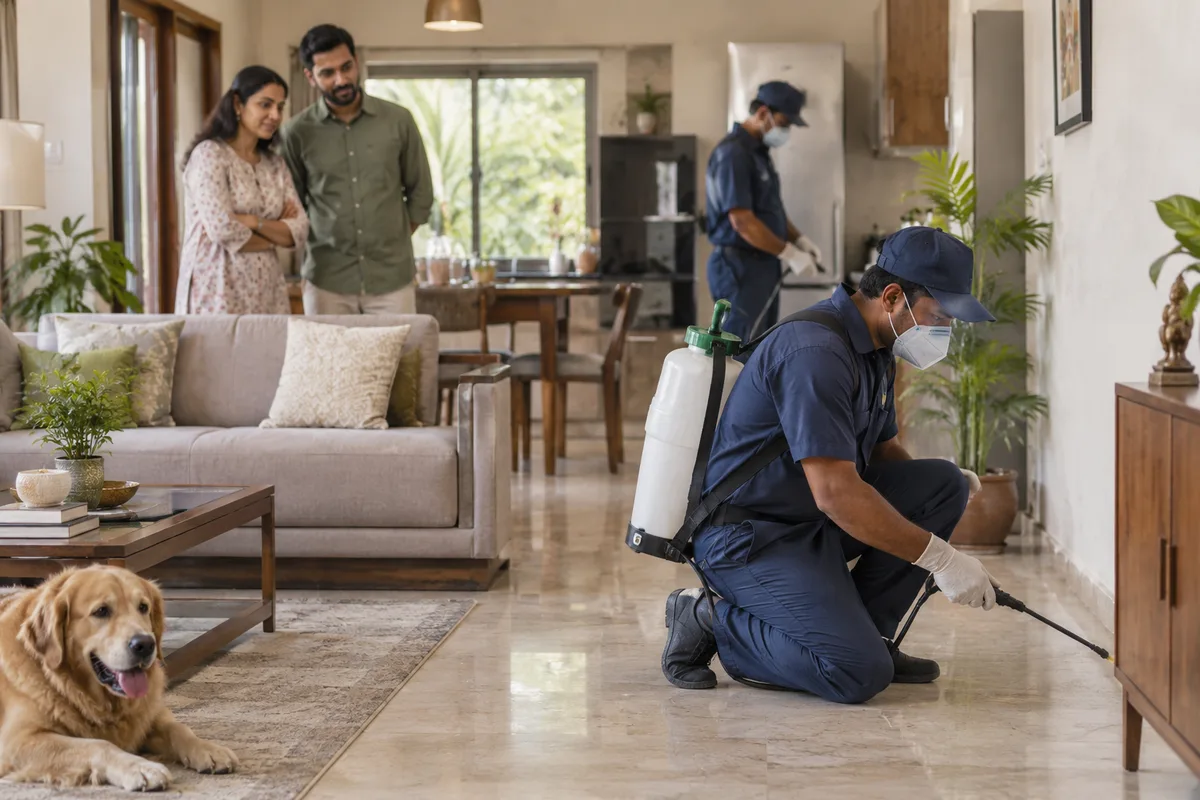
A family judges you at the gate, before the treatment is mentioned.
Branding for a pest control company is the uniform, the ID card, the vehicle and the quote, which together decide whether a household is comfortable letting a technician in. GullySales sets that identity and the material your technicians carry, so every visit looks like the same company.
Scope, fee, reporting and term are agreed in writing after we have read your brief and spoken to you.
What branding means
Branding is what a customer remembers about your business beyond the product, including your name, colours, tone of voice and what you are known for locally. GullySales sets or corrects this once and applies it consistently across your website, signage and adverts so the business looks like one company everywhere.
Also for pest control companies
- Apartment advertising for pest control companies
- SEO for pest control companies
- PPC advertising for pest control companies
- Lead generation for pest control companies
- Digital marketing for pest control companies
- Reputation management for pest control companies
- Local SEO for pest control companies
- Social media marketing for pest control companies
Sales and marketing for pest control companies, the overview.
Last updated 5 Oct 2026.
For pest control companies
Where it usually goes wrong, and what we would do.
“The uniform is the advertisement that gets seen most”
Your technician walks through a lobby, a lift and a corridor on every job. Residents who never searched for you read the shirt.
“A handwritten quote on a torn page undoes the website”
The family sees a proper website and then a scrap of paper at the door. A printed one-page quote carrying the treatment and the warranty settles the decision.
“Naming yourself after a pest or a chemical ages badly”
Firms named after cockroaches and sprays struggle to sell an annual contract to a hotel. The name has to work in a restaurant's vendor file too.
“Your vehicle is the only outdoor advertising you own”
A branded two-wheeler parked outside a building for two hours is seen by everyone in it. Most operators leave theirs plain.
What we do
What we deliver for pest control companies.
Every deliverable, what it covers for you, and the result it is there to produce. Nothing here is an extra.
A name and mark that suits both buyers
An identity that works on a household's door and in a hotel's vendor file, without insects or chemical imagery doing the talking.
Result: The same name sells a flat treatment and a yearly contract.
Uniform, ID card and equipment marking
Shirt, cap, shoe covers and a photograph ID card, specified so every technician arrives looking like the same firm.
Result: Nobody at the door wonders who this is.
Vehicle branding for two-wheelers and vans
Artwork sized for the vehicles you actually run, carrying the treatments and a number readable across a car park.
Result: Every parked job advertises to the building.
A printed quote and service report
One page carrying the treatment, the visits, the warranty period and the safety instructions, left with the household after every visit.
Result: The family keeps something with your number on it.
Society and commercial presentation material
A notice-board poster, a proposal cover and a service log sheet made to match everything else, for committees and facility managers.
Result: The firm looks the same to a secretary as to a household.
How the result is measured
- Recognition in customer feedback
- Consistency across channels
- Repeat enquiries by name
Recorded as a baseline before work starts, so every later report has an honest comparison.
Positioning in one sentence
The sentence a pest control company can fill in so a household is comfortable opening the door.
We treat [cockroaches, termites or mosquitoes] for [households, restaurants or builders] in [area], and unlike [an unmarked visitor] we arrive with [ID, a list of what we apply and a service card].
- Who it is for
- A household with cockroaches, a restaurant needing a service record, a builder wanting termite treatment before handover, a warehouse. Pick one first, since the paperwork each expects differs.
- What you treat
- Name treatments in words customers use: cockroach gel, termite pre-construction, rodent control, mosquito fogging. Keep the list short enough to be believed.
- What a customer gets that the neighbour's operator does not
- A technician in ID, a written list of what was applied, a service card with the next visit marked, and a number that reaches someone. Pick what happens on every visit.
- The proof you can show
- Licence or registration where it applies, technician ID photographs, the service report format, and reviews that mention how the technician explained safety. Commercial clients may share audit reports.
- Words customers ignore
- 'Safe for all', 'complete control' and 'permanent' are promises no honest operator can give. Replace them with what you apply and what the family should do before and after.
- The name and tagline test
- A name built on 'Kill' or 'Terminator' unsettles some households. Pick one that sounds like a household service, check it against Maps nearby, and keep it on the uniform, card and van.
Who it is for
This is written for these pest control companies.
- Residential pest control operators
- Termite treatment specialists
- Commercial AMC providers for restaurants and hotels
- Warehouse and industrial pest control contractors
- Mosquito fogging and municipal contract operators
- Multi-technician city-wide pest control companies
How it works
From your first message to the first report.
No open-ended retainer. Every step gives you something in writing.
First
Your brief
You tell us what you need in a few short steps: your business, what you want, where enquiries come from and how they are handled.
After the brief
A conversation and a written scope
We read it, then talk with whoever handles your enquiries. If you want our help, the scope, the fee and the reporting come in writing, and nothing starts before you have read them.
Before work starts
Baseline recorded
The numbers this work is meant to move, such as enquiries, quotations, orders, visits or renewals, written down so every later report has an honest comparison.
After the baseline
The first fix goes live
The fix we agreed to start with is put in place and measured against the baseline, whether that is a reply, a follow-up, a page, a listing or the handover between marketing and sales.
As agreed
Report against the baseline
What moved, what did not, and what changes next, in plain words. How often you get it is set in writing before work starts.
At renewal
Renew on the numbers
The term ends and you decide whether to continue from the results. The length is agreed in writing before anything starts.
How the branding work runs
- 1
Interview customers and team
We talk to real buyers, won and lost, and to people inside the business who deal with customers daily.
- 2
Review the competitive field
We look at how the nearest competitors present themselves so the position is not accidentally identical.
- 3
Draft the position
A first version of the positioning statement and messaging pillars is written and checked against what customers actually said.
- 4
Test it against real conversations
The draft is tried out in a real sales call or two before it is finalised, since a position that does not survive a real conversation needs rework.
- 5
Hand over the rollout brief
The final position, pillars and not-for list are documented for your team and any agency to apply consistently.
Why us
Why owners pick GullySales over an agency.
Marketing and sales, as one job
Most agencies stop at the enquiry. We also fix what happens after it: the reply, the follow-up, the quote and the CRM.
The person on the first call does the work
No account managers in between. You are never handed to someone you have not met.
A baseline before anything starts
Your numbers are written down on day one, so every later report compares against something honest.
The fee in writing, split three ways
Our time, your media spend and production on separate lines. You always see what goes to us.
No guarantees we cannot keep
The term is agreed in writing and never a default twelve months. We never promise a ranking or a lead count, because nobody controls those.
One office, and we say so
Nagarbhavi, Bengaluru. We work across India by call and WhatsApp and travel when a session needs to be in person.
#257, 3rd floor, Sri Nanjundeshwara Complex, Nagarbhavi 8th Block, Outer Ring Road. How we work.
Your brief
Tell us what you need, and we will read it before we call.
Eight short steps about your business, what you want and who decides. Most questions are a tap, and you can skip any you would rather answer on the call.
FAQ
Questions owners ask before they call.
Not here? More answers, or ask on WhatsApp.
Does a small operator need branding at all?
Should our name say which pest we treat?
Do we show the chemicals we use and our licence on the website?
Should the technician's uniform carry our name or a pest control look?
How much does it cost?
How long is the contract?
How soon will we see results?
Who will actually do the work?
What do you need from us?
What if we are not happy with the work?
From the blog
Further reading for pest control companies.
 7 min read · 22 May 2026How to get security contracts, and win cleaning and facility tendersSecurity, cleaning, pest control, painting and water treatment contracts are won on compliance papers, site references and the renewal you keep, not on the lowest rate alone.
 6 min read · 6 May 2026AMC renewal: how to sell and renew annual maintenance contractsMost AMCs lapse because nobody asks in time, not because customers refuse. Start the renewal 60 days early, show the service record, and sell the AMC at installation.
 7 min read · 20 Jan 2026What is answer engine optimisation?Answer engine optimisation means being the source quoted at the top of the page, by naming the question as a heading and answering it in the first forty words.
More for pest control companies
Everything else we would do for you.
Or start from the overview: sales and marketing for pest control companies.
Your next practical step
Tell us what you are trying to grow, and we will read it before we call.
Eight short steps, mostly taps. Skip anything you would rather answer on the call.