Pest control companies · Apartment advertising
In a society, the notice board and the annual contract are one campaign.
Apartment advertising for a pest control company is the notice board, the lift panel and the gate inside societies whose committees also sign common-area contracts. GullySales takes the written permission, times the posters to the monsoon and the annual meeting, and puts a proposal in the secretary's hand while residents are still calling.
Scope, fee, reporting and term are agreed in writing after we have read your brief and spoken to you.
What apartment advertising means
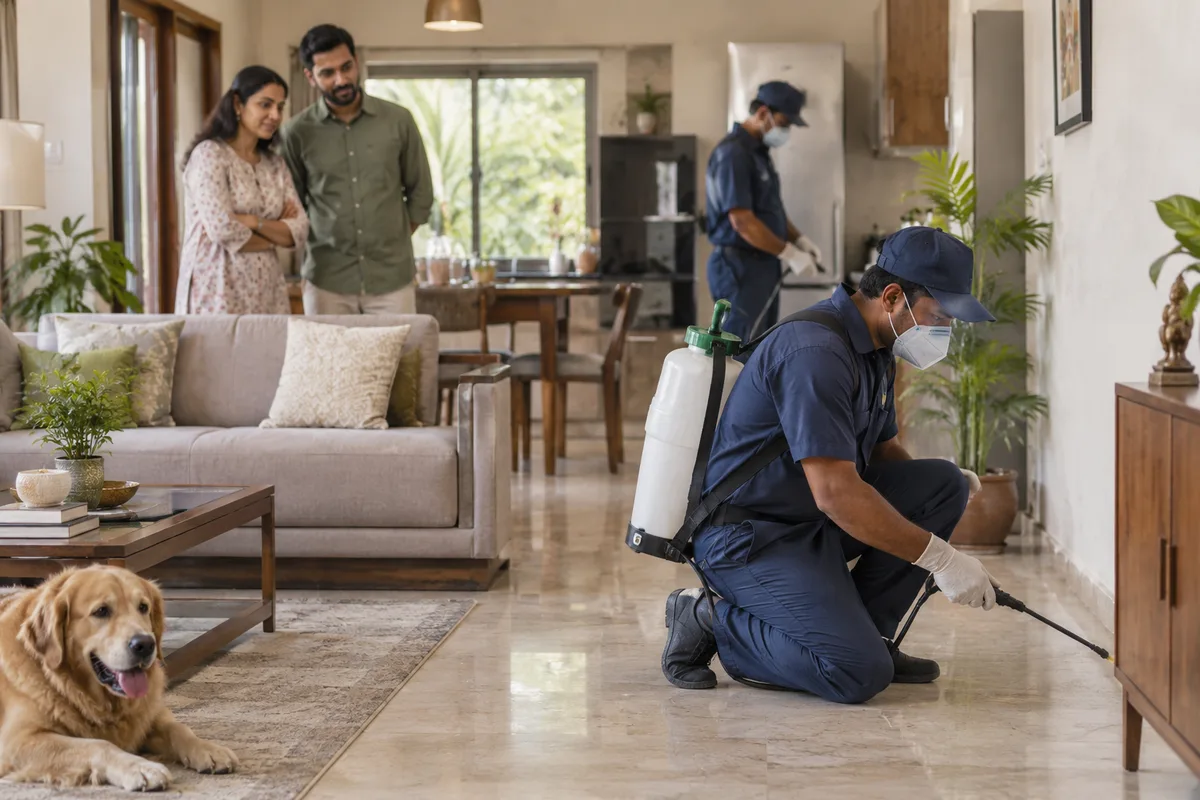
Apartment advertising is media and activity inside residential communities: the notice board, the lift panel, a Sunday stall. GullySales gets the association's written permission first, because anything put up without it comes down.
Also for pest control companies
- PPC advertising for pest control companies
- SEO for pest control companies
- Lead generation for pest control companies
- Digital marketing for pest control companies
- Reputation management for pest control companies
- Local SEO for pest control companies
- Branding and identity for pest control companies
- Social media marketing for pest control companies
Sales and marketing for pest control companies, the overview.
Last updated 5 Oct 2026.
For pest control companies
Where it usually goes wrong, and what we would do.
“Every poster has two readers”
One is the flat owner ringing about cockroaches in the kitchen. The other is the secretary who can hand you the basement, the drains and the terrace for a year, and a poster selling only a one-time flat treatment leaves that order on the table.
“The monsoon puts you on the board anyway”
Mosquito and termite complaints reach the notice board in the same week the rain does. A fogging offer that goes up then is read by people already arguing about it in the residents' group.
“The annual meeting decides next year's contract”
Common-area work is discussed at the general body meeting, and a new committee reopens its vendors. Being on the board and in the secretary's hand before that meeting beats a month of panels after it.
“Residents want to know about the children and the cat”
The question after the price is how long the flat has to stay empty and when the pets can come back. Put that on the poster and half the objections are dealt with before the call.
What we do
What we deliver for pest control companies.
Every deliverable, what it covers for you, and the result it is there to produce. Nothing here is an extra.
Society list by response time and by the age of the block
Older buildings with open drains and wooden fittings, inside the distance a technician can reach the same day, listed with the number of flats in each.
Result: You approach societies whose problems you are staffed for.
Written permission for each tower
The association or facility manager confirming what may go up, on which boards and for how long, before a single poster is printed.
Result: The print order matches what was actually cleared.
Posters naming the pest and the month
Termite, cockroach or mosquito treatment with the season and the price band on it, rather than your company name above a list of services.
Result: A resident with that exact problem reads their own problem.
A common-area proposal the committee can table
One page on the basement, drains, terrace and garden with a visit schedule and a rate, written so the secretary does not have to rewrite it before the meeting.
Result: The secretary has something to put in front of the committee.
An offer code the technician asks for
A code carried on that society's material alone and asked at booking, so a treatment can be traced back to the tower it came from.
Result: You know which societies pay for themselves.
Society by society reporting
Calls, treatments and contracts listed by community against the baseline taken before the campaign, with a dated photograph from every board.
Result: Next season's list is built from what worked, not from a vendor's claim.
How the result is measured
- Communities covered
- Permissions in writing
- Enquiries quoting the community code
Recorded as a baseline before work starts, so every later report has an honest comparison.
How it is bought, and approved
A pest control firm deals with two decisions in a society: the poster, and the common-area contract.
- One letter or one per tower
- Ask whether a single permission covers the whole society or each tower or wing has its own committee. Get it in writing for each, and note which towers it names.
- The contract renewal date
- The poster and the common-area contract are decided by different people. Ask the secretary when the annual contract for gardens, drains and garbage rooms comes up for renewal.
- What residents expect before a treatment
- Ask whether the society wants a notice on the board before a common-area job, and who keeps children and pets away from treated areas. Put the answers in your proposal.
- Papers the committee will want
- Keep your operator licence, insurance papers and the list of products you use ready to attach. Rules on pest control operators differ by state, so check your own.
- A word the technician asks for at the door
- Give residents a word to quote and have the technician ask for it. Write the society on the job card, so a treatment can be traced to the board that produced it.
Who it is for
This is written for these pest control companies.
- Residential pest control operators
- Termite treatment specialists
- Commercial AMC providers for restaurants and hotels
- Warehouse and industrial pest control contractors
- Mosquito fogging and municipal contract operators
- Multi-technician city-wide pest control companies
How it works
From your first message to the first report.
No open-ended retainer. Every step gives you something in writing.
First
Your brief
You tell us what you need in a few short steps: your business, what you want, where enquiries come from and how they are handled.
After the brief
A conversation and a written scope
We read it, then talk with whoever handles your enquiries. If you want our help, the scope, the fee and the reporting come in writing, and nothing starts before you have read them.
Before work starts
Baseline recorded
The numbers this work is meant to move, such as enquiries, quotations, orders, visits or renewals, written down so every later report has an honest comparison.
After the baseline
The first fix goes live
The fix we agreed to start with is put in place and measured against the baseline, whether that is a reply, a follow-up, a page, a listing or the handover between marketing and sales.
As agreed
Report against the baseline
What moved, what did not, and what changes next, in plain words. How often you get it is set in writing before work starts.
At renewal
Renew on the numbers
The term ends and you decide whether to continue from the results. The length is agreed in writing before anything starts.
How the apartment advertising work runs
- 1
Draw the ring
We agree how far a resident will realistically come to you. For a salon that is two or three societies. For a diagnostic centre it is the whole main road.
- 2
Shortlist and verify the societies
Which are self-managed and which are under a facility company, who the gatekeeper is, what categories they allow, and what they charge on their own account.
- 3
Get permission and quote properly
Permission letters are collected first. Only then do you see a rate, and it includes the society fee rather than surprising you with it later.
- 4
Print, install and audit
Artwork goes to each format's exact size, installation is scheduled with the facility manager, and every lobby is photographed with a date.
- 5
Run the activity
The clubhouse weekend is booked inside the display month, when your name is already on the wall of the lift they came down in.
- 6
Read it society by society
Calls and walk-ins are counted per code and the list is cut. Two societies usually carry a campaign and four carry nothing.
Why us
Why owners pick GullySales over an agency.
Marketing and sales, as one job
Most agencies stop at the enquiry. We also fix what happens after it: the reply, the follow-up, the quote and the CRM.
The person on the first call does the work
No account managers in between. You are never handed to someone you have not met.
A baseline before anything starts
Your numbers are written down on day one, so every later report compares against something honest.
The fee in writing, split three ways
Our time, your media spend and production on separate lines. You always see what goes to us.
No guarantees we cannot keep
The term is agreed in writing and never a default twelve months. We never promise a ranking or a lead count, because nobody controls those.
One office, and we say so
Nagarbhavi, Bengaluru. We work across India by call and WhatsApp and travel when a session needs to be in person.
#257, 3rd floor, Sri Nanjundeshwara Complex, Nagarbhavi 8th Block, Outer Ring Road. How we work.
Your brief
Tell us what you need, and we will read it before we call.
Eight short steps about your business, what you want and who decides. Most questions are a tap, and you can skip any you would rather answer on the call.
FAQ
Questions owners ask before they call.
Not here? More answers, or ask on WhatsApp.
Do we need permission once for the society, or for every tower?
Residents call us, but the society contract goes elsewhere. Why?
Does the society have to approve the method we name on a poster?
Another firm holds the society contract. Can we still treat individual flats?
How much does it cost?
How soon will we see results?
Who will actually do the work?
What do you need from us?
What if we are not happy with the work?
From the blog
Further reading for pest control companies.
 7 min read · 22 May 2026How to get security contracts, and win cleaning and facility tendersSecurity, cleaning, pest control, painting and water treatment contracts are won on compliance papers, site references and the renewal you keep, not on the lowest rate alone.
 6 min read · 6 May 2026AMC renewal: how to sell and renew annual maintenance contractsMost AMCs lapse because nobody asks in time, not because customers refuse. Start the renewal 60 days early, show the service record, and sell the AMC at installation.
 7 min read · 20 Jan 2026What is answer engine optimisation?Answer engine optimisation means being the source quoted at the top of the page, by naming the question as a heading and answering it in the first forty words.
More for pest control companies
Everything else we would do for you.
Closest to this: paid and media
Also for pest control companies
Or start from the overview: sales and marketing for pest control companies.
Your next practical step
Tell us what you are trying to grow, and we will read it before we call.
Eight short steps, mostly taps. Skip anything you would rather answer on the call.