Locksmiths · Print and outdoor media
Put a number where the locked-out customer is already looking.
Print and outdoor advertising for locksmiths places a name and a phone number on physical surfaces near the places customers get locked out or plan a lock change. GullySales works on the site and publication choice, the artwork, the booking record and the way each placement's calls are traced.
Scope, fee, reporting and term are agreed in writing after we have read your brief and spoken to you.
What print and outdoor media means
Print and outdoor media covers hoardings, newspaper adverts and pamphlets, offline placements that still work for reaching a local audience that does not search online first. GullySales chooses placements by locality and footfall and tracks which ones drive calls using a separate number or code.
Last updated 14 Nov 2026.
For locksmiths
Where it usually goes wrong, and what we would do.
“The customer reads the number once, under stress”
Someone standing at a door without a key looks at a hoarding, a van or a notice board for a few seconds and types what they see. A number that is small, split across two lines or hidden behind a logo is lost. Print and outdoor advertising for a locksmith is a legibility problem first: large digits, one number, one line saying what the business does, and nothing that competes with them.
“A site is only as good as the street it faces”
A hoarding at a junction nobody walks past, or a society board in a corner of the lobby, brings nothing however low the rate. What matters is whether the people who get locked out pass the place at the moment they need it: the lift lobby, the gate cabin, the parking entrance, the high street near a shopping parade. The first step is to visit sites, photograph them and note the viewing direction and any obstruction.
“Printed trust is the vehicle and the uniform”
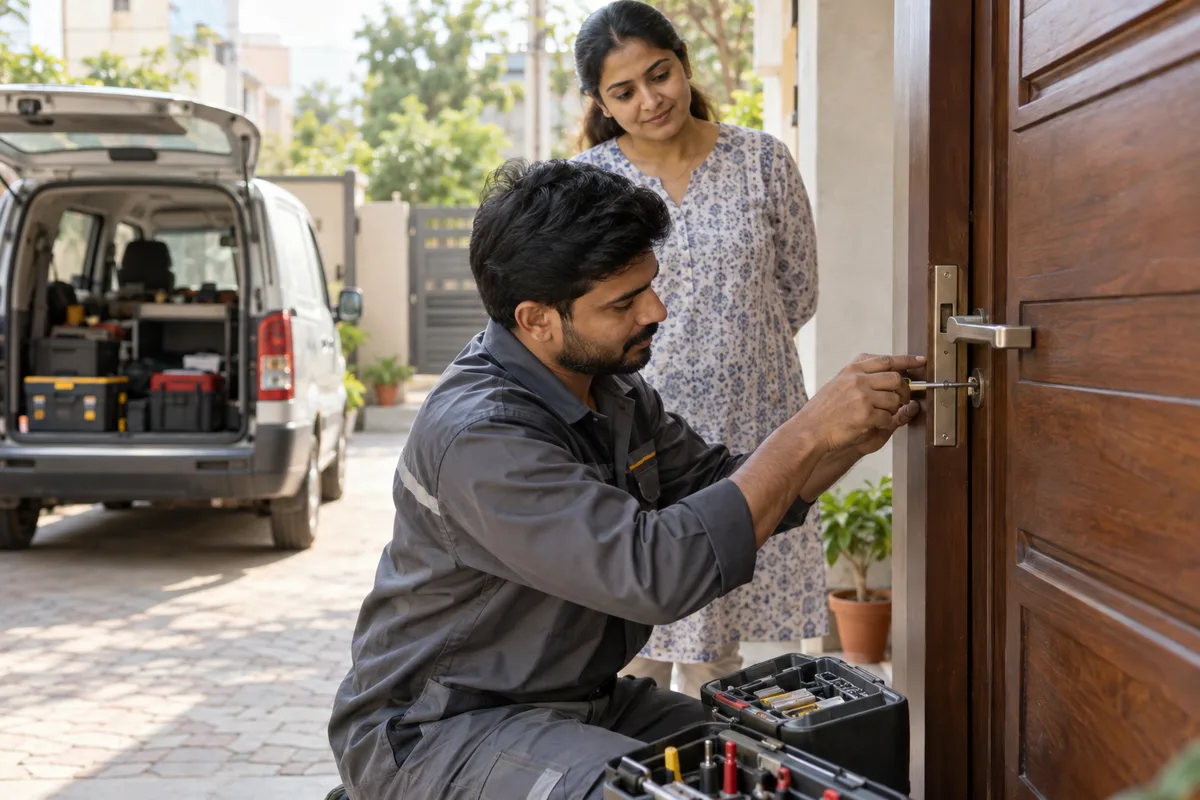
A locksmith's van, jacket and identity card are advertising that customers study at the doorstep. Branding on the vehicle with the business name and a number the customer can match to the one they rang makes a stranger easier to admit. The reverse also holds: unmarked vehicles and mismatched numbers make customers nervous, and a printed advert cannot repair it.
“Nobody can tell which placement rang”
Printed advertising rarely announces itself when it works. A caller says they found the number somewhere, and the owner writes nothing down. Without a different number or a code for each placement, the owner cannot tell a good notice board from a poor one, and renews all of them or none. Tracing each placement is a booking decision made before artwork, not an afterthought.
What we do
What we deliver for locksmiths.
The work available for this need. We agree the deliverables and responsibilities for your engagement in writing.
Catchment and placement brief
A written note of the areas the technician can reach, the types of customer sought and the places they pass: societies, shopping parades, parking entrances, offices, car dealerships. The owner checks it against where past jobs came from before any site or title is considered.
Result: Check that each place on the brief matches addresses in your job book.
Site and publication shortlist with photographs
A shortlist of sites and titles, each with photographs, the direction it faces, any obstruction and the reason it was chosen. For print, the edition, section and publisher-supplied readership information are recorded. We do not rely on a media owner's description alone.
Result: Visit one shortlisted site and compare it with the photographs.
Legible artwork for each format
Artwork for each space: a large-number sheet for a notice board, a board for a gate or kiosk, a panel for the van, a classified entry for a local paper. Each carries one number, one line of work and one plain statement the owner can document. The owner approves every proof before production.
Result: Read a proof at arm's length and see whether the number can be typed from memory.
Quote and booking record
Comparable quotes from media owners, permissions requested, and the final booking in writing: the exact site or edition, the display or insertion dates, and the agreed rate. The owner authorises the spend only after reading the booking. Terms that cannot be put in writing are noted.
Result: Confirm that the booking names the exact site and dates you paid for.
Placement-specific numbers or codes
A different number, extension or short code for each placement or group of placements, forwarded to the staffed line and tested. Where a separate number is not possible, a spoken or printed code is agreed. The person answering receives a sheet showing which code means which placement.
Result: Ring a number from outside and see the placement name appear in the log.
Installation evidence and response review
Photographs of each placement as installed or a copy of the published insertion, matched to the booking. The review compares recorded calls and jobs with cost placement by placement and names the gaps in tracing, before suggesting any renewal. Where nothing can be traced, the review says so.
Result: Compare the installation photograph with what the booking promised.
How the result is measured
- Enquiries by placement
- Cost per enquiry
- Reach by locality
Recorded as a baseline before work starts, so every later report has an honest comparison.
Who it is for
This is written for these locksmiths.
- Emergency and 24-hour locksmiths
- Automotive locksmiths and key programming specialists
- Residential lock and security installers
- Commercial and office locksmith services
- Safe installation and repair specialists
- Smart lock and digital security installers
- Society and RWA-contracted locksmiths
Before you decide
Agree the work. Know how to judge it.
Print and outdoor advertising for locksmiths: use these checks to prepare, choose the scope, and review what changes.
Bring the right evidence
State the buyer group, catchment, and dates that matter to the offer. Ask for the proposed inventory and available evidence about its audience, with the source and date shown.
Make the scope clear
Agree the exact placements, formats, booking period, and proof of delivery. Separate media charges from design, production, permissions, and installation where these apply.
Check the work in use
Compare delivery evidence with the agreed booking and record enquiries through a distinct response route where practical. Treat audience estimates separately from measured responses.
Know when to change course
Do not buy a placement only because it is discounted. If the location or audience does not fit the buyer, revisit the plan before committing production costs.
These are discussion points, not a fixed package. GullySales confirms the deliverables, responsibilities, fee, and term in writing after reading your brief and speaking with you.
Before we start
What to have ready before the work starts.
The records, access and decisions this work needs from locksmiths. Anything missing is noted in the written scope, with who will supply it.
- Photographs of past job locations
- Addresses or photographs of the societies, parades and streets where recent jobs happened. Print and outdoor choices are made from where customers really are, and without this record the choice defaults to whichever site the media owner offers first. A list of addresses is enough.
- A staffed number that matches your vehicle
- One number the customer will see on the van, the notice board and the advert, forwarded to a phone someone answers. If the printed number differs from the number that rings the customer's phone at the door, trust drops. We need to know which number the business actually wants to be known by.
- Documents for any verification statement
- Licences, clearance papers or registration that support what the artwork says about the business. A customer reads a printed claim as a promise. If a document is missing, the artwork carries no claim about it, and the line is added later once the paper is in hand.
- Permission from the people who control the surface
- The names of the society committee, shopkeeper or landlord who can approve a board or sign, and any written terms they have. Outdoor space belongs to someone, and a sign installed without consent comes down at the business's cost. We prepare the request and the owner makes the approach.
- A budget ceiling the owner is comfortable with
- A figure the owner has decided in advance for the whole print and outdoor effort, kept within the owner's own books. The booking list is built to fit it. Without a ceiling, quotes are compared with no limit to stop at, and the site that looks biggest wins over the one that reaches the right street.
How it works
How the print and outdoor media work runs
The work itself, in order. How an engagement starts, from your brief to a written scope, is set out on our method page.
- 1
Where your customers got locked out
We begin with the job book: where emergency calls came from, which societies and parades generate repeat work, and which areas the technician reaches without delay. The owner also records how many calls arrived before the placements began. These figures become the baseline against which the printed and outdoor placements are read later.
- 2
Walking the sites and reading the titles
We visit each candidate site, photograph it from where a customer would stand and note the viewing direction, lighting, obstructions and the people who pass it. For print we note the edition, position and the publisher's own readership information, which we treat as a claim rather than a measurement. Anything we cannot verify is marked as unverified.
- 3
Permission, owner consent and production brief
Hoardings, boards and notice-board space need the permission of whoever controls the surface, whether a society committee, a shop owner or a local authority. We prepare the request and the production specification; the owner or the owner's adviser confirms what is needed and holds the paperwork. Nothing is installed without it.
- 4
Designing for the one-glance reader
We draft artwork around a single number, a short line about the work and one verifiable statement, then proof it at the real size and from the real distance. Colour, contrast and typeface are chosen for dusk and for the glare of a car's headlights. The owner approves every line, and the number is checked against the line that will answer.
- 5
Booking, installation and number test
The owner approves the quote and signs the booking. We brief the installer or the publisher, collect installation photographs, and test each placement's number or code from outside. The person answering the phone receives the source sheet, so a caller who mentions the notice board in the lobby is logged as such.
- 6
Reading placements against the first figures
At the review, calls, jobs and cost are laid out placement by placement beside the baseline. Placements that brought paid work are kept, those that brought only wrong numbers are dropped, and those that cannot be traced are flagged. The owner decides on renewal with the job book open, and we say plainly when the evidence is too thin.
Where this fits
Three pieces of sales work, in this order.
This work sits inside sales process design, at stage 1, prospecting and lead generation. The audit comes before it, and sales management keeps it running.
Step 1
Sales audit
Find where deals are being lost and what to fix first.
Start here if you cannot say where orders are lost.
Step 2 · you are here
Sales process design
One written way to sell, from first enquiry to repeat order.
Start here if every salesperson sells differently.
Step 3
Sales management
A target, a review routine and someone who owns the number.
Start here if the team has targets and no routine.
FAQ
Questions owners ask before they call.
Not here? More answers, or ask on WhatsApp.
Is print and outdoor advertising worth it for a locksmith when everyone searches on the phone?
Which placements suit a locksmith best?
Can I put a notice in a society without permission?
How do I know which placement brought a call?
Will you promise calls or jobs from the placements?
Do you handle printing and installation?
How much does it cost?
How soon will we see results?
Who will actually do the work?
What do you need from us?

More for locksmiths
Related work to consider.
Closest to this: paid and media
Also for locksmiths
Or start from the overview: sales and marketing for locksmiths.
Your next practical step
Tell us what you are trying to grow, and we will read it before we call.
Eight short steps, mostly taps. Skip anything you would rather answer on the call.