Water and fire damage restoration companies · Local SEO
Be on the map in the county where the crew is, not only at the office.
Local SEO for a restoration company decides whether your listing appears in the map pack when somebody inside your reach searches at midnight. GullySales sets the service area to the counties a crew can genuinely make, gets the emergency hours right, and builds the review routine that holds the ranking.
Scope, fee, reporting and term are agreed in writing after we have read your brief and spoken to you.
What local SEO means
Local SEO is the work of making your business show up for searches that name your town or locality, such as a service plus an area name. GullySales sets up locality pages, local citations and map listings so nearby customers find you before a competitor across town.
Also for water and fire damage restoration companies
- SEO for water and fire damage restoration companies
- Website for restoration companies
- PPC ads for water and fire damage restoration companies
- Lead generation for water and fire damage restoration companies
- Digital marketing for water and fire damage restoration companies
- Reputation management for water and fire damage restoration companies
- Branding and identity for water and fire damage restoration companies
- Social media marketing for water and fire damage restoration companies
Sales and marketing for water and fire damage restoration companies, the overview.
Last updated 14 Nov 2026.
For water and fire damage restoration companies
Where it usually goes wrong, and what we would do.
“The map pack is drawn from where the searcher stands”
A listing pinned at your shop ranks for a few miles around it. Towns at the edge of your territory need pages and reviews from work done there.
“Open twenty-four hours has to be true”
Set that attribute and then miss a call at two in the morning, and you earn the review that removes you from the pack.
“A second office is not a second listing until it is real”
A mailbox in the next county gets suspended. A staffed address with a sign and equipment on site is what Google will verify.
What we do
What we deliver for water and fire damage restoration companies.
The work available for this need. We agree the deliverables and responsibilities for your engagement in writing.
A profile set up for emergency work
Category, service area, emergency attributes and the hours somebody truly answers, with water, fire, mould and reconstruction named in the description.
Result: The listing says what you do at the hour people search.
Photographs from real losses, cleared first
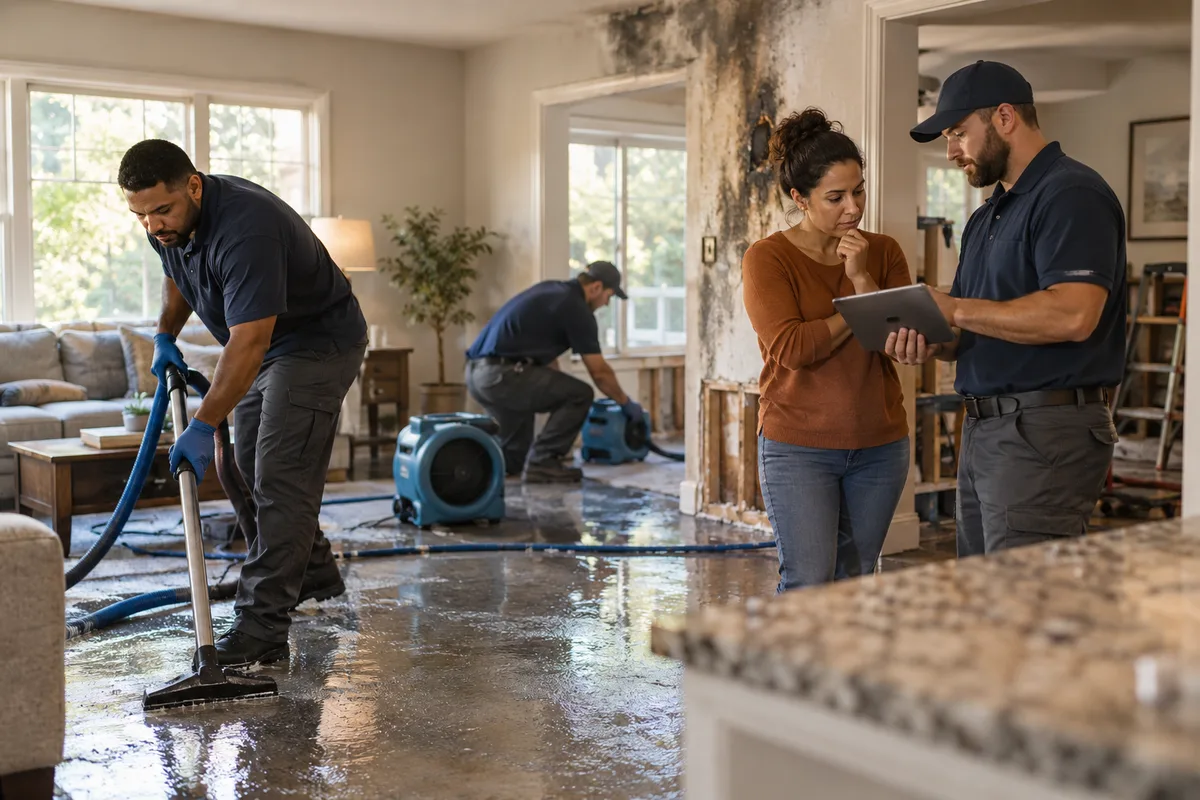
Equipment in a flooded basement, a pack-out in progress and a finished rebuild, uploaded regularly and agreed with the homeowner beforehand.
Result: The listing shows your work rather than your yard.
Town pages carrying the jobs done there
A page per town naming the neighbourhoods, the age of the houses and the losses you have handled, so a distant listing has something behind it.
Result: Outer towns stop being a blank on the map.
A review ask built into the job closeout
The request added to your final walkthrough checklist, so it happens on every job instead of when somebody in the office remembers.
Result: Reviews arrive steadily rather than in bursts.
One set of details everywhere it matters
Name, address, phone and hours checked on Google, Yelp, the Better Business Bureau, your carrier programme profiles and any franchise page left open.
Result: An adjuster checking you up finds one company.
Map calls counted against trucks dispatched
Calls and direction requests from the listing, matched to jobs dispatched and read against the baseline taken before work started.
Result: The listing is judged on trucks rolling.
How the result is measured
- Map pack ranking
- Local search visibility
- Enquiries by locality
Recorded as a baseline before work starts, so every later report has an honest comparison.
What Google weighs here
How a household or building manager with a flood or fire finds a restoration company, and what to fix first.
- Primary category
- Choose Water damage restoration service or Fire damage restoration service, whichever brings most of your jobs. Add the other as secondary. Mould and cleaning services need their own line in services.
- Open all hours has to be true
- Set open 24 hours only if a person answers at night. A flooded flat that rings at three in the morning and reaches a voicemail has already rung the next company.
- Towns the crew can reach
- List the towns and districts where a crew can really be sent in an emergency. A pin at the office is not where the loss will be, and an overlong list invites jobs you cannot reach.
- Insurer panel names and spellings
- If you are on an insurer's or a loss assessor's panel, check that the company name on their list matches your listing. A different spelling makes the claims desk think you are another firm.
- Photographs cleared with the owner
- Show equipment, drying set-ups and crews at work, with the owner's consent and no house numbers, faces or belongings. A person in a bad week reads a clean, anonymous photograph as care.
Who it is for
This is written for these water and fire damage restoration companies.
- Water mitigation companies working residential losses
- Fire and smoke damage restoration companies
- Mould remediation specialists
- Contents cleaning and pack-out operations
- Restoration companies holding a general contractor licence for the rebuild
- Independents competing with national franchises
- Franchise owners who need local work beyond the brand's leads
- Commercial large-loss and multi-family restoration teams
- Biohazard and trauma scene cleaning companies
Before you decide
When this may not be the right fit.
- The listing address is a home or a yard where the company does not meet customers, and the platform's rules on that have not been read
- The company will not answer the phone out of hours but the listing says it is open all night
- No crew works in the towns you want to appear in, so those pages would describe jobs that never happened
Before you decide
Agree the work. Know how to judge it.
Local SEO for water and fire damage restoration companies: use these checks to prepare, choose the scope, and review what changes.
Bring the right evidence
Confirm the real business address, service area, contact details, and who controls the business listings. Keep examples of calls that came from the wrong location or asked for a service you do not provide.
Make the scope clear
Choose the locations you actually serve and the information each needs. Agree who approves listing changes, responds to enquiries, and keeps opening hours accurate.
Check the work in use
Check the journey from a local search to a call or enquiry on a phone. The address, service area, and description should agree across your website and listings.
Know when to change course
Do not create an office claim for a place where you only serve customers remotely. Clear service coverage is more useful than a misleading local presence.
These are discussion points, not a fixed package. GullySales confirms the deliverables, responsibilities, fee, and term in writing after reading your brief and speaking with you.
Before we start
What to have ready before the work starts.
The records, access and decisions this work needs from water and fire damage restoration companies. Anything missing is noted in the written scope, with who will supply it.
- Owner access to the business listing
- Every change depends on the login. It should belong to someone still with the company, with a recovery phone you control. If a prior agency owns it, we begin with the recovery route. Share the verification phone number or email as well, because the platform may send a code.
- A decision on how the address shows
- A yard or van-based company can hide the street address. Decide whether to show it or hide it, and confirm the address is real. If the answer is unclear, ask your adviser before we set it.
- The after-hours routing for calls
- Calls come at midnight. Tell us who answers and what happens if nobody does. If the number rings out, we do not publish round-the-clock hours.
- A cleared set of job photographs
- Bring images from past jobs that carry no personal detail, with written permission where a home is visible. If none are cleared, we begin with trucks and equipment. Remove anything that shows a vehicle number plate or a street sign.
- A list of towns where you have worked
- Town pages need real jobs. Provide the list by town, with the type of loss. If a place has only one job, we group it with the neighbouring towns.
How it works
How the local SEO work runs
The work itself, in order. How an engagement starts, from your brief to a written scope, is set out on our method page.
- 1
Pin your service area on a real map
We draw the area your trucks can reach in the time a homeowner expects, from your yard or office, and compare it with the towns where you have jobs. You mark the places you would rather not serve. The map is the base for the listing, because the pack is drawn from where the searcher stands. We also note the neighbouring towns that sit just outside, where a competitor may be closer.
- 2
Confirm the address and the way it shows
We check how your address appears, whether it is a yard, an office or a service-area business with a hidden address. You tell us what is true. A listing that shows an address where nobody attends is a risk, so we set it as the platform's current rules require.
- 3
Set the profile for emergency work
We complete the profile fields for the services you provide, the hours, the phone number and the booking route. You confirm any claim of open round the clock, which must be true. If a night call goes to an answering service, we say so. We ask who watches the phone number on the listing, and whether texts reach the same person.
- 4
Add photographs cleared from real jobs
We select photographs of equipment, trucks and finished rooms, cleared of identifying detail. You or your project manager give permission for each. Pictures from real losses carry more weight than stock images.
- 5
Write town pages from jobs done there
For each town where you have worked, we write a short page linked from the listing, drawing on the jobs done and the streets you know. You review the facts. We do not list a town where no crew has been.
- 6
Count map calls against trucks sent
We read the calls, direction requests and messages from the listing against the dispatches recorded before we began. You see which towns and which hours produced work. You decide where to add pages or photographs.
Where this fits
Three pieces of sales work, in this order.
This work sits inside sales process design, at stage 1, prospecting and lead generation. The audit comes before it, and sales management keeps it running.
Step 1
Sales audit
Find where deals are being lost and what to fix first.
Start here if you cannot say where orders are lost.
Step 2 · you are here
Sales process design
One written way to sell, from first enquiry to repeat order.
Start here if every salesperson sells differently.
Step 3
Sales management
A target, a review routine and someone who owns the number.
Start here if the team has targets and no routine.
FAQ
Questions owners ask before they call.
Not here? More answers, or ask on WhatsApp.
Can we list every county we cover?
How do we rank in a town forty miles away?
A listing shows our name but the call goes to a call centre elsewhere. What now?
We work from a yard and a van, with no shopfront. What address do we list?
How do we deal with a competitor who lists a false address near us?
How much does it cost?
How long is the contract?
How soon will we see results?
Who will actually do the work?
What do you need from us?
More for water and fire damage restoration companies
Related work to consider.
Closest to this: search and visibility
Also for water and fire damage restoration companies
- PPC ads for water and fire damage restoration companies
- Lead generation for water and fire damage restoration companies
- Digital marketing for water and fire damage restoration companies
- Reputation management for water and fire damage restoration companies
- Branding and identity for water and fire damage restoration companies
- Social media marketing for water and fire damage restoration companies
Or start from the overview: sales and marketing for water and fire damage restoration companies.
Your next practical step
Tell us what you are trying to grow, and we will read it before we call.
Eight short steps, mostly taps. Skip anything you would rather answer on the call.