Electroplating companies · Social media
Use social posts to show the line, the checks and the people who run them.
Social media for a plating house means short posts and videos that show process control to the engineers who follow industrial pages. GullySales plans what to post, writes it with your quality person and keeps the posts away from any claim you cannot prove.
Scope, fee, reporting and term are agreed in writing after we have read your brief and spoken to you.
What social media means
Social media is the ongoing posting your business does on platforms such as Instagram, Facebook and LinkedIn to stay visible to customers and prospects between purchases. GullySales plans a posting calendar, writes captions and designs the images so the page looks active and answers what a visitor would ask.
Also for electroplating companies
- Content marketing for electroplating companies
- Lead generation for electroplating companies
- SEO for electroplating companies
- Local SEO for electroplating companies
- Buyer personas for electroplating companies
- CRM for electroplating companies
- Follow-up systems for electroplating companies
- WhatsApp marketing for electroplating companies
Sales and marketing for electroplating companies, the overview.
Last updated 14 Nov 2026.
For electroplating companies
Where it usually goes wrong, and what we would do.
“LinkedIn is where the engineers are”
Quality heads and purchase engineers keep LinkedIn profiles for their jobs. A company page that posts a thickness check or a trial lot story reaches them where they already look. A page that posts only festival greetings gives them no reason to follow.
“A tank is not a post, a check is”
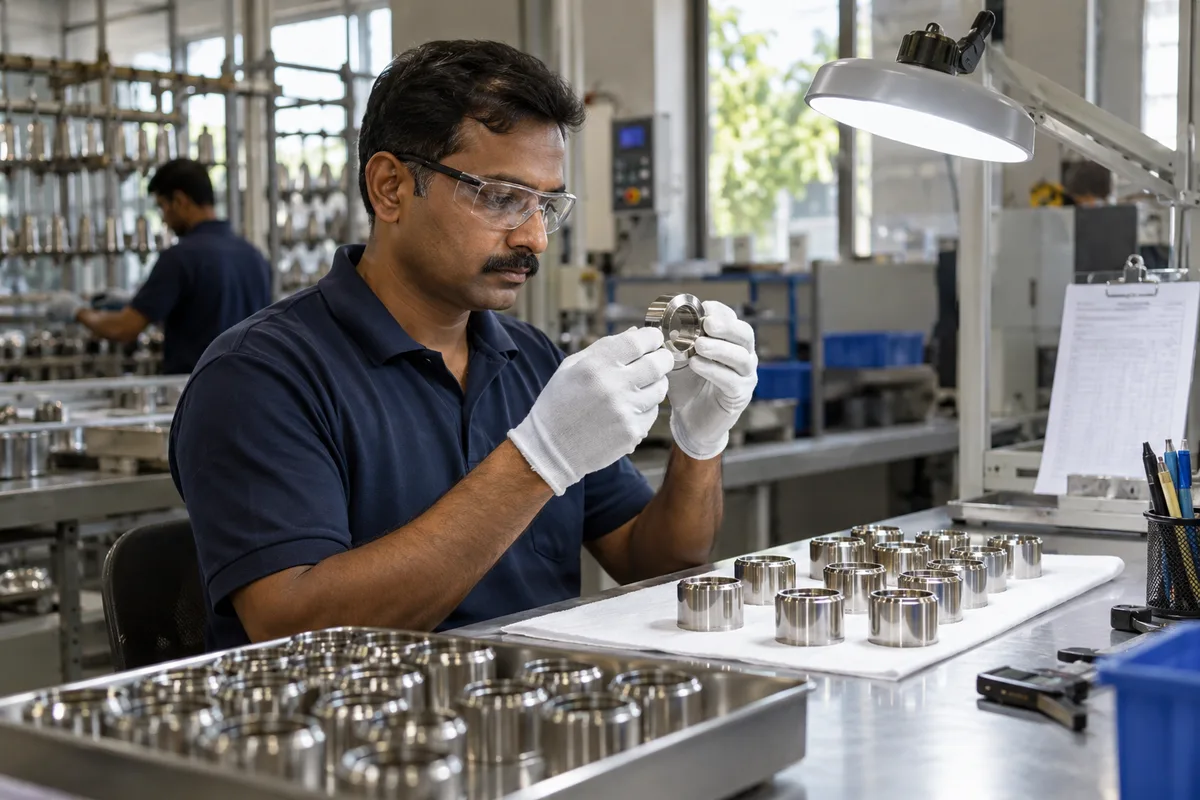
A photograph of a bath says little. A photograph of an operator taking a thickness reading, with a caption naming the part and the method, shows the discipline a buyer is trying to judge. Choose moments that show control.
“Shop-floor video needs permission and care”
Filming a customer's part can break a confidentiality term, and a video that shows an untidy corner hurts you. Agree what may be filmed, clear the frame of marked parts, and keep the safety gear visible.
“Posts should lead to the proof pack”
A post that interests an engineer should end with a way to ask for your process notes or a trial lot. Without that, attention goes nowhere and the next post starts from zero again.
What we do
What we deliver for electroplating companies.
The work available for this need. We agree the deliverables and responsibilities for your engagement in writing.
Profile set-up for a plating business
LinkedIn and, if useful, YouTube profiles filled with finishes, location and a link to the enquiry page.
Result: A visiting engineer sees what you plate in a moment.
Post bank from the plant
A set of post ideas drawn from daily work, such as inspection, racking, passivation and packing.
Result: You always have something real to post.
Caption guide for technical posts
Plain wording rules, agreed with your quality person, for how to describe a test or a result.
Result: No post says more than your records support.
Permission checklist
A list of what may be photographed or filmed, and who signs it off.
Result: Nothing confidential reaches the page.
Link to the enquiry path
Each post ends with a route to the proof pack or the trial lot form.
Result: Attention leads to a conversation.
How the result is measured
- Posts published
- Engagement rate
- Enquiries from social profiles
Recorded as a baseline before work starts, so every later report has an honest comparison.
Posts and pieces to plan
What a plating house can post for engineers on LinkedIn and video.
- Salt-spray panel after the test
- A photograph of the test panel with the standard and exposure named in the caption. Post only results the unit's records support.
- Thickness check at the bench
- A short clip of the gauge being used on a lot, with the reading shown and the part masked of any buyer detail.
- A pretreatment tank explained
- Why a part is degreased and acid-pickled before plating, in two sentences over a photograph. It answers a question a quality engineer asks.
- Rack versus barrel for a part
- A post comparing the two on a sample part, saying what suits small fasteners and what suits a larger casting.
- Process engineer introduction
- The person who owns the bath chemistry, with the training they hold. It shows a named person is accountable for the process.
- Notice of the audit-ready proof pack
- A post that links to the downloadable pack, saying what it holds, so interested buyers reach the proof directly.
Who it is for
This is written for these electroplating companies.
- Zinc and zinc-nickel plating for fasteners and automotive parts
- Decorative and hard chrome plating
- Nickel plating for engineering and electrical components
- Copper and tin plating for electrical and electronics parts
- Barrel plating for small parts
- Rack plating for larger components
- Plating on aluminium and castings
- In-house plating units that accept outside work
Before you decide
When this may not be the right fit.
- Your customers bar any photograph of their parts, and you have no samples of your own to show
- Nobody will answer a comment from an engineer, and an unanswered question reads worse than no page
Before you decide
Agree the work. Know how to judge it.
Social media marketing for electroplating companies: use these checks to prepare, choose the scope, and review what changes.
Bring the right evidence
Review the posts that produced useful conversations, not only the ones with the most views. Gather buyer questions and decide which team member can contribute credible material.
Make the scope clear
Choose the audience and channel before setting a posting volume. Agree who supplies material, approves posts, and handles messages, including complaints or questions the agency cannot answer.
Check the work in use
Follow a post through to the profile, website, and response. A useful report explains the quality of conversations and enquiries, alongside reach and engagement.
Know when to change course
If publishing takes time away from unanswered buyer messages, fix the response routine first. Do not expand to another channel without a clear reason for being there.
These are discussion points, not a fixed package. GullySales confirms the deliverables, responsibilities, fee, and term in writing after reading your brief and speaking with you.
Before we start
What to have ready before the work starts.
The records, access and decisions this work needs from electroplating companies. Anything missing is noted in the written scope, with who will supply it.
- Admin rights to any existing profile
- Login or admin invitations for pages carrying the company name, including old ones made by others. If control is lost, we create new profiles in the company's name and ask the platform to retire the old. Collect also the logo files and the plant name as printed on your letterhead, so that every profile shows the same name and picture.
- A person from quality to supply readings
- Someone who can photograph a reading or record, with permission, and tell us what it means. Without a technical source, captions become general, and the post reads like any supplier's. Ask them also to explain each reading in one plain sentence, since a caption must be understood by a buyer who is not a plater.
- Customers' consent for any part shown
- A message from each customer whose part may appear, even a short yes. The unit holds the message. Without consent we show only your own test pieces and process steps. Keep the messages together in one folder, labelled by customer, so that a question about consent can be answered at once and not after a search.
- A rule on safety clothing and chemicals
- State what workers must wear in any photograph and which areas may not be shown. Ask your safety officer if you have one. Without a rule, one image can raise questions that the post cannot answer. Add rules for phones near the baths, for the shot of a drum label and for any visitor who happens to be in frame.
- A named person to answer messages
- One person who sees messages and comments and moves a drawing request to the enquiry path. Without a name, engineers who respond are ignored and the page loses credibility.
How it works
How the social media work runs
The work itself, in order. How an engagement starts, from your brief to a written scope, is set out on our method page.
- 1
Find out which engineers follow industrial pages
We look at who follows rival platers and component suppliers on LinkedIn and Instagram, and ask your customers which pages they read. You tell us which buyers you want to reach. The number of followers who work for target plants is counted at the start. We also note whether the plant already has a page that buyers tagged or mentioned, since an existing page with a few real followers is worth keeping and improving.
- 2
Draw up the post bank on the shop floor
We walk the plant with your quality person and list what photographs well: a thickness reading, a bath log, a rack loaded for zinc, a tagged lot ready to dispatch. You say what stays off. The result is a bank of posts drawn from real checks. We note the times when the line is loaded and the floor is tidy, so that photographs are planned for those moments and not taken in a rush.
- 3
Write the permission checklist
We write a checklist covering customer marks, drawings, worker safety clothing, chemical drums and anything else visible in frame. You approve it and one person applies it before every post. A single missed customer mark can cost a buyer. The person who applies it signs a short note against each post, so that a mistake can be traced to a step and not to a person.
- 4
Draft captions with the quality person
Each caption says what was checked and how, in plain words, and links to the proof pack where there is one. Your quality person reads it. A claim that cannot be backed with a record is removed. We also mark any caption that mentions a standard, because naming one implies you meet it, and that needs a record behind it.
- 5
Link posts to the enquiry path
Every post carries a way to send a drawing or ask for the pack, and we agree who answers a message. You name the person. A post without a route to the unit produces attention and no enquiries. We write the first reply to each kind of message, so that a drawing request, a price question and a job seeker are each handled the same way whoever is at the desk.
- 6
Count enquiries that began on a post
After the posts have run we count messages, pack requests and drawings that began on social media, with follower counts from target plants, and compare them with the starting figures. Which posts to repeat and which to stop is yours to decide. We compare the posts with the pack requests they produced, which shows whether engineers read a post and act or only scroll past it.
Where this fits
Three pieces of sales work, in this order.
This work sits inside sales process design, at stage 0, foundation. The audit comes before it, and sales management keeps it running.
Step 1
Sales audit
Find where deals are being lost and what to fix first.
Start here if you cannot say where orders are lost.
Step 2 · you are here
Sales process design
One written way to sell, from first enquiry to repeat order.
Start here if every salesperson sells differently.
Step 3
Sales management
A target, a review routine and someone who owns the number.
Start here if the team has targets and no routine.
FAQ
Questions owners ask before they call.
Not here? More answers, or ask on WhatsApp.
Is social media worth the effort for a job-work plater?
Who should post for us?
Do we show a customer's logo on a post?
Can a post about a rejected lot help the unit?
Do plant engineers look at social media at all?
Who should post, the owner or the quality person?
How much does it cost?
How long is the contract?
How soon will we see results?
Who will actually do the work?
More for electroplating companies
Related work to consider.
Closest to this: content and social
Also for electroplating companies
Or start from the overview: sales and marketing for electroplating companies.
Your next practical step
Tell us what you are trying to grow, and we will read it before we call.
Eight short steps, mostly taps. Skip anything you would rather answer on the call.