Food product manufacturers · Market penetration strategy
Selling more in the towns you already serve starts with knowing which outlets reorder.
Market penetration for a food manufacturer is a plan to sell more of the existing range through the districts, distributors and outlets already on your books. GullySales reads your billing and secondary sales, finds where coverage is thin and which distributors hold stock without pushing it, and ranks the moves worth trying.
Scope, fee, reporting and term are agreed in writing after we have read your brief and spoken to you.
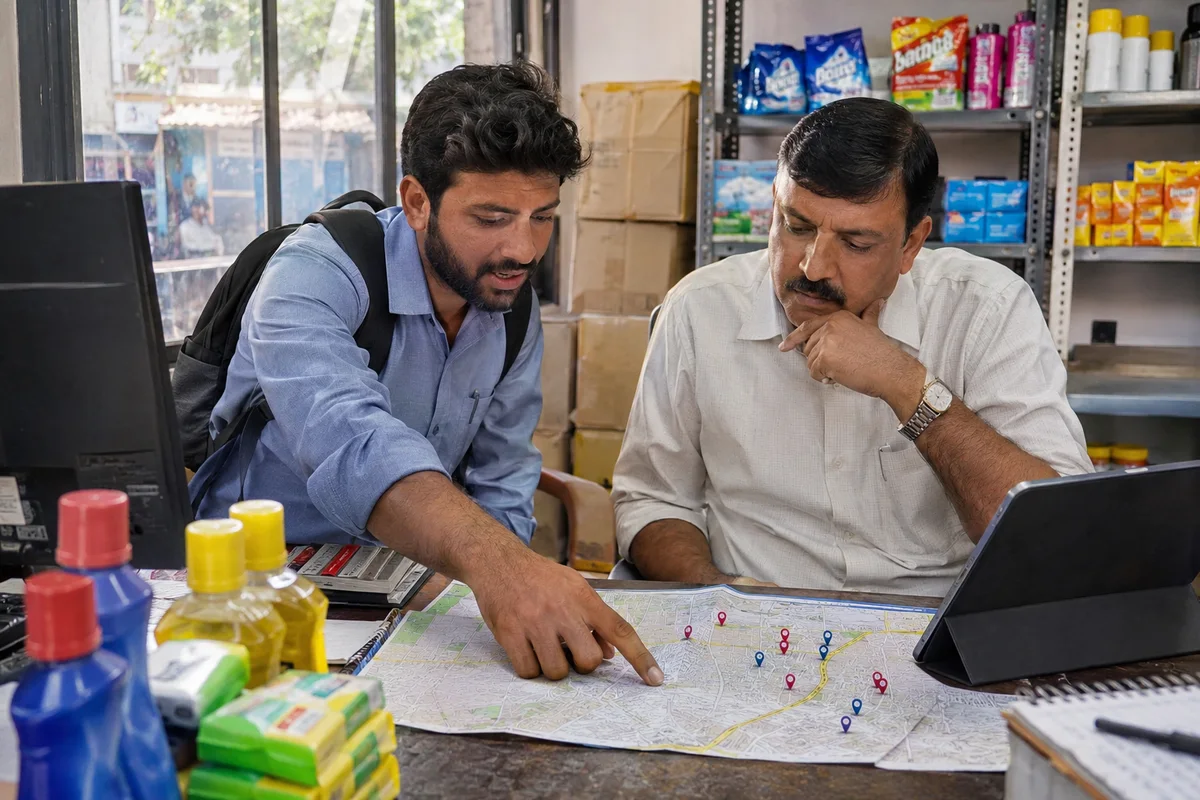
What market penetration strategy means
Market penetration strategy is a plan to sell more of your existing products in the areas and accounts you already serve. GullySales finds where coverage is thin, which current buyers give you only part of their purchase, and which dealers are not pulling their weight, then ranks the moves worth making.
Also for food product manufacturers
- Digital marketing for food product manufacturers
- Buyer persona for food product manufacturers
- Media operations consulting for food product manufacturers
- SEO for food product manufacturers
- PPC ads for food product manufacturers
- Lead generation for food product manufacturers
- Local SEO for food product manufacturers
- Social media marketing for food product manufacturers
Sales and marketing for food product manufacturers, the overview.
Last updated 14 Nov 2026. Rules for this trade differ by state and professional body, and they change. We describe restrictions in general terms, so check the current position with your own council or adviser before you publish anything.
For food product manufacturers
Where it usually goes wrong, and what we would do.
“Billing to the distributor looks like growth”
Cartons leave the godown and the invoice is raised, so the month looks healthy. The question is what share reaches a shelf and sell through. A distributor holding a full godown is a distributor who does not need to reorder, and the figure hides it.
“The home district is full and the next one is empty”
A maker with strong reorders in the base town still has nothing in towns an hour's drive away. Nobody there has been asked. Penetration starts with the map of the district you serve, then the outlets in it that have never stocked the brand.
“One pack in the range does all the selling”
The shopkeeper stocks the masala and ignores the pickle and the ready mix from the same maker. Selling the second and third product to an outlet that already trusts the brand costs a salesperson less than a new outlet does.
“Schemes reward loading, not selling”
A year-end scheme tied to bulk billing teaches the distributor to take stock in a lump and push it back in the next quarter. A scheme tied to outlets reached and reorders asks for the behaviour you want.
What we do
What we deliver for food product manufacturers.
The work available for this need. We agree the deliverables and responsibilities for your engagement in writing.
District and outlet coverage map
A sheet built from your invoices and salesperson visit notes, showing which districts, towns and outlet types are served, thinly served or not reached.
Result: You can point at the gaps in the districts you already supply.
Distributor depth review
A comparison of distributors by range stocked, reorder pattern, outlets served and the stock held against what moved, taken from your records and a call to each.
Result: You see which distributors push the brand and which only hold it.
Range spread by outlet
For your best outlets, a record of which products they stock and which they do not, with the reason given by the shopkeeper marked as said, not as confirmed.
Result: Each salesperson carries a list of outlets that stock only one pack.
Scheme and margin options
Scheme choices for named outlet groups and distributors, each with the margin effect worked out for you to check. You approve any change; we do not set your price.
Result: You can compare a scheme against your margin before announcing it.
Ranked list of moves
The coverage, range and scheme options set in order, with what each needs from your salespeople and who owns it.
Result: The team starts with one agreed move and not a long wish list.
Secondary sales tracking sheet
A simple record kept by salespeople and distributors of outlet orders and reorders, so the next review reads sell-through.
Result: You can see what reached the shopper, not only what left the godown.
How the result is measured
- Accounts buying more than one of your product lines
- Dealers active against dealers signed up
- Localities and trade clusters visited against the territory list
Recorded as a baseline before work starts, so every later report has an honest comparison.
Who it is for
This is written for these food product manufacturers.
- Spice, masala and blended powder makers
- Pickle, chutney and preserve manufacturers
- Namkeen, snack and savoury makers
- Sweets and traditional confectionery producers
- Ready-to-cook and instant mix brands
- Millet, health food and organic brands
- Flour mills and grain processors
- Beverage, juice and syrup makers
- Private label and contract food manufacturers
- Food exporters and merchant exporters
Before you decide
Agree the work. Know how to judge it.
Market penetration strategy for food product manufacturers: use these checks to prepare, choose the scope, and review what changes.
Bring the right evidence
Bring a recent won order and an enquiry that went nowhere. Trace how each buyer found you, what they asked, and who handled the next step. A channel list alone will not explain the difference.
Make the scope clear
Choose one offer and one buyer group first. Agree which part needs attention: being found, getting a useful enquiry, or turning an enquiry into an order. Separate recommendations from the work required to carry them out.
Check the work in use
A useful plan names the first change, its owner, the evidence behind it, and the number that will show whether it worked. Ask what has deliberately been left out and why.
Know when to change course
If your team cannot answer the enquiries it already receives, improve that handover before buying more traffic. If the offer itself is unclear, test it with buyers before adding channels.
These are discussion points, not a fixed package. GullySales confirms the deliverables, responsibilities, fee, and term in writing after reading your brief and speaking with you.
Before we start
What to have ready before the work starts.
The records, access and decisions this work needs from food product manufacturers. Anything missing is noted in the written scope, with who will supply it.
- Sales by distributor and district
- A billing extract showing what each distributor bought, in which packs, over a few seasons. Rough is acceptable. Without it, coverage cannot be read and the whole exercise falls back on the owner's impressions of which districts are strong. Where the extract only goes back one season, we say so in the baseline and do not compare it against a festival season.
- A list of outlets for each salesperson
- Who visits which shops, and how frequently. The shelf map is built from these rounds. Without the lists, the map covers only the outlets we visit ourselves, which is too few to see where the empty streets are. Where a salesperson has left, the list is rebuilt from the last bills of the outlets that salesperson served.
- Distributor stock reports
- What each distributor holds today, pack by pack, and what is near its date. A photograph of a stock sheet is enough. Without it, depth is guessed from billing, and loading cannot be told from selling. Where distributors refuse, the owner decides whether to ask again through the salesperson or leave that district for later.
- Current schemes and margins at each step
- The offers now in force and the margin the distributor and the shopkeeper keep on each pack. Only the owner holds this. Without it, the scheme options cannot be compared and are shown in outline only. A scheme that exists only as a verbal promise to one distributor is written down first, so that it can be compared with the others.
- Distributor willingness to share secondary sales
- Distributors must agree to report what their outlets bought, even in rough form. A visit by the owner settles it. Without their agreement, the tracking sheet records primary sales only and the final reading cannot tell what left the shelf. A visit by the owner settles it for a distributor who has not shared figures before.
How it works
How the market penetration strategy work runs
The work itself, in order. How an engagement starts, from your brief to a written scope, is set out on our method page.
- 1
Read the billing record by district and outlet
We take the sales record and sort it by distributor, district and outlet, to see where the pack is bought and where it is only billed. You tell us which distributors you consider strong and which weak, and we test that belief against the figures. This is the baseline, and nothing else moves until you have agreed it. If the extract is only by distributor, we ask the field team to split it by outlet for one district so the method can be shown on a small sample first.
- 2
Map where the pack stands on the shelf
Using the field team and a few shop visits, we mark which outlets in a district stock which packs and which stock none. The map shows the empty streets lying next to the full ones. The owner checks it against what the team knows from their own rounds, and corrects the places where the map is wrong. Outlets are marked by type, such as grocery store, provision shop, bakery and caterer, since each type holds a different part of the range.
- 3
Talk to distributors about depth
We ask each main distributor how many outlets they actually serve, what stock they hold and what they find hard to move. You are told what they say. Where the answers differ from the billing record, we note the difference and put it to the owner, not to the distributor.
- 4
Work out the range spread by outlet type
For each outlet type we see whether one pack does all the selling and whether the others are stocked at all. The owner decides which second or third pack to push into outlets that hold only one, using what the shelf map and the distributors have shown.
- 5
Weigh scheme and margin options
We set out schemes that reward a shop for selling rather than for loading, such as an incentive linked to reorders, and show what each would do to the margin of the distributor, the shopkeeper and you. The owner chooses. We do not change prices, and the owner decides which option to try in which district.
- 6
Rank the moves and track secondary sales
The moves are ranked by effort and likely coverage, and the owner picks the first. A sheet is set up to record what leaves the shelf, as reported by retailers and distributors. After a trial in one district we read it against the baseline recorded at the start.
Where this fits
Three pieces of sales work, in this order.
This work sits inside sales process design, at stage 0, foundation. The audit comes before it, and sales management keeps it running.
Step 1
Sales audit
Find where deals are being lost and what to fix first.
Start here if you cannot say where orders are lost.
Step 2 · you are here
Sales process design
One written way to sell, from first enquiry to repeat order.
Start here if every salesperson sells differently.
Step 3
Sales management
A target, a review routine and someone who owns the number.
Start here if the team has targets and no routine.
FAQ
Questions owners ask before they call.
Not here? More answers, or ask on WhatsApp.
How is this different from entering a new city?
What if my salespeople do not keep outlet records?
Will you change our trade prices?
How do we know a distributor is loading and not selling?
Which district should we deepen first?
How long is the contract?
How soon will we see results?
Who will actually do the work?
What do you need from us?
What if we are not happy with the work?
From the blog
Further reading for food product manufacturers.
 5 min read · 6 Oct 2026How food brands win the trade and the shopperA food or household brand is chosen twice, by the distributor or retailer who stocks it and by the shopper who picks it up. What each buyer checks.
 6 min read · 21 Sept 2026TV advertising vs OTT advertising: what are you actually buying?Television sells slots against ratings and prices in the wastage. OTT sells impressions to chosen people and charges for the choosing.
 8 min read · 21 Sept 2026How to advertise to distributorsDistributors decide on investment, margin and territory. Put those in the advertisement and the enquiries you get come from people who can sign.
More for food product manufacturers
Related work to consider.
Closest to this: strategy and research
Also for food product manufacturers
Or start from the overview: sales and marketing for food product manufacturers.
Your next practical step
Tell us what you are trying to grow, and we will read it before we call.
Eight short steps, mostly taps. Skip anything you would rather answer on the call.