Food product manufacturers · Product packaging and box design
Design the pack to be found at the counter and in a thumbnail.
Packaging and box design for a food maker is the artwork on a pouch, carton, jar wrap, tin or gift box: the front face, the sides, the printed surfaces and the file the printer works from. GullySales designs from your brand and your approved words, then hands the printer layered files and a specification sheet.
Scope, fee, reporting and term are agreed in writing after we have read your brief and spoken to you.

What product packaging and box design means
Product packaging and box design is the artwork for a pack, carton or box: the front panel, the sides, the structure's printed surfaces and the file the printer works from. GullySales designs the artwork from your brand and your supplied words, then hands over layered files and a specification sheet your printer can check before anything is made.
Also for food product manufacturers
- Product branding for food product manufacturers
- Crisis communications for food product manufacturers
- Brand architecture for food product manufacturers
- Product packaging copywriting for food product manufacturers
- Marketplace listing and A+ content design for food product manufacturers
- SEO for food product manufacturers
- PPC ads for food product manufacturers
- Lead generation for food product manufacturers
Sales and marketing for food product manufacturers, the overview.
Last updated 14 Nov 2026. Rules for this trade differ by state and professional body, and they change. We describe restrictions in general terms, so check the current position with your own council or adviser before you publish anything.
For food product manufacturers
Where it usually goes wrong, and what we would do.
“The shopkeeper decides before the shopper does”
In a kirana store, a new packet is placed where the shopkeeper chooses to put it. A pack that looks like three others on the rack is easy to ignore, and one that is hard to stack or tears in a carton is easy to refuse. Design has to work for the person who handles the pack all day, not only for the person who buys it once.
“The same pack lives on a shelf and in a thumbnail”
On Blinkit, Zepto or a marketplace page, the front face is shrunk to a small square next to a dozen competitors. Fine ornament, thin type and a pale background vanish. A food pack that reads clearly at that size is built with a strong name, a clear flavour cue and an image that does not need to be enlarged to be understood.
“Print and material limit what the artwork can do”
A laminated pouch, a paperboard carton, a glass jar wrap and a tin all print differently. Colours shift on foil, fine text fills in on uncoated board, and a varnish can hide or lift the very detail the designer relied on. Packaging artwork has to start from the supplier's dieline and the printer's limits, or the printed pack disappoints after the plates are made.
“A range must look like one family without confusing the buyer”
Flavours, sizes and blends need to be told apart at a glance by a distributor counting cartons and a shopper reaching for the right one. If every variant looks the same, mistakes at the counter and the godown multiply. If every variant looks different, the brand disappears. The design needs a fixed part and a changing part, planned together.
What we do
What we deliver for food product manufacturers.
The work available for this need. We agree the deliverables and responsibilities for your engagement in writing.
A pack brief agreed in writing
A short brief records the product, the buyer, the shelf or screen where it sells, the competing packs it must stand apart from and what the pack must say at first glance. You approve the direction before any drawing starts, so the work rests on a decision and not on a guess.
Result: A written brief that you have approved before artwork begins.
Front panel concepts
A small set of directions for the front face, each showing name, image, colour and hierarchy at the size a shopper sees. Each is also shown as a thumbnail and next to a few competitors, so you judge it where it will be judged. You choose one direction to develop.
Result: You choose one front panel direction, seen at shelf and thumbnail size.
Full artwork for every face
The chosen direction applied to the front, back, sides, top, bottom, flaps and any inner print. Each face has its job, and the reading order works as the shopper turns or opens the pack. Window, tear notch and seal areas are kept clear of important elements.
Result: Artwork for every printed face, laid out on the supplier's dieline.
A placement map for supplied text
The words you or a copywriter supply are set into the panels with a clear hierarchy. Space for the licence number, the nutrition table, the ingredients, the net quantity, the barcode and the batch area is marked on the artwork, with the wording left to your adviser.
Result: Every required declaration has a marked and sufficient space on the artwork.
Range and variant versions
Where you sell several flavours, blends or sizes, the design is built as a system with one fixed part and one changing part. Each variant is laid out and named, so a distributor sorting cartons and a shopper at the counter can tell them apart.
Result: Every variant laid out as a version of one system, with its own name.
Print-ready files and a specification sheet
Layered artwork, linked images, fonts supplied or outlined, colour references and a one-page specification sheet go to your printer. Flat and rendered views show how the pack reads in a row of rivals. Queries are answered on paper before the run starts.
Result: Your printer holds the files and a sheet that answers its questions in advance.
How the result is measured
- Enquiries from dealers that ask which carton is which
- Boxes or cartons returned or reprinted for artwork errors
- Printer queries raised after the files were sent
Recorded as a baseline before work starts, so every later report has an honest comparison.
Who it is for
This is written for these food product manufacturers.
- Spice, masala and blended powder makers
- Pickle, chutney and preserve manufacturers
- Namkeen, snack and savoury makers
- Sweets and traditional confectionery producers
- Ready-to-cook and instant mix brands
- Millet, health food and organic brands
- Flour mills and grain processors
- Beverage, juice and syrup makers
- Private label and contract food manufacturers
- Food exporters and merchant exporters
Before you decide
Agree the work. Know how to judge it.
Product packaging and box design for food product manufacturers: use these checks to prepare, choose the scope, and review what changes.
Bring the right evidence
Identify the product, process, or buyer question the images or film must explain. Gather reference material and confirm permission for people, premises, and client work that may appear.
Make the scope clear
Agree the shot list, formats, usage rights, and approval stages before production. Separate filming or photography from editing, animation, and later adaptations.
Check the work in use
Check the finished asset in the place it will be used: a mobile page, presentation, advert, or product listing. Look at crop, captions, sound, and whether the important detail remains clear.
Know when to change course
Do not present an illustration or generated scene as evidence of client work. If a claim needs a real product demonstration, obtain that evidence before using the asset to support it.
These are discussion points, not a fixed package. GullySales confirms the deliverables, responsibilities, fee, and term in writing after reading your brief and speaking with you.
Before we start
What to have ready before the work starts.
The records, access and decisions this work needs from food product manufacturers. Anything missing is noted in the written scope, with who will supply it.
- The packaging supplier's dieline
- Ask your printer or pouch supplier for the dieline, material and finish details. The artwork is built on it. Without it, the design must be redrawn when the structure is confirmed, and trim, fold and seal areas can swallow a name or a barcode.
- Approved pack text and declarations
- Bring the words for every panel and the details of the declarations your adviser requires. We place them and reserve their space, but we do not write or decide them. Missing text delays the artwork or leaves late changes that break the layout.
- Your brand files and any existing packs
- Send the logo files, the colours and fonts you use and photographs of your current packs. They show what shoppers recognise and what must be kept. If a maker's mark exists only as a photograph, we flag it, because a low-quality logo will print poorly.
- A list of variants, sizes and channels
- List every flavour, blend and size now sold and planned, and where each is sold: kirana, supermarket, quick commerce, export. The system is designed around that list. A variant that appears after the design is finished can force a rework of the whole range.
- Two or three shopkeepers or distributors to consult
- Name people who handle your pack all day and will say honestly what they notice. A short reaction from them can change a front panel direction before print. Without them, the choice rests on how the maker sees the pack, not how the counter sees it.
How it works
How the product packaging and box design work runs
The work itself, in order. How an engagement starts, from your brief to a written scope, is set out on our method page.
- 1
Read the brief and the supplier's dieline
We start from your product description, your brand files and the dieline from your packaging supplier. If no dieline exists, the pack structure is settled first, because artwork drawn before the structure is fixed has to be redrawn when the first sample arrives.
- 2
Study the shelf you sell on
We look at the racks and the screens where the pack will compete: a kirana shelf, a supermarket aisle, a quick commerce grid. We note colours already crowded, the shapes shoppers know and the cues a food shopper uses to judge flavour and freshness. We list the findings before any sketch is made.
- 3
Sketch front panel directions
We prepare a small set of front panel directions and show each at three sizes: on the shelf, in a thumbnail and in the hand. You and, where useful, a distributor or a shopkeeper react to them. We combine the best parts or develop the strongest one.
- 4
Apply the direction to the whole pack
The chosen front is carried to every face. We set the text you supplied, mark the space for the declarations your adviser sets, and build the range system for flavours and sizes. Each face is checked against the way the pack is opened and used.
- 5
Review mock-ups and make a proof
We show flat and rendered views, and the supplier prints a proof or a sample on the real material. Colour on foil or board differs from a screen, so we read the proof together and adjust the artwork before the full run is ordered.
- 6
Hand over the files and read the result
We deliver the layered files, the specification sheet and the range system. After the pack reaches the shelf, we read it against the shopkeeper comments and thumbnail checks recorded before the work began, and note what changed.
Where this fits
Three pieces of sales work, in this order.
This work sits inside sales process design, at stage 1, prospecting and lead generation. The audit comes before it, and sales management keeps it running.
Step 1
Sales audit
Find where deals are being lost and what to fix first.
Start here if you cannot say where orders are lost.
Step 2 · you are here
Sales process design
One written way to sell, from first enquiry to repeat order.
Start here if every salesperson sells differently.
Step 3
Sales management
A target, a review routine and someone who owns the number.
Start here if the team has targets and no routine.
FAQ
Questions owners ask before they call.
Not here? More answers, or ask on WhatsApp.
Do you write the text that goes on the pack?
Can you design for our existing printer and pouch supplier?
Will you make a physical sample?
How do you handle a range of flavours and sizes?
What if we only need a label for a jar or a tin?
Will a new pack increase reorders?
How much does it cost?
How long is the contract?
How soon will we see results?
Who will actually do the work?
From the blog
Further reading for food product manufacturers.
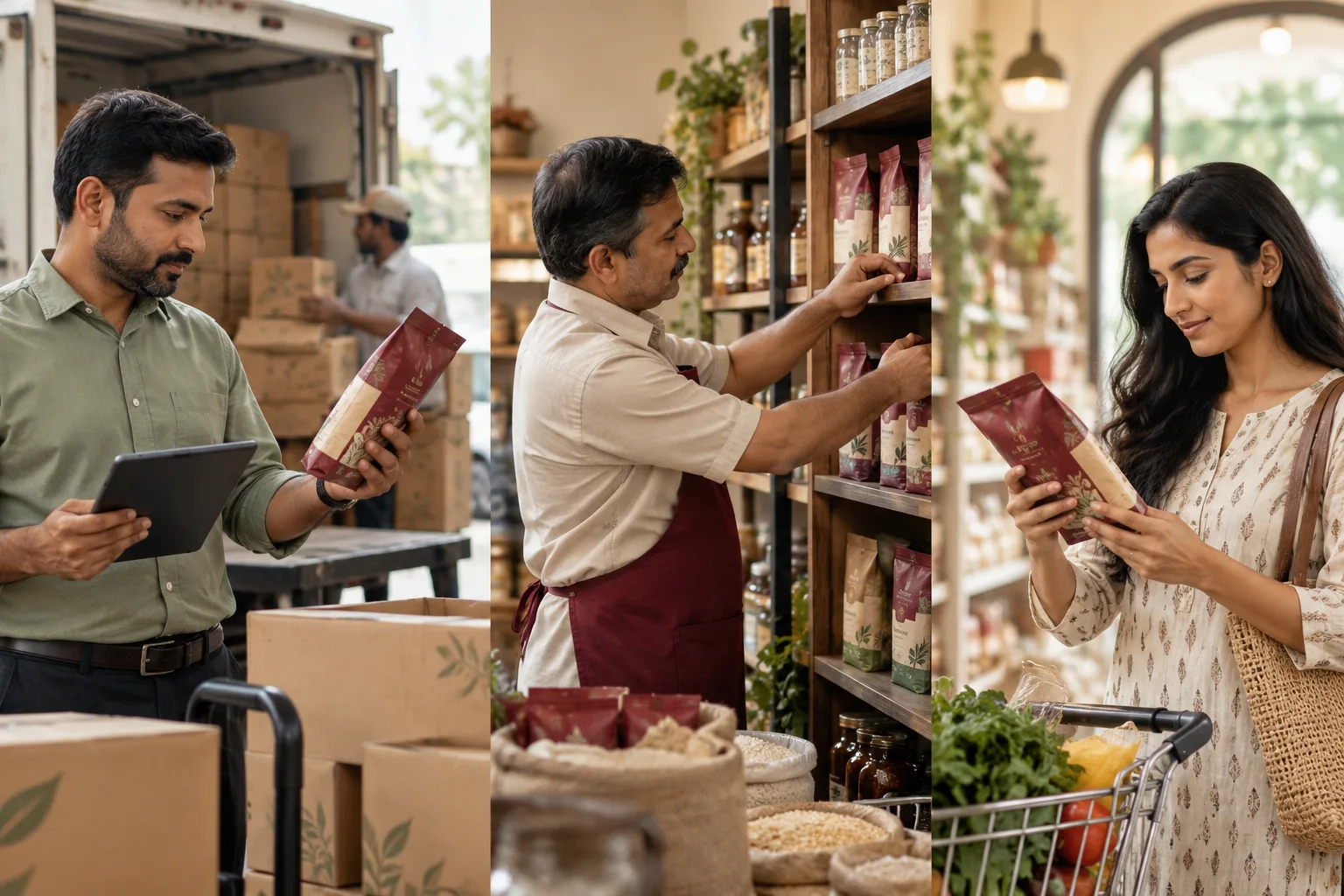 5 min read · 6 Oct 2026How food brands win the trade and the shopperA food or household brand is chosen twice, by the distributor or retailer who stocks it and by the shopper who picks it up. What each buyer checks.
 6 min read · 21 Sept 2026TV advertising vs OTT advertising: what are you actually buying?Television sells slots against ratings and prices in the wastage. OTT sells impressions to chosen people and charges for the choosing.
 8 min read · 21 Sept 2026How to advertise to distributorsDistributors decide on investment, margin and territory. Put those in the advertisement and the enquiries you get come from people who can sign.
More for food product manufacturers
Related work to consider.
Closest to this: brand and design
Also for food product manufacturers
Or start from the overview: sales and marketing for food product manufacturers.
Your next practical step
Tell us what you are trying to grow, and we will read it before we call.
Eight short steps, mostly taps. Skip anything you would rather answer on the call.