Household products brands · Buyer persona
Know who really chooses your cleaner: the homemaker, the shopkeeper or the housekeeping head.
A buyer persona for a household products brand is a written profile of each person who decides whether a bottle, pouch or can is bought, stocked or reordered. GullySales builds these profiles from your billing, your salesmen's beat notes and your institutional orders, so each offer is written to one real buyer.
Scope, fee, reporting and term are agreed in writing after we have read your brief and spoken to you.

What buyer persona means
A buyer persona is a plain description of the kind of customer who actually buys from you. It includes what they search, what worries them and who else they ask before deciding. GullySales builds this from real enquiries and past sales rather than a generic template, then uses it to write every page and advert.
Also for household products brands
- Digital marketing for household products brands
- SEO for household products brands
- Social media marketing for household products brands
- Content marketing for household products brands
- Branding for household products brands
- Lead generation for household products brands
- Sales management for household products brands
- Outdoor advertising for household products brands
Sales and marketing for household products brands, the overview.
Last updated 6 Oct 2026.
For household products brands
Where it usually goes wrong, and what we would do.
“The homemaker and the shopkeeper want different things from one pack”
The homemaker weighs fragrance, stain removal and cost per bucket. The shopkeeper weighs margin, shelf space and whether a leaking carton is replaced. A single message to both persuades neither, so each gets its own.
“A hostel warden and a hotel housekeeping head do not buy alike”
The warden watches the monthly bill per student and wants a supplier who delivers on the day. The housekeeping head compares litre cost, dilution and how a floor looks after cleaning. Both need a sample first, but they ask different questions.
“The distributor is a buyer too, and is rarely written about”
A distributor reads your scheme, your credit period and how soon claims are settled before reading anything about the product. A persona for this buyer lists those worries and the proof that answers each one.
“Region changes the persona more than age does”
A homemaker in a coastal town and one in a dry inland district clean different floors, with different water and different habits. Personas drawn from your own district sales show where one pack message fails.
What we do
What we deliver for household products brands.
Every deliverable, what it covers for you, and the result it is there to produce. Nothing here is an extra.
Homemaker persona by pack and price point
Profiles for the sachet buyer, the bottle buyer and the refill pouch buyer, each with the habit, the doubt and the shop where the purchase happens.
Result: Every pack has a named buyer and a reason to be bought.
Retailer and wholesaler persona
A profile of the kirana owner and the wholesaler covering margin, shelf position, returns of damaged stock and who they listen to.
Result: Salesmen pitch to what the shopkeeper actually worries about.
Institutional buyer personas
Separate profiles for the hostel warden, hotel housekeeping head, hospital purchase officer and housekeeping contractor.
Result: Each institution type gets its own sample plan and questions.
Distributor persona
A profile of the distributor's cash, claims and loading worries, with the document or answer that settles each one.
Result: Distributor conversations start from the real objection.
One-page persona cards for the sales team
Each persona reduced to a card with a question to ask, a proof to show and a thing never to say.
Result: A new salesman can use the cards on the first beat.
How the result is measured
- Enquiry match to persona
- Conversion rate by persona
- Content aligned to persona
Recorded as a baseline before work starts, so every later report has an honest comparison.
Who is asking
The buyers who decide whether a cleaner is tried, stocked or reordered.
- Homemaker at the apartment stall
- Wants to know whether the dishwash cuts grease on steel and how much one bottle covers. Cost per wash is the doubt, and a sample on the stall answers it.
- Kirana owner on the beat
- Asks about margin, shelf space and whether a leaking carton is replaced. The salesman who has a clear answer to returns gets the shelf slot.
- Wholesaler before a festival
- Wants the scheme in writing, the stock date and the return terms for unsold bars. Without them the order is kept small.
- Hostel warden
- Watches the bill per student and wants delivery on the promised day. Asks for a sample can and the litre cost before talking about brand.
- Hotel housekeeping head
- Compares dilution, floor finish and litre cost against the current supplier. Wants a safety data sheet and a person to call when a can runs short.
Who it is for
This is written for these household products brands.
- Detergent powder, bar and liquid brands
- Dishwash gel, liquid and bar makers
- Floor, toilet and glass cleaner brands
- Phenyl, disinfectant and bleach makers
- Mosquito repellent and air freshener brands
- Scrubber, sponge, wipe, mop and broom makers
- Garbage bag, foil, tissue and kitchen roll brands
- Institutional and housekeeping chemical suppliers
Not for
It is not the right fit if.
- You have no billing or beat notes by shop yet, so any persona would be a guess and the first job is to start recording who buys.
- You sell a single pack through one distributor in one town, where the owner already knows every buyer by name.
- The sales team will not use a one-page card in the field, so a profile would stay in a folder.
How it works
How the buyer persona work runs
The work itself, in order. How an engagement starts, from your brief to a written scope, is set out on our method page.
- 1
Understand the current view
We start with how your team currently describes the customer, since the gap between belief and reality is the finding itself.
- 2
Audit past enquiries and sales
We look at recent enquiries and closed deals to see who actually bought, not who was assumed to buy.
- 3
Interview customers and staff
Structured conversations with recent buyers, held as talk about the last purchase and not a questionnaire. We ask what happened before they called, who else was involved and what they compared. Customers agree before we contact them, and their answers are reported without names.
- 4
Build the personas
Findings are written into short, usable persona documents rather than a long report.
- 5
Apply to your marketing
We show where each persona should change a page, an ad or a script you already have. The sales team reads the drafts and says which ring true. A persona they do not recognise is rewritten.
Where this fits
Three pieces of sales work, in this order.
This work sits inside sales process design, at stage 0, foundation. The audit comes before it, and sales management keeps it running.
Step 1
Sales audit
Find where deals are being lost and what to fix first.
Start here if you cannot say where orders are lost.
Step 2 · you are here
Sales process design
One written way to sell, from first enquiry to repeat order.
Start here if every salesperson sells differently.
Step 3
Sales management
A target, a review routine and someone who owns the number.
Start here if the team has targets and no routine.
FAQ
Questions owners ask before they call.
Not here? More answers, or ask on WhatsApp.
Where does the information for a persona come from?
How many personas does a household brand need?
Do personas change with the festival season?
Should we write a persona for the distributor too?
How much does it cost?
How long is the contract?
How soon will we see results?
Who will actually do the work?
What do you need from us?
What if we are not happy with the work?
From the blog
Further reading for household products brands.
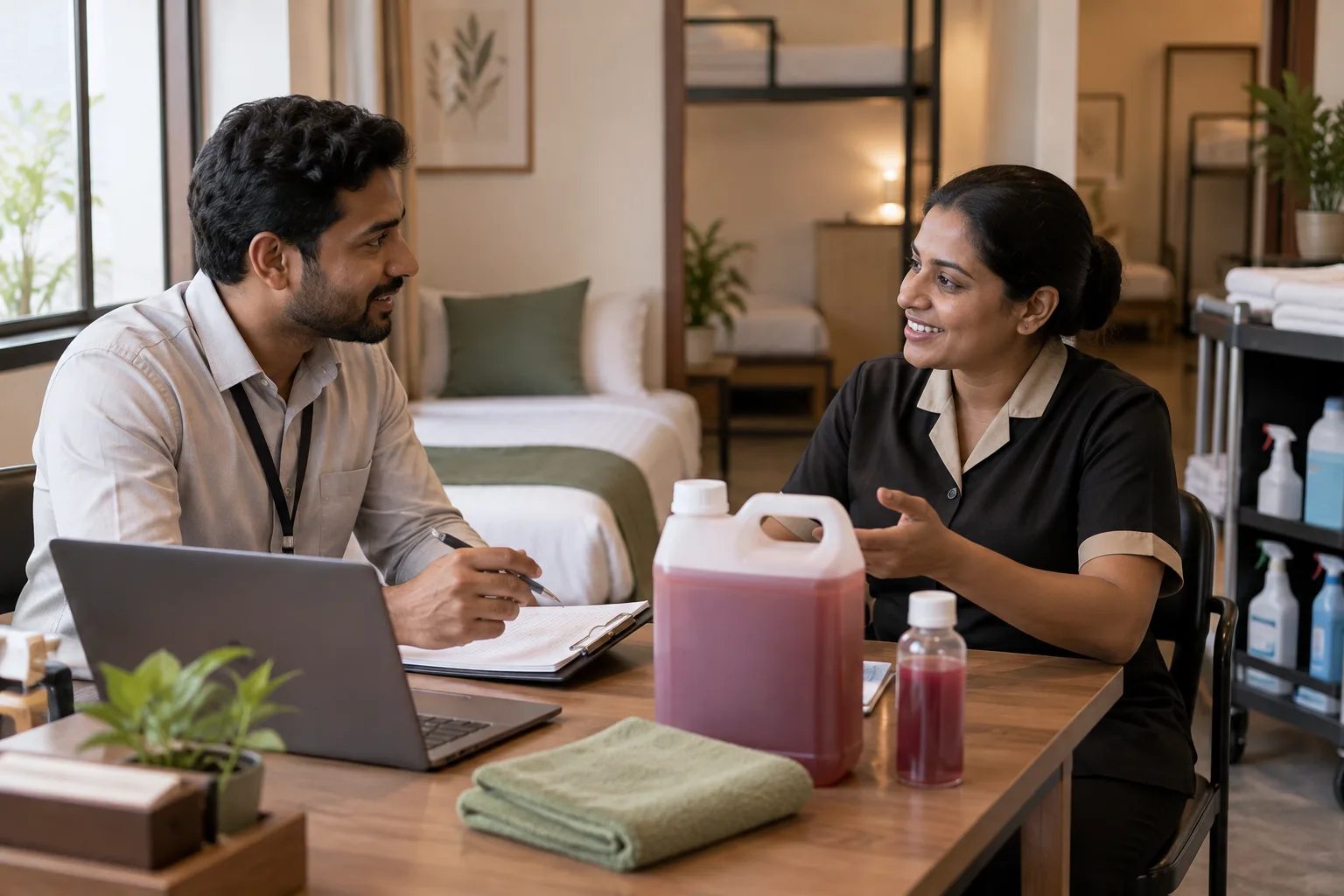 6 min read · 6 Oct 2026Why hostels try your cleaner once and never reorderHostels, PGs and hotels sample a cleaner once and drift to another supplier because nobody asked how the trial went. Here is the follow-up that turns a sample can into a standing order.
 5 min read · 6 Oct 2026How food brands win the trade and the shopperA packed food or household brand is chosen twice: by the distributor, retailer or kitchen that stocks it, then by the shopper who picks it up. Here is what each buyer checks and where brands lose both.
More for household products brands
Everything else we would do for you.
Closest to this: strategy and research
Also for household products brands
Or start from the overview: sales and marketing for household products brands.
Your next practical step
Tell us what you are trying to grow, and we will read it before we call.
Eight short steps, mostly taps. Skip anything you would rather answer on the call.