Industrial equipment manufacturers · Value-based selling implementation
A stopped line costs the plant every hour, and your quotation should say so.
Value-based selling implementation for an equipment manufacturer teaches reps to sell on what a machine saves or protects inside the buyer's plant, using the buyer's own costs. GullySales builds a value note for each machine type, trains reps to fill it from RFQ conversations, and prepares answers for the price comparison that follows.
Scope, fee, reporting and term are agreed in writing after we have read your brief and spoken to you.
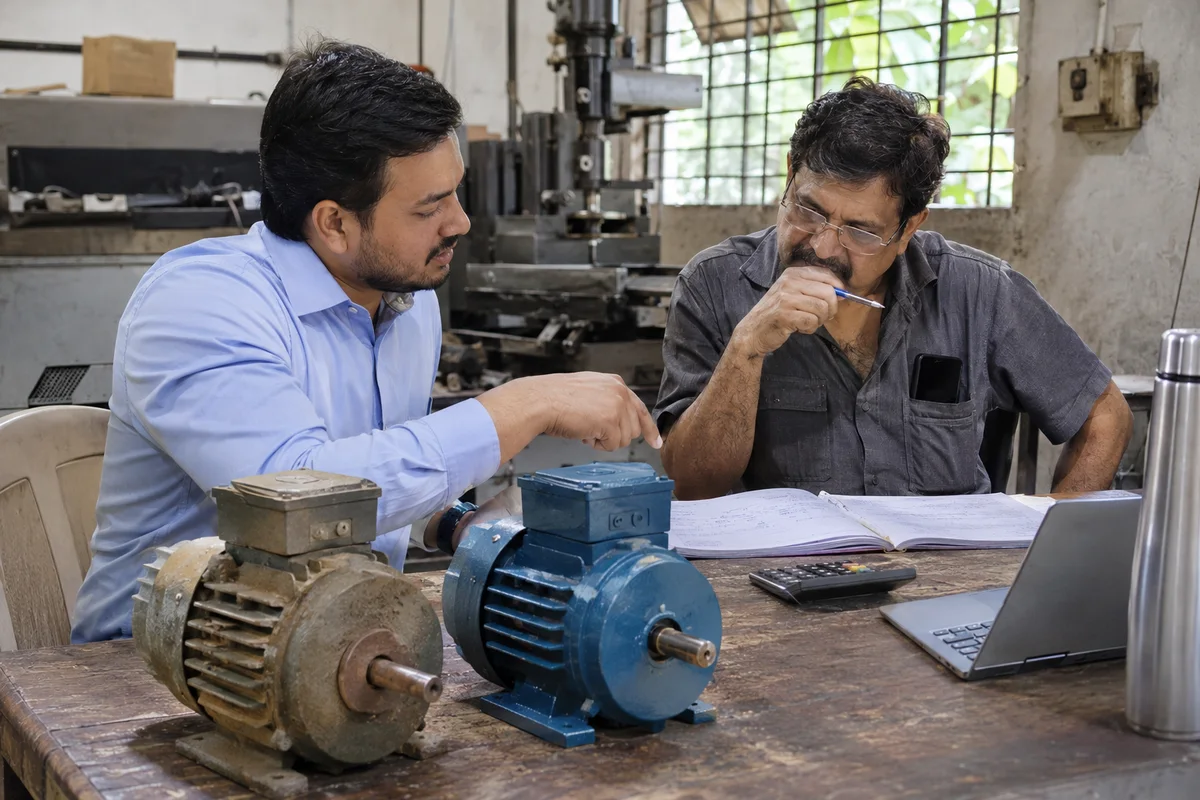
What value-based selling implementation means
Value-based selling implementation teaches your sales team to sell on what the offer does for the buyer's business, using the buyer's own costs and problems. GullySales builds a value note for each offer, trains reps to fill it from buyer conversations, prepares price-pushback responses, and coaches the first live deals.
Also for industrial equipment manufacturers
- Sales management for industrial equipment manufacturers
- Sales metrics for industrial equipment manufacturers
- Sales strategy for industrial equipment manufacturers
- Sales training for industrial equipment manufacturers
- Consultative selling implementation for industrial equipment manufacturers
- Sales discovery process design for industrial equipment manufacturers
- Sales manager training for industrial equipment manufacturers
- Sales margin improvement for industrial equipment manufacturers
Sales and marketing for industrial equipment manufacturers, the overview.
Last updated 14 Nov 2026.
For industrial equipment manufacturers
Where it usually goes wrong, and what we would do.
“The RFQ asks for a rate and gets one”
A procurement team sends the same specification to several suppliers and compares the totals. A rep who replies with a rate alone enters a contest decided on the lowest figure, even where the machine would cost the plant less to own.
“Downtime is the buyer's number, not yours”
Only the plant knows what an idle line, a rejected batch or an overtime shift costs. A rep who asks the maintenance head is working with real figures. A rep who quotes an industry figure from a brochure is not believed.
“Service and spares are sold as a footnote”
The after-sales promise decides repeat orders, yet it appears at the end of a quotation in a single line. A buyer comparing two machines cannot see what the spares stock, response routine and training are worth to the plant.
“Price pushback is answered with a discount”
When the purchase head says a rival is cheaper, the quickest reply is a lower rate. Nobody asked which part of the quotation worried the buyer, so the discount is given away without changing the buyer's mind.
What we do
What we deliver for industrial equipment manufacturers.
The work available for this need. We agree the deliverables and responsibilities for your engagement in writing.
Buyer cost map for each machine type
A one-page list of where buyers lose money or time before choosing your machine: changeover, rejects, downtime, power use, operator skill.
Result: Reps know which costs to ask about in each sector.
Value note per machine
A worksheet with blank fields for the buyer's current cost, what your machine changes and what the buyer agrees to. Every figure is the buyer's, confirmed in the conversation.
Result: No value claim goes into a quotation without the buyer's own number.
Discovery question sheet for plant engineers and purchase heads
Questions written for both people in the room, covering line speed, stoppages, rework, spares holding and approval steps.
Result: One conversation gathers what the value note needs.
Total-cost comparison sheet
Your quotation set beside a rival one with installation, commissioning, spares, training and credit terms laid out line by line.
Result: The buyer compares what each supplier is actually offering.
Price pushback responses
Short replies built from your own discounted and lost orders. Each asks which part of the price concerns the buyer before returning to the value note.
Result: The rep has an answer other than a lower rate.
Coaching on live RFQs
Review of the first real quotations written with the method, with notes on where a figure was assumed instead of asked.
Result: Reps learn on orders that matter.
How the result is measured
- Quotations carrying a value note with the buyer's confirmed figures
- Discount given against the approved limit, compared with the baseline
- Deals where the buyer raised price and the rep asked a discovery question first
Recorded as a baseline before work starts, so every later report has an honest comparison.
Who it is for
This is written for these industrial equipment manufacturers.
- CNC machine and precision equipment manufacturers
- Industrial pump and compressor manufacturers
- Packaging machinery manufacturers
- Conveyor and material handling equipment makers
- Motor and drive manufacturers
- Custom fabrication and job-work manufacturers
- Export-oriented industrial equipment makers
- Spare parts and after-sales service providers
Before you decide
Agree the work. Know how to judge it.
Value-based selling implementation for industrial equipment manufacturers: use these checks to prepare, choose the scope, and review what changes.
Bring the right evidence
Bring real questions, objections, and call examples that the team finds difficult. Agree which selling behaviour needs to change and how it will be observed at work.
Make the scope clear
Choose the roles and situations to practise. Separate a training session from coaching, manager follow-up, and any scripts or reference material to be produced.
Check the work in use
Use a realistic practice conversation, then review the same skill in live work with appropriate permission. Look for a change in behaviour before attributing a sales result to training.
Know when to change course
If the problem is an unclear offer, missing product knowledge, or no permission to make a decision, fix that first. A communication workshop cannot remove those barriers.
These are discussion points, not a fixed package. GullySales confirms the deliverables, responsibilities, fee, and term in writing after reading your brief and speaking with you.
Before we start
What to have ready before the work starts.
The records, access and decisions this work needs from industrial equipment manufacturers. Anything missing is noted in the written scope, with who will supply it.
- Three quotations that were lost on price
- Real losses show the habit we are changing. Bring the quotation, the RFQ and any reply from the buyer. If a loss was never explained, the sales head says what was believed, and we mark it as an assumption.
- Service records showing the cost of a stoppage
- The cost map depends on how machines fail and what it costs the buyer. Bring service reports with the fault, the part, the machine's downtime and what the buyer was told about the cause. Reports on warranty failures are as useful as those on wear, because a buyer remembers the first failure longest. Without them, the map names costs from the engineer's memory and is marked as such.
- A design engineer and a service engineer
- Both must give time to the cost map and the value notes. They know what the machine really changes. If only one is free, the note covers that side and says the other is untested.
- A rule on savings the team may state
- Decide in writing what savings the team may state to a buyer. A claim must be backed by a test or a record. Without a rule, engineers will tell buyers figures they cannot support, and the note will not stop them.
- Live RFQs for the coaching
- Coaching needs open enquiries to work on. Tell us which deals may be used and which are sensitive. If no live RFQ is available, the coaching uses past cases and carries less weight, and the engineers have no real buyer to test the questions on.
How it works
How the value-based selling implementation work runs
The work itself, in order. How an engagement starts, from your brief to a written scope, is set out on our method page.
- 1
Review three deals that ended on price
We open three recent quotations that were lost or cut on price and read the RFQ, the offer and the emails that followed. With the sales head we ask what the buyer actually said about their own costs, such as scrap, stoppages or operator time, and what your engineer said back. This shows whether the conversation was about the rate alone.
- 2
Draw the cost map for each machine type
With a service engineer and a design engineer we list the costs a buyer carries around your machine: downtime, rejection, power, operator hours, spares and maintenance. For each machine type we mark which of these your machine changes. The map names the costs only, and contains no figures that you have not seen in your own records. Where a machine changes nothing in a cost, we say so, since a value note that claims every saving loses the engineer's trust.
- 3
Write one value note per machine
Each note is a page that says, in the buyer's terms, where the machine reduces or protects a cost, what the buyer must tell you to work it out, and what proof you hold. Your engineer checks every statement. A note that rests on a claim you cannot document is rewritten until it can stand. The note also lists what the buyer's engineer must tell you, such as the hours run and the reject rate, so the working can be done in the buyer's presence and not guessed afterwards. We also write two short question sheets, one for the plant engineer, who knows the downtime and rejection, and one for the purchase head, who knows the budget route and the rules on cost of ownership, ordered so an engineer can use them on a first call without sounding like a form.
- 4
Build the total-cost comparison sheet
We prepare a sheet that places your offer next to a rival's on the buyer's own numbers: price, spares, service visits, expected downtime and power. The buyer fills in the figures, including the rival's price and the rival's service terms as the buyer understands them. We mark anything the buyer is unsure of, because a comparison built on a wrong rival figure invites an argument at the next meeting. Your sales engineer practises filling it with a buyer on a real quotation, and we remove any row nobody can complete honestly.
- 5
Write the answers to price pushback
We write responses for the usual challenges, such as the lowest-price rule, a rival's offer and a request for a discount at the last meeting. Each response turns back to the cost map and offers a trade instead of a cut. The sales head approves the responses, and the team practises them on past deals. Each response ends with a question that returns the conversation to the buyer's own costs, since an answer that only defends the price leaves the buyer comparing the rate again.
- 6
Coach on live RFQs and read the outcome
We sit with the engineers as new RFQs come in, and help them fill the value note and the comparison sheet. After a set of quotations has closed, we read the outcomes against the opening deals: how many were discussed on cost beyond price, and what the sales head saw. The sales head decides what to extend.
Proof
Published examples of our work.
Real clients and the work recorded for each engagement. These examples may cover related services or industries. They show the method, not a guaranteed result.
Burhani Hydroline
- Situation
- The website was dated. Menus were hard to follow, pages were slow, and it did not work properly on a phone, which is where a buyer looks first.
- What we did
- Research before design
- Wireframes and prototypes
- The full product catalogue
- An online checkout
- Result
- No numbers were recorded for this engagement. The work is described in full in the case study.
Also worked with
Chord Road Hospital · Curtain Label · Difesa Security Services · Felicity Inn · Hands On CSR · Implevista · Kambar Group · Kalessi · Kerur Pain Clinic · LL Trust · Lucky Deals · Natural Gases · NavaShakthi Souhardha · NewCom Logistics · Proton Technical Services · SB Engineering · Shakthi Foundation · Shakthi Group · Urbanest · Insyde Studio · Venkateshwara Laser Tech · Vivara Studios
Where this fits
Three pieces of sales work, in this order.
This work sits inside sales process design, at stage 1, prospecting and lead generation. The audit comes before it, and sales management keeps it running.
Step 1
Sales audit
Find where deals are being lost and what to fix first.
Start here if you cannot say where orders are lost.
Step 2 · you are here
Sales process design
One written way to sell, from first enquiry to repeat order.
Start here if every salesperson sells differently.
Step 3
Sales management
A target, a review routine and someone who owns the number.
Start here if the team has targets and no routine.
FAQ
Questions owners ask before they call.
Not here? More answers, or ask on WhatsApp.
Our buyers say the L1 supplier gets the order. Does this still apply?
Will you write the savings claims for our brochure?
Is this a sales training course?
What do we do when a buyer will not share plant costs?
Should a service engineer join the price conversation?
How long is the contract?
How soon will we see results?
Who will actually do the work?
What do you need from us?
What if we are not happy with the work?
From the blog
Further reading for industrial equipment manufacturers.
 6 min read · 10 Oct 2026How manufacturers can generate enquiries from relevant business buyersRelevant RFQs come from buyers who can verify you: real specifications on product pages, matching listings and a quick way to screen requests.
 6 min read · 6 Oct 2026How industrial buyers decide which unit gets the RFQWhat industrial buyers check before sending an RFQ, across nine manufacturing trades, and where a unit drops off the shortlist.
 7 min read · 21 Sept 2026How to advertise to plant headsPlant heads can block a purchase but rarely sign one. Learn why breakdown searches, estate media and a trial offer reach them better than brand ads.
More for industrial equipment manufacturers
Related work to consider.
Closest to this: sales craft
- Sales management for industrial equipment manufacturers
- Sales metrics for industrial equipment manufacturers
- Sales strategy for industrial equipment manufacturers
- Sales training for industrial equipment manufacturers
- Consultative selling implementation for industrial equipment manufacturers
- Sales discovery process design for industrial equipment manufacturers
- Sales manager training for industrial equipment manufacturers
- Sales margin improvement for industrial equipment manufacturers
Also for industrial equipment manufacturers
- Answer engine optimisation for industrial equipment manufacturers
- Branding for industrial equipment manufacturers
- Content marketing for industrial equipment manufacturers
- Digital marketing for industrial equipment manufacturers
- Email marketing for industrial equipment manufacturers
- Google Business Profile management for industrial equipment manufacturers
Or start from the overview: sales and marketing for industrial equipment manufacturers.
Your next practical step
Tell us what you are trying to grow, and we will read it before we call.
Eight short steps, mostly taps. Skip anything you would rather answer on the call.